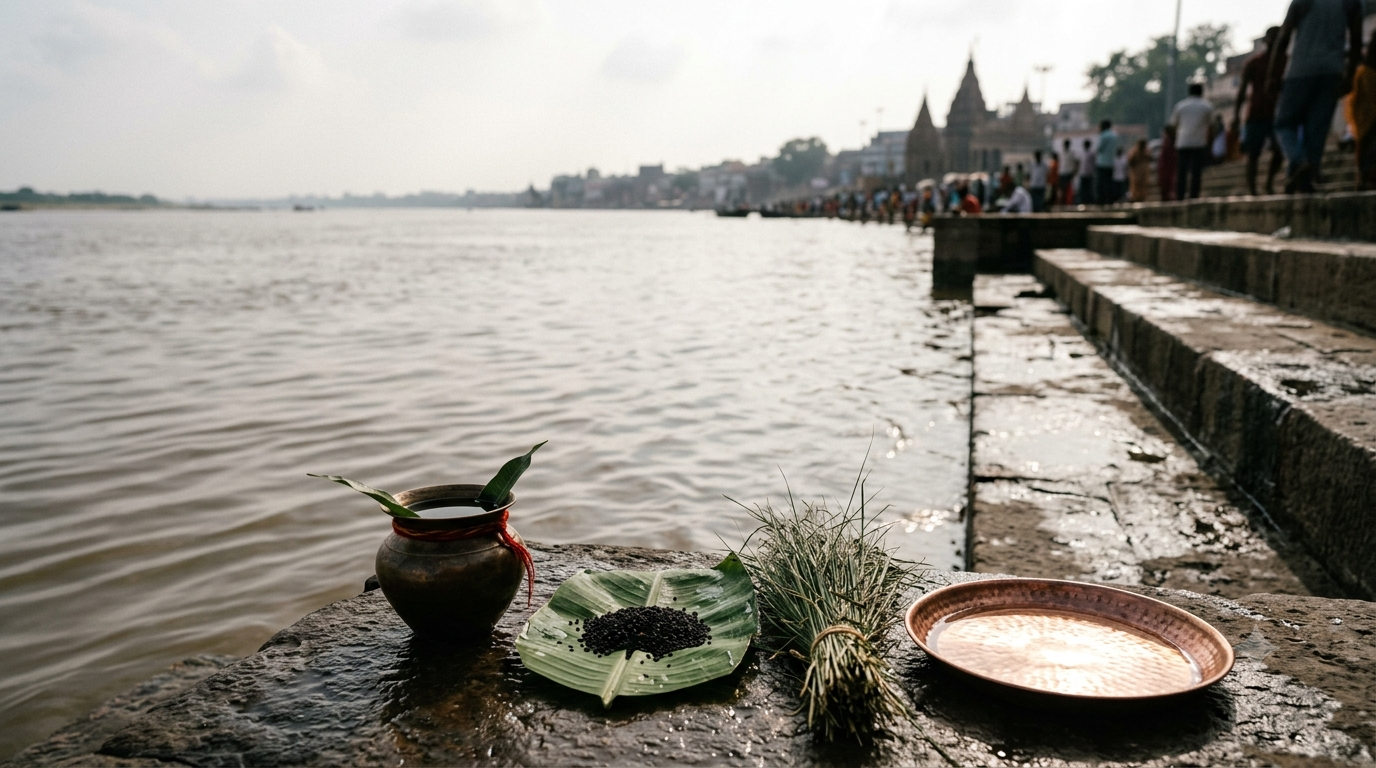
Mahalaya Amavasya 2026 falls on Saturday, 10 October, but the tithi itself does not begin on that date. The Amavasya opens at 9:35 PM on 9 October and closes at 9:19 PM on 10 October, according to Indian Standard Time. That gap confuses thousands of families every year, because several websites reprint the tithi window as if it were the ritual window. It is not, and observing shraddha at the wrong hour remains the single most common mistake around this day.
Temples Map is an independent temple information guide. We hold no affiliation with any temple, trust, math or panchangam authority, and we accept no bookings, donations or ritual payments. Please confirm every timing with your family priest or with a panchang set to your own city.
Mahalaya Amavasya 2026 at a Glance
- Date in India: Saturday, 10 October 2026
- Amavasya tithi begins: 9:35 PM on Friday, 9 October 2026 (IST)
- Amavasya tithi ends: 9:19 PM on Saturday, 10 October 2026 (IST)
- Other names: Sarva Pitru Amavasya, Pitru Moksha Amavasya, Mahalaya, Amavas Shraddha
- Pitru Paksha 2026 window: 26 September to 10 October 2026
- Ritual window: afternoon only, from Kutup Muhurat through Aparahna Kaal
- Next day: Shardiya Navratri begins Sunday, 11 October 2026
Mahalaya Amavasya 2026 Date and Exact Tithi Timings
Families across India mark Mahalaya Amavasya 2026 on Saturday, 10 October 2026. It closes Pitru Paksha, the fortnight set aside for ancestral rites. Because the day covers every ancestor at once, it draws far more observance than any other day in the fortnight.
| Detail | Verified value (IST) |
|---|---|
| Observance date in India | Saturday, 10 October 2026 |
| Amavasya tithi begins | 9:35 PM, Friday 9 October 2026 |
| Amavasya tithi ends | 9:19 PM, Saturday 10 October 2026 |
| Lunar month | Ashwin (purnimanta) / Bhadrapada (amanta) |
| Paksha | Krishna Paksha |
| Pitru Paksha 2026 | 26 September to 10 October 2026 |
Why the tithi starts on 9 October but the day is 10 October
Hindu days run sunrise to sunrise, not midnight to midnight. So a tithi that opens at 9:35 PM on 9 October belongs to the following sunrise-to-sunrise day. Shraddha also follows the aparahna rule, which fixes the rite in the afternoon.
On 10 October the Amavasya still runs right through that afternoon window. That is why every major panchangam places the observance on 10 October in India. The evening of 9 October carries no shraddha obligation at all.
The Mahalaya Amavasya 2026 Timing Mistake Almost Every Guide Repeats
Here is the correction that matters most. The tithi window and the ritual window are two different things, yet countless pages publish only the tithi and tell readers to “complete the rituals” inside it. Since Amavasya often begins or ends at night, that instruction sends families toward a pre-dawn or late-night shraddha.
Traditional practice does not allow it. Parvana shraddha belongs to the afternoon, and you should finish it before sunset. A page that tells you to complete pitru karyas by 9:19 PM has quietly confused an astronomical reading with a ritual instruction.
When shraddha is actually performed on this day
Three named windows govern the rite, and all three sit in the middle of the day. Kutup Muhurat comes first, followed by Rohina Muhurat, and then the longer Aparahna Kaal. The performer offers tarpan at the close of the shraddha.
Roughly speaking, Kutup begins a little before local noon and the Aparahna Kaal runs into mid-afternoon. Exact clock times depend on your sunrise, so they shift by city and no single national figure will fit.
How to get the correct muhurat for your own city
Set your location first, then read the timings. On Drik Panchang’s Amavasya Shraddha page you can change the city, after which the Kutup, Rohina and Aparahna figures recalculate for that sunrise.
The difference is not trivial. Between Kolkata and Ahmedabad the same muhurat can move by well over half an hour, because sunrise differs sharply across India’s single time zone.
Conflicting Mahalaya Amavasya 2026 Dates You Will See Online
Search this topic and you will meet at least four different dates. Most of them are errors, though one fits a different audience perfectly well. Knowing which is which saves a wasted day of preparation.
| Date you may see | Where it comes from | Verdict |
|---|---|---|
| 10 October 2026 | Indian panchangams, sunrise-based reckoning | Correct for India |
| 9 October 2026 | Panchang set to a US or Canadian city | Correct there, wrong for India |
| 21 September 2026 | Last year’s date carried forward | Wrong — that was 2025 |
| 30 September or 9 November 2026 | Data-entry slips on astrology sites | Wrong |
The 2025 mix-up tops the list. Sarva Pitru Amavasya fell on 21 September 2025, so a page updated carelessly still shows a September date. In 2026 the observance lands 19 days later, because lunar months drift against the Gregorian calendar.
Who Should Observe It, and for Which Ancestors
Sarva Pitru Amavasya works as the safety net of the fortnight. During Pitru Paksha each tithi belongs to ancestors who died on that lunar day, which assumes the family knows the date. Many do not, so Mahalaya Amavasya 2026 matters most to households that cannot name a tithi.
Observe it if any of the following applies to your family. The Garuda Purana treats this Amavasya as the appropriate substitute when the specific tithi is unknown or unobservable.
- Nobody recorded the death tithi of an ancestor, or the family has forgotten it
- You missed the correct tithi earlier in the fortnight
- An elder died on Amavasya, Purnima or Chaturdashi tithi
- An ancestor left no descendants, or died unmarried
- Someone in the line never received proper final rites
- You can observe only one day of the whole fortnight
How Families Perform the Rituals at Home
Most households keep the observance simple, and simplicity is not a shortcoming here. The sequence below reflects common domestic practice on Mahalaya Amavasya 2026, although every sampradaya and region varies in detail.
- Bathe early and keep the day sattvic, avoiding onion, garlic, meat and alcohol.
- Prepare the offering food before noon so you do not rush the rite.
- Take the sankalpa in the Kutup or Rohina window, naming your gotra and the ancestors.
- Offer pinda and then tarpan with water, black sesame and darbha grass.
- Set aside portions for the crow, the cow and the dog before anyone eats.
- Feed guests or those in need, and give daana according to your means.
- Light a sesame-oil lamp in the evening as the family sees the ancestors off.
Rivers and holy tanks draw large gatherings on this day. Gaya in Bihar remains the best known destination, and the state’s official Pitrapaksha information page describes the ritual sites along the Phalgu river.
What to Do If You Cannot Observe the Day
Official calendars stop at the date, so nobody tells you what happens when the day is simply impossible. Perhaps you are travelling, unwell, or on shift. These are the realistic fallbacks, ranked.
- Keep a minimal rite at home. Water, sesame and a lamp offered with sankalpa carry weight when you cannot arrange a full shraddha.
- Ask a family elder to include your sankalpa. One performer can name the whole line, which is the point of a sarva rite.
- Use a later Amavasya. Tradition counts twelve monthly Amavasya days among the occasions suitable for shraddha.
- Fall back on daana. Feeding people or animals in the ancestors’ name serves as the accepted substitute when ritual is impossible.
What tradition does not offer is a night-time version of the rite. If the afternoon is gone, shift the observance to another day rather than pushing it past sunset.
The moment Amavasya ends, Devi Paksha begins. Pratipada opens at 9:19 PM on 10 October 2026 and runs until 9:30 PM the next evening. Families therefore perform Ghatasthapana on the morning of Sunday, 11 October 2026.
This handover explains a detail many guides miss. Mahalaya stays a day of mourning and remembrance until sunset, yet in Bengal the same dawn turns festive, because Mahishasuramardini plays before first light. Both moods belong to the same tithi.
Regional Differences Worth Knowing
The tithi stays identical everywhere, but the label and the emphasis do not. Knowing your family’s convention prevents an argument over an apparent contradiction between two calendars.
- Telugu, Kannada, Marathi and Gujarati calendars follow amanta reckoning, so this Amavasya closes Bhadrapada masam.
- North Indian calendars follow purnimanta reckoning, so the same day carries the name Ashwin Krishna Amavasya. Both descriptions are correct.
- Bengal treats Mahalaya as the arrival of Durga, with artisans performing Chokkhu Daan on the idols.
- Families abroad should follow their local panchang, since the tithi may fall on 9 October in the Americas.
Safety Notes for the Fasting Day
Many performers fast until the shraddha finishes, which can mean nothing but water until mid-afternoon. That is manageable for most adults, yet it deserves thought if health is a factor.
Anyone who is diabetic, pregnant, elderly, or on regular medication should speak to a doctor before attempting a long waterless fast. Shraddha rituals are matters of faith and tradition; they do not treat any medical or financial problem, and no ritual should replace professional care. River bathing also needs care, because October currents run strong after the monsoon.
What Experienced Families Do Differently
A few habits separate a calm Mahalaya Amavasya 2026 from a stressful one. None of them appear on a standard calendar page.
- Fix the muhurat for your city a week ahead, since families book priests heavily on this date.
- Write down the gotra and the names before the day, because memory fails under pressure.
- Buy black sesame and darbha grass early, as local shops sell out during the fortnight.
- Reach river ghats before 9 AM, otherwise the queue eats into the aparahna window.
- Record the tithi in a family file afterwards, so the next generation is not searching for it.
Before You Go
Mahalaya Amavasya 2026 is on Saturday, 10 October, with the tithi running from 9:35 PM on 9 October to 9:19 PM on 10 October. Treat those figures as the astronomical frame, not the ritual clock. The rite itself belongs to the afternoon, inside Kutup, Rohina and Aparahna Kaal for your own city.
If you want the full tithi-by-tithi fortnight rather than this single day, our guide to the Mahalaya Pitru Paksha start date and calendar maps every shraddha day. The Maha Bharani Shraddha observance and the Bhadrapada Masam calendar cover related dates in the same season.
Frequently Asked Questions
Is Mahalaya Amavasya 2026 on 9 or 10 October?
In India it falls on Saturday, 10 October 2026. The tithi begins at 9:35 PM on 9 October, so a night-time start makes some readers assume the earlier date. Panchangs set to North American cities do list 9 October, which suits that time zone only.
What is the shraddha muhurat on Mahalaya Amavasya 2026?
The rite falls in the afternoon, across Kutup Muhurat, Rohina Muhurat and Aparahna Kaal. Panchangs calculate these windows from local sunrise, so they differ by city and no single national time will fit. Set your city on a panchang site to read the exact figures.
Can shraddha be performed at night on this day?
No. Parvana shraddha belongs to the afternoon and should conclude before sunset. Pages that quote the tithi end time as a ritual deadline are misreading the panchang.
What is the difference between Mahalaya Amavasya and Pitru Paksha?
Pitru Paksha covers the whole fortnight, running from 26 September to 10 October in 2026. Mahalaya Amavasya is only its final day. The fortnight assigns each ancestor a tithi, while the last day covers everyone together.
Who performs the ritual in the family?
Tradition gives the role to the eldest son or the senior male member, though practice varies widely by region and family. Many households today share the observance. Ask your family priest what your own sampradaya prescribes.
Can shraddha be done at home instead of Gaya?
Yes. Gaya, Prayagraj, Haridwar and Varanasi carry special significance, but a home observance performed sincerely is complete in itself. Travel is a preference, not a requirement.
Not quite. Amavasya ends at 9:19 PM on 10 October 2026, and Pratipada starts at that moment. Ghatasthapana follows the next morning, Sunday 11 October 2026. In Bengal, however, Mahalaya dawn already marks Durga’s arrival.
Why is Mahalaya Amavasya 2026 so much later than in 2025?
Sarva Pitru Amavasya fell on 21 September 2025, so 2026 lands 19 days later. Hindu months follow the moon, while the Gregorian calendar follows the sun, and the two drift apart until an extra lunar month resets them. Last year’s date therefore never makes a safe guide.