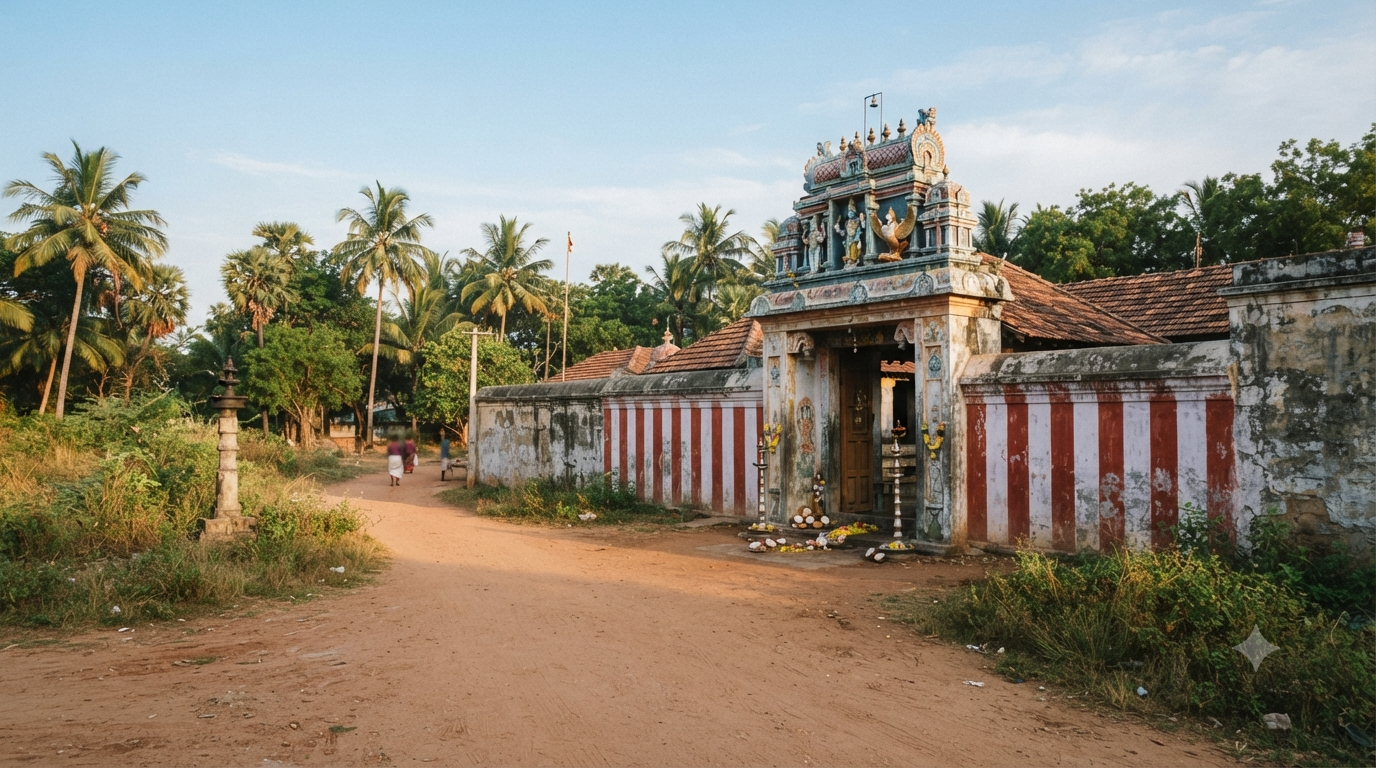
Vaikuntanatha Temple Therani is a Vishnu shrine in Therani village near Nagari, Andhra Pradesh. Its story includes royal patronage, years of neglect and a documented revival. The most important correction for visitors is that the temple did undergo renovation; we cannot describe its surviving appearance as untouched by restoration.
Independent guide: Temples Map is not affiliated with the temple or its administrators. We do not arrange visits, accept bookings, or collect payments. Confirm access and any official arrangements through appropriate local authorities before travelling.
Vaikuntanatha Temple Therani at a Glance
- Location: Therani village, Nagari area, Chittoor district, Andhra Pradesh.
- Main deity: Lord Vishnu as Sri Vaikuntanatha Swamy; accounts also identify Sridevi and Bhudevi at the shrine.
- Historical period: About five centuries old, according to a report in The Hindu dated 13 September 2010. This is a reported historical estimate, not a newly established construction date.
- Historical association: Therani Nadadur Sudarsanachariar, the Karvetinagaram rulers and Vijayanagara emperor Sri Krishnadevaraya, as described in that report.
- Documented restoration: A temple revival and Maha Samprokshanam ceremony featured in the 2010 newspaper report.
- Check before travel: Current opening hours, entry or ritual fees, transport frequency and visitor facilities have not been independently confirmed.
These points separate the shrine’s recorded history from visitor details that may change. In particular, a historical riverbank location is not a promise of flowing water beside the temple today.
Seven Facts about Vaikuntanatha Temple Therani
1. The shrine honours Vishnu as Vaikuntanatha Swamy
Vaikuntanatha means the Lord of Vaikunta, a name associated with Vishnu’s divine abode in Vaishnava belief. Sources describing this temple identify Vaikuntanatha Swamy as its presiding deity. They also name Sridevi and Bhudevi, the consorts traditionally associated with Vishnu.
This devotional identity gives Vaikuntanatha Temple Therani its place among the region’s Vishnu shrines. However, we found no reliable current source for the daily ritual sequence, special darshan categories or festival calendar. Visitors should not assume a particular puja will take place during their visit.
2. Its reported origins belong to the Vijayanagara period
In “Ancient temple springs back to life”, published on 13 September 2010, journalist Rangarajan described the temple as roughly 500 years old. The report connected its foundation to Therani Nadadur Sudarsanachariar, a scholar at the court of the Karvetinagaram rulers.
According to that account, the local rulers built the shrine at Sudarsanachariar’s request with the permission of emperor Sri Krishnadevaraya. The report recounts this history, but we have not checked a dated foundation inscription for this guide. It is also more precise than saying the scholar personally constructed the building.
3. Neglect and renovation at Vaikuntanatha Temple Therani
The same report describes how the old temple fell into serious disrepair. It links the decline partly to the migration of families connected with its hereditary trustees. Later, T.N. Gopalan, a retired Tamil Nadu Public Works engineer with roots in Therani, helped organise its revival.
Rangarajan reported that the renovation and associated religious procedures took 57 days. The newspaper also described a Maha Samprokshanam ceremony marking renewed worship. Therefore, calling Vaikuntanatha Temple Therani “untouched by restoration” would erase a major chapter of its history. The report confirms a revival, but it does not document which individual stones or carvings remain original.
This renovation is central to the history of Vaikuntanatha Temple Therani. It also makes the difference between a careful history and a misleading claim of complete preservation.
4. The Kushasthali River is a historical location marker
The Hindu placed the temple on the banks of the Kushasthali River near Nagari. A later paper, “Chalaparakona: The rock art site near Kushasthali River in Andhra Pradesh”, also discusses Therani and the region’s historic sites along that watercourse.
Those sources support the geographic association. They do not establish today’s water level, river access, a safe bathing spot or the sound of running water near the entrance. River conditions vary, so treat the river as heritage context rather than a guaranteed sightseeing feature. Do not approach an unfamiliar bank simply to photograph it.
5. Its architectural interest deserves careful description
Therani’s temple belongs to a region strongly associated with Vijayanagara-era patronage. Yet that connection alone cannot prove that every visible pillar, carving or roofline comes from the sixteenth century. Restoration may change how a historic shrine looks, and older photographs can show different stages of its condition.
When visiting, look for the relation between the sanctum, the entrance and any surviving decorative details. Respect barriers and do not touch fragile surfaces. For context on how historians assess physical evidence, see our guide to temple inscriptions in India. We have not verified a particular inscription at Therani for this article.
6. The 2010 revival is central to the temple’s identity
The local response to the renovation is as notable as the old construction story. Rangarajan recorded that older villagers recalled a busier period of worship and welcomed the shrine’s return to religious life. This helps explain why the restoration matters: it was about renewed community use, not merely the appearance of a heritage building.
For another perspective on the difference between structural repair and living worship, read our overview of temple revival in Andhra Pradesh. That article gives wider context; it should not be read as evidence of new work or present-day services at Therani.
7. Therani has a distinct place beside major pilgrimage routes
The temple lies in the Nagari area, not inside the Tirumala temple complex. The Chittoor district administration’s mandal list confirms Nagari as part of the district’s administrative geography. Some older descriptions put Therani roughly 5 km from Nagari and around 50 km from Tirupati, although the distance depends on the start point and road.
A visit to Vaikuntanatha Temple Therani can appeal to readers interested in a specific regional history rather than large pilgrimage facilities. However, this is not a substitute for a confirmed Tirumala darshan plan. For other temple ideas in the broader region, see our guide to lesser-known temples around Tirupati.
Planning a Visit to Vaikuntanatha Temple Therani
The safest plan starts with the village and its Nagari location, not with a promised opening time. Current public information does not establish a reliable daily schedule or a temple-managed booking channel. Build flexibility into your trip, especially if you are travelling from Tirupati or crossing the state border.
How to identify the correct temple
Search maps for Sri Vaikuntanatha Swamy Temple in Therani village, near Nagari in Chittoor district. Check the village name and surrounding roads before starting. The words “Vaikuntanatha” and “Vaikuntha” occur in names of other Vishnu temples, so a search result from a different town may lead you astray.
Compare the map pin with local direction signs if available. If the location looks uncertain, confirm it locally rather than relying on an unreviewed address or a guessed road. We could not verify route quality or last-mile transport, so do not count on a particular taxi, bus or train connection.
Opening hours and fees at Vaikuntanatha Temple Therani
We could not confirm current temple opening hours, entry fees, seva charges or an authorised website for this specific shrine. Therefore, this guide does not publish a timetable or payment procedure. The 2010 report tells us worship resumed then, but it gives no assurance about access today.
Check with an identifiable local temple or public authority before making a special journey. Avoid websites or messages demanding advance payment to “secure” access. Temples Map cannot confirm bookings or provide access on behalf of the shrine.
What to carry and what not to assume
- Carry drinking water, weather protection and any regular medication because no reliable source confirms local facilities.
- Wear modest clothing suited to a place of worship, and follow instructions given at the site.
- Do not assume toilets, parking, refreshments, wheelchair access or a staffed help desk will be available.
- Ask before taking photographs, especially near the sanctum or worshippers.
- Leave the riverbank alone if access or footing is uncertain, particularly after rain.
Warm weather and outdoor waiting can be tiring, especially for older visitors and children. Plan accordingly rather than assuming shade or drinking-water points exist at the temple.
If the temple is closed when you arrive
We cannot guarantee a visit because current access arrangements remain unconfirmed. If you find the entrance shut, do not enter through a side gate or follow unofficial payment requests. Seek reliable local guidance about whether and when public worship resumes.
If you cannot verify an opening, leave the visit for another day. Travellers combining Therani with a fixed darshan appointment elsewhere should protect that main booking first. A flexible heritage stop is safer than a tight itinerary built on uncertain hours.
What to Remember About Vaikuntanatha Temple Therani
Its most compelling story is not a claim of untouched stonework. The shrine’s value lies in a reported Vijayanagara-era origin, Vishnu worship and the community effort that brought it back into use. The 2010 newspaper account explains the restoration more clearly than unsourced claims about elaborate carvings or constant riverside scenery.
For a visit, locate Therani near Nagari and verify the day’s access through reliable local channels. Treat all distances as planning estimates, not travel-time guarantees. This approach respects both the historical evidence and the uncertainty around current facilities.
Frequently Asked Questions
Where is Vaikuntanatha Temple Therani?
It stands in Therani village near Nagari, in Andhra Pradesh’s Chittoor district. The village is distinct from Tirumala and other temples with similar Vishnu names. Confirm the exact map pin and final approach before setting off.
How old is the temple?
The Hindu described the shrine as approximately 500 years old in its September 2010 report. That supports a reported Vijayanagara-period association, not an independently established year of construction. Avoid treating the estimate as a precise archaeological date.
Was the temple restored?
Yes. Rangarajan’s 2010 report explicitly describes renovation led with help from T.N. Gopalan and a Maha Samprokshanam ceremony. Therefore, do not market the temple as untouched by restoration.
Which deity is worshipped here?
The presiding deity is Lord Vishnu as Sri Vaikuntanatha Swamy. Descriptions of the shrine also mention Sridevi and Bhudevi. Exact current puja schedules require local confirmation.
Is the Kushasthali River flowing beside the temple?
Historical sources place the shrine by the Kushasthali River. They do not confirm today’s flow, water level or safe access. Do not plan a river activity based on that historical description.
What are the opening hours and entry fee?
We could not confirm reliable current opening hours or a fee schedule for this specific temple. Check locally before travelling and do not rely on old third-party figures. This site does not take payments or reservations.
Can I visit from Tirupati in one day?
Therani is sometimes described as roughly 50 km from Tirupati, but that estimate does not guarantee a quick return. A same-day visit depends on your route, transport and confirmed temple access. Leave extra time if you have another fixed pilgrimage appointment.