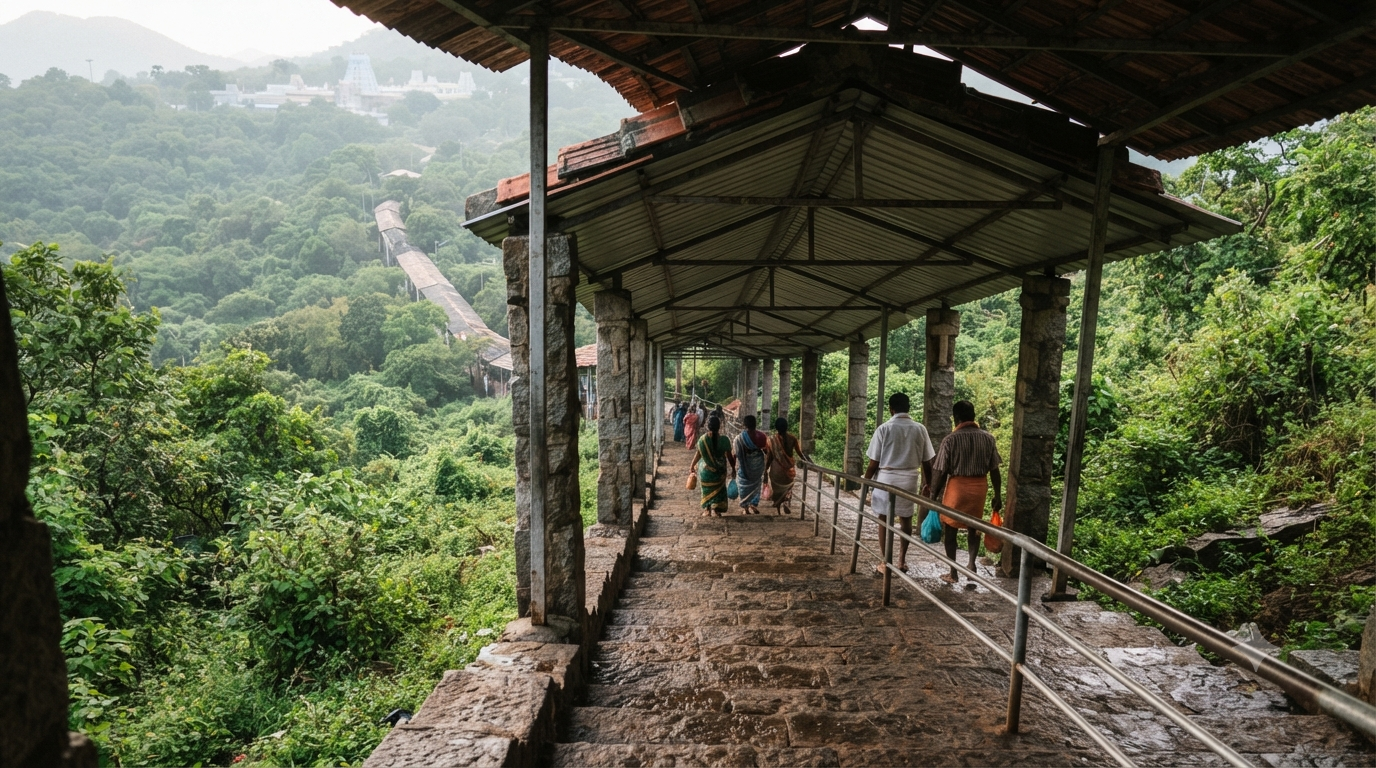
Alipiri footpath timings are not a number you should copy from an old blog and treat as guaranteed for every day. Tirumala Tirupati Devasthanams (TTD) has changed pedestrian controls when wildlife activity, crowd pressure, festivals, or security conditions require it. The safest plan is to start early and use the latest TTD notice. Then confirm the Alipiri gate status before climbing.
Independent guide: TemplesMap.com is not affiliated with, endorsed by, or the official website of Tirumala Tirupati Devasthanams. We do not issue darshan tokens, take bookings, collect donations, or accept payments. Use the official TTD websites for live notices, darshan services, and last-minute restrictions.
One important correction comes first. The old page treated 4:00 AM to 10:00 PM as a fixed daily rule. It also referred to COVID vaccination certificates.
The old wording no longer reflects current guidance. TTD’s latest accessible notices show that safety controls can change. A vaccination certificate is no longer a normal footpath-entry requirement.
Alipiri Footpath Timings at a Glance
Separate the older published closing limit from newer safety reviews. That gives the clearest picture. TTD explicitly stated in June 2023 that pilgrims could use the Alipiri route up to 10:00 PM.
In July 2026, however, TTD studied a 6:00 PM entry cutoff for both routes. Wildlife movement prompted the review.
| Planning point | Current guidance | What to do |
|---|---|---|
| Ordinary Alipiri entry | TTD has not published one permanent daily opening-and-closing table in its current general footpath page | Confirm the gate status on your travel day |
| Older official closing limit | Up to 10:00 PM was stated by TTD in June 2023 | Do not assume it still applies unchanged |
| 2026 safety review | TTD studied a possible 6:00 PM entry cutoff | Start well before evening |
| Children below 12 | TTD restricted footpath trekking to 5:00 AM–2:00 PM | Enter before 2:00 PM with children |
| Route length | About 7.8 km, according to TTD | Allow roughly 3–5 hours based on pace |
That means a daylight start is the most reliable choice. If you plan a late entry, check TTD News first. Also confirm the gate information before travelling to the foothill.
What Are Alipiri Footpath Timings Today?
Alipiri footpath timings should be treated as day-specific because TTD can tighten pedestrian entry without much lead time. The last clear official Alipiri closing statement allowed pilgrims up to 10:00 PM. A July 2026 TTD safety review then considered stopping entry at 6:00 PM. Therefore, do not rely on 10:00 PM as a guaranteed current closing time.
TTD’s official Tirupati-to-Tirumala travel page confirms that Alipiri remains one of the two official pedestrian routes to Tirumala. It lists the route at about 7.8 km and gives an approximate walking time of three hours. That page does not provide a single fixed daily gate schedule, which is why old timing claims need extra caution.
If you want a simple planning rule, begin after daybreak and aim to enter no later than the afternoon. This gives you a buffer for security checks, rest stops, crowd controls, rain, and any same-day restriction at the gate.
Why the Old 4:00 AM–10:00 PM Rule Needs a Caveat
The old article stated that the path opened at 4:00 AM and closed at 10:00 PM. A June 2023 TTD statement supported the 10:00 PM figure. TTD issued it while discussing wildlife controls after a leopard incident. However, later safety policy became more restrictive for some pilgrims.
In August 2023, TTD set a 5:00 AM–2:00 PM window for families with children below 12. Then, on 18 July 2026, TTD again reviewed wildlife movement. It proposed studying a 6:00 PM cutoff for both footpaths.
We found no later accessible TTD press release that makes the proposed 6:00 PM cutoff a permanent daily order. So the accurate answer is not to invent a new fixed time. The page should tell pilgrims what TTD has officially said and where uncertainty remains.
Route Distance, Steps and Walking Time
TTD lists the Alipiri route at about 7.8 km. It gives an approximate walking time of three hours. In practice, many pilgrims need longer because of breaks, queues, family pace, heat, or knee strain. Allowing three to five hours is more realistic for trip planning.
Pilgrims commonly count roughly 3,550 steps on this route. Counts can vary slightly because some people treat landings differently. Alipiri is much longer than Srivari Mettu, but its gradients are spread over a longer distance. That makes it the traditional endurance route rather than the shortest climb.
Do not schedule a tight darshan reporting time immediately after your expected arrival. A slow climb can easily add an hour or more. So keep a generous buffer before any booked reporting slot.
Alipiri Footpath Timings and Child Safety Rules
Alipiri footpath timings are stricter for families with young children. TTD set a 5:00 AM–2:00 PM footpath window for parents with children below 12. This restriction followed wildlife incidents and should be treated as a safety rule unless TTD publishes a newer relaxation.
TTD and forest officials have also increased surveillance along vulnerable stretches. The July 2026 review called for continuous monitoring and a dedicated wildlife monitoring cell. It also proposed a rapid emergency response team.
Keep children close throughout the forested sections. Do not let them run ahead or fall far behind the family group. Follow security instructions immediately, because temporary holding or grouped movement can happen when staff consider a stretch sensitive.
Are Alipiri Footpath Timings Different During Brahmotsavam?
Alipiri footpath timings can change during major festivals because TTD manages unusually large crowds and transport restrictions. Historical TTD notices show that pedestrian routes have sometimes stayed open for extended hours on Garuda Seva days. That does not mean 24-hour access is automatic every year.
TTD scheduled the 2026 annual Brahmotsavams from 15 to 23 September. It also introduced special crowd, medical, and transport arrangements. TTD also set up additional first-aid points at Alipiri Rajagopuram, the 1,500th step, Seventh Mile, and other busy locations.
If you are walking during Brahmotsavam, Vaikunta Ekadasi, Rathasapthami, or another peak event, use the festival-specific TTD notice rather than a normal-day timing article. Crowd rules can override the routine pattern.
Does Walking Alipiri Guarantee a Divya Darshan Token?
No. Walking the Alipiri route does not by itself guarantee that you will receive a Divya Darshan token. Token locations and quotas have changed several times, and TTD can move counters or restrict a quota. Treat the climb and the darshan-token process as related but separate planning tasks.
TTD resumed Divya Darshan tokens on both footpaths on a trial basis in April 2023. Later, the arrangement changed. In June 2025, TTD moved the Divya Darshan token counters for Srivari Mettu walkers to the Bhudevi Complex near Alipiri. TTD was still inspecting Divya Darshan and Time Slot Sarva Darshan counters at Bhudevi Complex in May 2026.
For ordinary free darshan, TTD named Bhudevi Complex, Vishnu Nivasam, and Srinivasam as SSD counters in January 2025. Daily quotas still apply. Because these systems change, check the current counter before choosing a route simply for a token benefit.
If you already hold a paid darshan slot, do not assume walking changes your reporting time or queue category. Follow the instructions printed on your ticket and use only the official TTD booking portal for reservations.
Luggage, Water, Rest Stops and Medical Help
TTD provides several useful services for pedestrians. Its official pages list free luggage transport, drinking water, toilets, shelters, medical help, security patrols, refreshments, and religious broadcasts.
Alipiri trekkers can deposit luggage at the foothills and collect it at Tirumala. A September 2026 TTD review confirms luggage acceptance at Alipiri. TTD transports those bags to the GNC luggage centre in Tirumala. A new technology-based tracking system was under review, so the collection process may continue to improve.
Keep medicines, ID, phone, wallet, and anything needed during the climb with you. Do not place essential medication in checked luggage, because you will not have access to the bag while walking.
Alipiri or Srivari Mettu: Which Footpath Suits You?
Alipiri is the longer traditional route, while Srivari Mettu is much shorter. TTD lists Alipiri at about 7.8 km and Srivari Mettu at about 2.1 km. The shorter route can save time, but it has its own daytime gate schedule and token rules.
| Feature | Alipiri | Srivari Mettu |
|---|---|---|
| Official route length | About 7.8 km | About 2.1 km |
| Typical effort | Longer endurance climb | Shorter, steeper climb |
| Planning style | Allow 3–5 hours | Allow around 1.5–2 hours |
| Best for | Traditional full foot pilgrimage | Pilgrims wanting a shorter trek |
For the current alternate-route schedule, see our Srivari Mettu footpath timings guide. If walking is unsuitable for your group, compare the Tirupati to Tirumala ghat road timings instead.
How to Reach the Alipiri Footpath Entrance
Alipiri sits at the Tirupati foothills and is the main starting point for the longer pedestrian route. TTD says pilgrims can reach the foothills by free TTD buses or APSRTC services. These depart from Tirupati railway and bus stations.
Autos, taxis, and local buses also reach Alipiri. If you are carrying a large bag, use the official luggage facility before starting the steps. Arrive early enough to handle baggage, security screening, toilet breaks, and any token enquiry without eating into your climbing window.
If you plan to use public transport instead of walking, remember that the ghat-road schedule is separate from Alipiri footpath timings. Do not mix vehicle gate hours with pedestrian access hours.
What If the Gate Timing Changes on Your Travel Day?
If the gate opens later, closes earlier, or staff temporarily hold entry, there is no guaranteed workaround. Safety orders take priority. Your best fallback is the road route to Tirumala or a postponed climb. Switch to Srivari Mettu only if its gate and your darshan plan allow it.
First, ask TTD security at Alipiri whether the restriction is temporary. Second, check the latest notice on TTD News. Third, if walking is no longer practical, use an APSRTC or other authorised road service rather than waiting outside a closed pedestrian gate.
Do not pay anyone who claims they can bypass a footpath restriction or guarantee a special token. No private agent can override TTD safety controls or create an official darshan quota.
Health and Wildlife Safety Before You Climb
The climb is physically demanding, so treat it as a trek rather than a short temple walk. TTD itself asks pedestrians to consider their health condition before choosing the footpath. People with significant heart, breathing, mobility, or knee problems should get medical advice before attempting the route.
Carry drinking water, use the rest shelters, and slow down if you feel dizzy or unusually breathless. Keep regular medication with you. During hot weather, an early start reduces heat exposure, while daylight also makes wildlife-related instructions easier to follow.
Never feed animals or leave food waste on the route. TTD’s 2026 wildlife review specifically linked waste management with reducing animal attraction near pedestrian areas. Smoking, alcohol, gutka, and intoxicants are also prohibited in Alipiri and other TTD areas.
Alipiri Footpath Timings: Practical Checklist Before You Start
Alipiri footpath timings matter most when they are combined with a realistic start plan. A pilgrim who arrives near a cutoff can lose the walking plan. The route may remain open only for people already inside.
- Check TTD News on the morning of travel for wildlife, weather, festival, or crowd restrictions.
- Reach Alipiri early, especially if you have children below 12 or need luggage handling.
- Carry valid photo ID because TTD uses identity checks for issued token quotas.
- Keep essential medicines, water, and a charged phone with you during the climb.
- Allow at least three to five hours for the route instead of planning around the fastest possible time.
- Keep a buffer before any booked darshan reporting slot.
- Use only official TTD channels for darshan, accommodation, and payment.
If your main priority is a ₹300 Special Entry Darshan slot rather than the walking vow itself, see our Tirumala ₹300 ticket booking guide. Booking and footpath access are different systems, so plan each one separately.
Before You Go
The key point is simple: do not treat one old opening-and-closing figure as a permanent TTD rule. The Alipiri route remains an official way to walk to Tirumala, but entry controls can change when safety conditions change.
Start early, give yourself several hours, and follow the gate instruction you receive that day. Check Alipiri footpath timings again before departure, especially with children below 12. If a late start is unavoidable, verify access before travelling to Alipiri.
Frequently Asked Questions
What time does Alipiri footpath open?
TTD’s current general footpath information page does not publish one fixed daily opening time for Alipiri. Older guides commonly quote early-morning opening times, but same-day safety controls can alter access. For a dependable trip, reach in the morning and confirm the gate status at Alipiri before starting.
What time does Alipiri footpath close?
TTD officially stated in June 2023 that Alipiri pilgrims could climb up to 10:00 PM. However, in July 2026 TTD said it was studying a 6:00 PM entry cutoff because of wildlife movement. Since no later accessible order clearly fixes one permanent time, confirm the closing limit on your travel day.
Are Alipiri footpath timings the same every day?
No. Alipiri footpath timings can change during wildlife alerts, heavy crowds, maintenance, major festivals, or security operations. TTD may also control how pilgrims move through sensitive stretches. A normal-day schedule should never override a same-day instruction from TTD security or forest staff.
Can children use the Alipiri footpath?
Yes, but TTD has a special time restriction for younger children. The published wildlife-safety rule gives families with children below 12 a 5:00 AM–2:00 PM footpath window. Keep children close and follow any newer instruction displayed at the gate.
How long does it take to walk from Alipiri to Tirumala?
TTD gives an approximate walking time of three hours for the 7.8 km Alipiri route. Many pilgrims need three to five hours after allowing for breaks, queues, heat, and family pace. Keep extra time if you have a darshan reporting slot after the climb.
Do Alipiri walkers get Divya Darshan automatically?
No. Walking does not guarantee a Divya Darshan token, because TTD controls token quotas and counter locations separately. Recent official notices focused Divya Darshan token issuance at Bhudevi Complex for Srivari Mettu pilgrims. Check the live counter arrangement before choosing Alipiri for a presumed token benefit.
Is luggage transport available for Alipiri walkers?
Yes. TTD provides free luggage transport for pedestrians who deposit bags at the foothill facility. TTD transports Alipiri luggage to the designated GNC collection counter in Tirumala. Keep your ID, medicines, money, and other essentials with you during the climb.
Is Alipiri safer in the daytime?
A daylight climb gives you more margin before an evening restriction. It also avoids darkness and can reduce seasonal heat exposure. TTD continues wildlife surveillance, so obey security staff. Never wander away from the main pedestrian path.