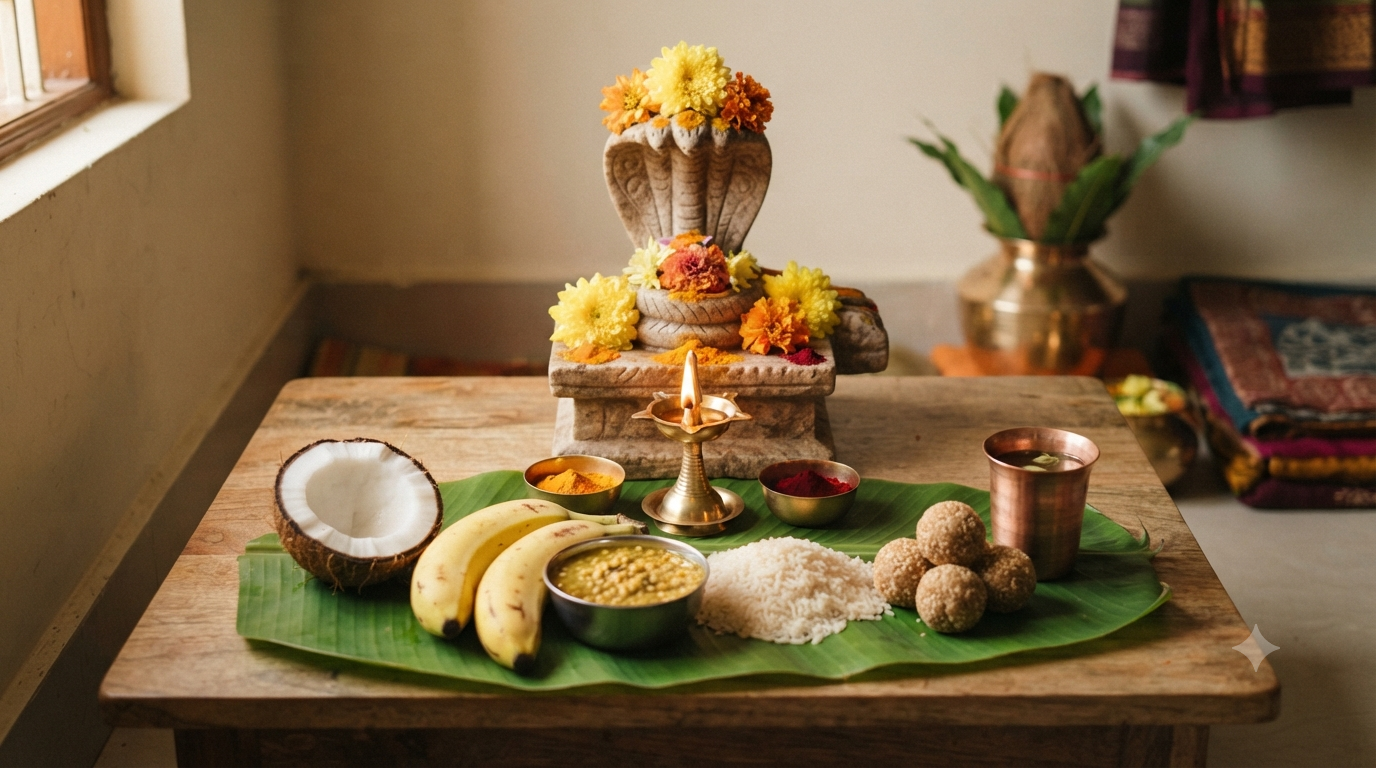
Nagula Chavithi Pooja in Telugu households centres on Naga Devata worship, a simple vratam, and traditional naivedyam such as chalimidi and chimmili. In 2026, the observance falls on Friday, 13 November. This guide gives the current date, a practical pooja vidhanam, the samagri list, prasadam recipes, and safer ways to follow the tradition.
Temples Map is an independent temple and festival guide. We are not affiliated with any temple, trust, priest network, or government department. We do not accept pooja bookings, donations, or payments, so use only an official temple or endowments portal for any temple service.
Nagula Chavithi Pooja Date and Tithi in 2026
Nagula Chavithi falls on Friday, 13 November 2026, during Karthika Shukla Chavithi. Drik Panchang places the Chavithi tithi from about 6:09 PM on 12 November to 8:42 PM on 13 November. The exact clock time can shift slightly by city.
The important point is the sunrise rule followed by Telugu panchangams. Since Chavithi continues through sunrise on 13 November, Telugu families keep the main observance that day. Some websites still show 12 November because they use the tithi start date instead of the festival observance date.
If your family follows a particular purohit or local panchangam, use that tradition for the exact muhurat. A midday Naga puja window is commonly shown, but the local city setting should decide the final timing. For the wider Telugu festival calendar, see our Karthika Masam 2026 dates.
Nagula Chavithi at a Glance
- Festival: Nagula Chavithi, also called Naga Chaturthi in some families.
- 2026 date: Friday, 13 November 2026.
- Lunar day: Karthika Shukla Chavithi.
- Main worship: Naga Devatas, usually through a Naga idol, Naga stone, or temple shrine.
- Common naivedyam: Pachi chalimidi, chimmili or nuvvula undalu, vada pappu, panakam, fruit, and coconut.
- Common observance: A vratam or simple fast followed by puja and prasadam, according to family custom.
- Important safety point: Do not handle snakes or pour food into an occupied snake burrow. Use a symbolic Naga shrine instead.
What Is the Meaning of Nagula Chavithi?
Nagula Chavithi is a Telugu Hindu observance dedicated to the Naga Devatas, the sacred serpent deities. Families observe it mainly in Andhra Pradesh and Telangana, with related customs in parts of Karnataka. Families traditionally pray for the well-being of children, household protection, and harmony with nature.
The festival also reflects the place of serpents in Hindu sacred imagery. Adishesha is closely linked with Lord Vishnu, while Vasuki appears in stories connected with Lord Shiva and the Samudra Manthan. These are religious traditions and symbols, not claims of guaranteed worldly outcomes.
A popular oral explanation links the day with Vasuki and the churning of the ocean. However, vratha kathas differ between regions and families. It is better to follow the story used in your own household than to treat one internet version as the only authoritative account.
Nagula Chavithi Pooja Samagri List
The Nagula Chavithi Pooja samagri can stay simple. You do not need an elaborate kit, and there is no official requirement to buy a special package online. A clean home altar or Naga shrine with basic puja items is enough for most family traditions.
| Item | Use | Simple substitute |
|---|---|---|
| Naga idol, photo, or Naga stone | Main focus of worship | Temple Naga shrine |
| Turmeric and kumkum | Traditional offering | Use what your family normally uses |
| Flowers | Archana and decoration | Locally available fresh flowers |
| Deepam and oil or ghee | Lamp offering | One small lamp is sufficient |
| Incense | Optional dhupa | May be skipped if smoke is a concern |
| Water | Achamanam and symbolic offering | Clean drinking water |
| Milk | Used in some family traditions | Offer in a vessel to the deity, not to a live snake |
| Fruit and coconut | Naivedyam | Any fresh seasonal fruit |
| Chalimidi or chimmili | Traditional prasadam | One simple sweet is enough |
| Vada pappu or panakam | Light naivedyam | Optional according to custom |
Some families also use betel leaves, betel nuts, akshatalu, sandal paste, or specific vratam materials. Those details vary by sampradaya, so follow your family practice when it differs from this list.
How to Do Nagula Chavithi Pooja at Home
You can perform Nagula Chavithi Pooja at home as a simple devotional sequence. There is no need to imitate a full temple ritual if your family has never followed one. Keep the altar clean, prepare the naivedyam first, and perform the worship calmly.
- Clean the prayer space. Bathe, wear clean clothes, and set a Naga image, idol, or Naga stone on a clean surface.
- Light the lamp. Place flowers, turmeric, kumkum, fruit, coconut, and prasadam nearby before you begin.
- Take sankalpam. State the day, your name or family intention, and that you are observing Nagula Chavithi according to your tradition.
- Offer water and flowers. Apply turmeric and kumkum to the Naga representation if that is customary in your home.
- Chant familiar prayers. You may recite Naga names, a Naga Gayatri, Subrahmanya prayers, or a simple namaskaram used by your family.
- Offer naivedyam. Place chalimidi, chimmili, vada pappu, panakam, fruit, or the dishes your family prepares.
- Perform deepa harati. Complete the puja with a lamp and prayer for family well-being.
- Read the vratam story. If your family follows a Nagula Chavithi katha, read that version after the main offerings.
- Distribute prasadam. Break the fast only in the manner followed by your household or after the puja is complete.
If you visit a temple, follow the temple priest’s instructions instead of carrying a home sequence into the sanctum. For Andhra Pradesh temples under the Endowments Department, use the official AP Endowments portal for genuine temple-service information.
A Safer Way to Follow the Putta Tradition
Many Telugu families traditionally visit a putta, or anthill, on Nagula Chavithi. Respect the symbolism, but do not disturb a live burrow or try to attract, touch, display, or feed a snake. A Naga stone, temple shrine, or symbolic altar gives the same devotional focus without putting people or wildlife at risk.
The Wildlife Institute of India states that snakes do not deliberately drink milk and advises people not to kill them. Its field material also explains that snakes play an important role in controlling rodents. Therefore, pouring milk into a live burrow is not necessary for worship and can create avoidable harm.
If a snake appears near a home, keep people away and contact the local forest department or an authorised rescuer. Do not attempt a rescue yourself. The Wildlife Institute of India snake manual is a useful reference on snake behaviour and common myths.
Nagula Chavithi Pooja Prasadam List
Nagula Chavithi Pooja prasadam differs by household, but four preparations appear often in Telugu homes. Pachi chalimidi and chimmili are the most distinctive, while vada pappu and panakam keep the naivedyam simple. Fruit and coconut can be added without making the offering complicated.
| Prasadam | Main ingredients | Preparation |
|---|---|---|
| Pachi chalimidi | Rice flour, jaggery, cardamom | Mix without cooking into a soft offering |
| Chimmili / nuvvula undalu | Sesame, jaggery | Grind or pound and shape into small balls |
| Vada pappu | Yellow moong dal | Soak, drain, and offer plain |
| Panakam | Jaggery, water, pepper, cardamom | Dissolve and serve as a drink |
There is no single compulsory menu for every family. If your elders prepare only chalimidi and fruit, that is still a complete household offering. The purpose of naivedyam is devotion, not the number of dishes.
How to Make Pachi Chalimidi
Pachi chalimidi is a soft rice-flour and jaggery prasadam made without a cooked syrup. For a small family batch, start with one cup of fine rice flour and add grated jaggery gradually. Mix in cardamom and a small spoon of ghee if your family uses it.
Add only enough moisture to bind the mixture, because too much water makes it sticky. Some homes use a little grated coconut, while others keep it to rice flour and jaggery. Shape it into small portions or offer it as a soft mound.
How to Make Chimmili or Nuvvula Undalu
Chimmili uses sesame seeds and jaggery, so the ingredient list is short. Use roughly one cup of sesame seeds with about half a cup of grated jaggery as a starting ratio. Family recipes vary, especially on whether the sesame is roasted lightly or used raw.
Grind or pound the sesame first, then add jaggery and pulse until the natural oils help the mixture hold together. Form small balls with clean hands. If your household has a fixed method, follow that instead of changing the texture just to match an online recipe.
How to Make Vada Pappu and Panakam
For vada pappu, rinse yellow moong dal and soak it until it softens, usually for about 30 to 60 minutes. Drain it well before offering. Some families add nothing else because it is meant to remain a plain, fresh naivedyam.
For panakam, dissolve jaggery in clean water and add a little black pepper and cardamom. Strain it if the jaggery has sediment. Make only the quantity you need, since fresh panakam tastes better and is easier to handle safely.
Fasting, Vratam, and Family Practice
Fasting customs differ widely. Some women keep a strict fast until the puja, while others take fruit, milk, or a light meal. There is no reason to force a severe fast if your health, age, pregnancy, medicines, or work conditions make it unsafe.
If you have diabetes, kidney disease, are pregnant, are elderly, or take medicines with food, ask a doctor before keeping a long fast. You can adapt the devotional observance without turning it into a health risk. Do not push children into strict fasting.
The same principle applies to ritual claims. Nagula Chavithi is a religious practice rooted in faith and family tradition. Do not present it as a medical cure, fertility treatment, or guaranteed remedy for horoscope problems.
Common Mistakes to Avoid
- Using an old date: the 2022 date on the earlier version of this page no longer applies. For 2026, use Friday, 13 November.
- Confusing the tithi start with the festival day: Chavithi begins on 12 November evening, but the Telugu observance falls on 13 November.
- Booking a private “online pooja” because the page says so: no online booking is required for a home vratam. Use only a temple’s official channel for temple sevas.
- Feeding or handling live snakes: worship a Naga idol, stone, or shrine instead.
- Assuming one prasadam list is compulsory: naivedyam varies by family and region.
- Forcing a strict fast: adapt the vratam if health or medicines make fasting risky.
Nagula Chavithi and Naga Panchami Are Not the Same Date
Nagula Chavithi and Naga Panchami both honour serpent deities, but they fall on different lunar days and seasons. Telugu families observe Nagula Chavithi on Karthika Shukla Chavithi. Naga Panchami is widely observed on Shravana Shukla Panchami in many parts of India.
In Telugu regions, another Naga Panchami can also follow Nagula Chavithi during Karthika. That is why search results sometimes mix the names and dates. Always check the tithi, month, and local tradition rather than relying on a bare festival label.
Tirumala also has a distinct Nagula Chavithi observance connected with the Pedda Sesha Vahanam procession. If you are planning a visit, our Pedda Sesha Vahanam guide explains that separate temple tradition.
Before You Begin the Vratam
Nagula Chavithi Pooja does not need expensive materials, a private booking, or contact with a live snake. Fix the correct date first, prepare a simple Naga altar, make the prasadam your family knows, and follow the vratam with care. If local custom differs, family tradition and the local temple’s guidance should take priority.
For 2026, mark Friday, 13 November. Keep any city-specific muhurat tied to your local panchangam, because sunrise and madhyahna timings shift by location. Most importantly, keep the worship devotional, safe, and respectful to wildlife.
Frequently Asked Questions
When is Nagula Chavithi in 2026?
Nagula Chavithi is on Friday, 13 November 2026. The Chavithi tithi begins on the evening of 12 November and continues until the evening of 13 November. Telugu panchangams therefore keep the main observance on 13 November.
What is the correct Nagula Chavithi Pooja time?
The exact pooja time depends on your city because panchang timings use local sunrise and midday calculations. Drik Panchang shows a midday puja window for the day, but Andhra Pradesh locations can differ by several minutes. Use your local city setting or family panchangam for the final time.
What prasadam is made for Nagula Chavithi?
Common Telugu prasadam includes pachi chalimidi, chimmili or nuvvula undalu, vada pappu, and panakam. Fruit and coconut are also common. The list is not compulsory, so follow the dishes traditionally prepared in your own family.
Can Nagula Chavithi Pooja be done at home?
You can perform Nagula Chavithi Pooja at home with a Naga image, idol, or Naga stone, plus a lamp, flowers, turmeric, kumkum, and naivedyam. A temple visit is optional unless your family tradition specifically requires one.
Should milk be poured into a snake pit?
No live snake needs milk, and the Wildlife Institute of India states that snakes do not deliberately drink it. For a safer observance, offer milk symbolically to a Naga idol or at a temple under priest guidance. Do not disturb an occupied anthill or snake burrow.
Is online pooja booking required for Nagula Chavithi?
No. A home vratam does not require any online booking. If you want a specific temple seva, use only that temple’s official website or the relevant government endowments portal. Temples Map does not arrange priests, bookings, donations, or payments.
Who usually observes Nagula Chavithi?
Traditionally, many married women in Telugu households observe the vratam and pray for family and children’s well-being. However, worship is not limited to one group. Families may participate together according to their own custom.
Is Nagula Chavithi the same as Naga Panchami?
No. Nagula Chavithi falls on Karthika Shukla Chavithi in the Telugu tradition, while the better-known Naga Panchami falls on Shravana Shukla Panchami. Both honour Naga Devatas, but they belong to different lunar dates and regional customs.