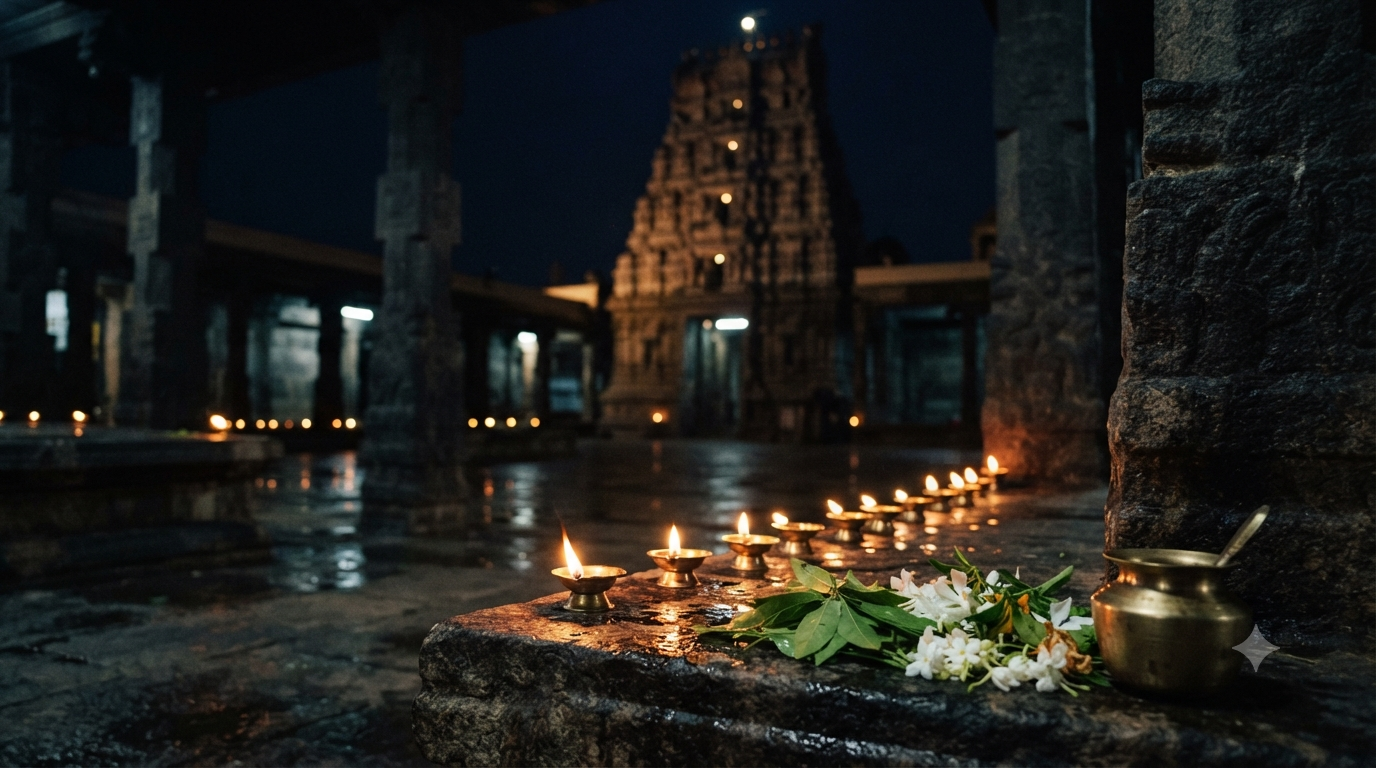
The Masa Shivaratri date and time shifts every single month, so one fixed slot on your calendar will never work. This guide lists every confirmed date for the rest of 2026 and all of 2027, along with the exact midnight puja window. Most sites still print “6 PM” beside these dates, yet that figure belongs to a completely different vratam. Every date below was cross-checked against two independent panchangams before publishing.
Temples Map is an independent guide. We are not affiliated with any temple, trust or devasthanam, and we do not accept bookings, poojas, donations or payments. For sevas and tickets, please use the official temple portal.
Masa Shivaratri Date and Time at a Glance
Here is the short version before the full tables below.
- Next date: Wednesday, 9 September 2026, with the puja window near midnight.
- Tithi: Krishna Paksha Chaturdashi, the fourteenth day of the waning moon.
- Main puja window: Nishita Kaal, roughly 40 to 55 minutes around local midnight.
- Not the same as: Pradosham, which falls on Trayodashi and centres on sunset.
- Count in 2027: thirteen dates, because two Shivaratris land inside July.
- Biggest one: Maha Shivaratri on Saturday, 6 March 2027.
What Is Masa Shivaratri?
Masa Shivaratri is the monthly night of Lord Shiva. It falls on Krishna Paksha Chaturdashi, the fourteenth day of the waning moon, in every lunar month. Devotees fast through the day and worship Shiva close to midnight. Once each year the same tithi becomes Maha Shivaratri, the greatest of them all.
Because the tithi keeps moving, you have to read the Masa Shivaratri date and time fresh from a panchangam every month.
In the Telugu calendar, two Chaturdashi tithis occur inside one month. One sits in Sukla Paksha, just before Pournami. The other sits in Krishna Paksha, just before Amavasya. Only the second one carries the Shivaratri vratam, so the bright-fortnight Chaturdashi is not a Shivaratri at all.
Amanta and Purnimanta Naming
South Indian states follow the Amanta system, where the lunar month ends at Amavasya. North India follows Purnimanta, where it ends at Pournami. Because of that, one region names the same night Magha Krishna Chaturdashi while the other calls it Phalguna Krishna Chaturdashi. The naming differs, although both traditions observe the identical calendar night.
Masa Shivaratri Date and Time in 2026
The Masa Shivaratri date and time for each remaining month of 2026 appears in the table below. Four such days are left in the year. The next one falls on Wednesday, 9 September 2026, and the Nishita Kaal window runs from about 11:55 PM to 12:41 AM. Since the tithi ends the following morning, the fast is broken after sunrise on 10 September.
| Month | Date and Day | Lunar Month, Tithi | Nishita Kaal (New Delhi) |
|---|---|---|---|
| September | Wednesday, 9 September | Bhadrapada, Krishna Chaturdashi | 11:55 PM to 12:41 AM |
| October | Thursday, 8 October | Ashwina, Krishna Chaturdashi | 11:43 PM to 12:33 AM |
| November | Saturday, 7 November | Kartika, Krishna Chaturdashi | 11:39 PM to 12:31 AM |
| December | Monday, 7 December | Margashirsha, Krishna Chaturdashi | 11:46 PM to 12:41 AM |
Earlier in 2026 there was an extra twist. An Adhika Masa, or leap month, fell in Jyeshtha, so panchangams recorded the Shivaratri on 13 June 2026 as Adhika Masik Shivaratri. That single insertion pushed every later date roughly one lunar month away from where a normal year would place it. Anyone copying an old chart would therefore print the wrong Masa Shivaratri date and time for months on end.
Masa Shivaratri Date and Time in 2027
The full Masa Shivaratri date and time list for 2027 follows, with the Nishita Kaal window for each night. Thirteen such days fall in the calendar year, not twelve. Two of them land in July, on 2 July and again on 31 July. The second one is also Sawan Shivaratri, while the March date doubles as Maha Shivaratri.
| Date (2027) | Lunar Month, Tithi | Nishita Kaal (New Delhi) | Note |
|---|---|---|---|
| Tuesday, 5 January | Pausha, Krishna Chaturdashi | 11:59 PM to 12:53 AM | Tuesday, highly auspicious |
| Thursday, 4 February | Magha, Krishna Chaturdashi | 12:09 AM to 1:01 AM | — |
| Saturday, 6 March | Phalguna, Krishna Chaturdashi | 12:08 AM to 12:57 AM | Maha Shivaratri |
| Monday, 5 April | Chaitra, Krishna Chaturdashi | 12:01 AM to 12:46 AM | — |
| Tuesday, 4 May | Vaishakha, Krishna Chaturdashi | 11:56 PM to 12:39 AM | Tuesday, highly auspicious |
| Thursday, 3 June | Jyeshtha, Krishna Chaturdashi | 11:59 PM to 12:39 AM | — |
| Friday, 2 July | Ashadha, Krishna Chaturdashi | 12:05 AM to 12:45 AM | — |
| Saturday, 31 July | Shravana, Krishna Chaturdashi | 12:07 AM to 12:49 AM | Sawan Shivaratri |
| Monday, 30 August | Bhadrapada, Krishna Chaturdashi | 11:59 PM to 12:44 AM | — |
| Tuesday, 28 September | Ashwina, Krishna Chaturdashi | 11:47 PM to 12:35 AM | Tuesday, highly auspicious |
| Wednesday, 27 October | Kartika, Krishna Chaturdashi | 11:39 PM to 12:31 AM | — |
| Friday, 26 November | Margashirsha, Krishna Chaturdashi | 11:42 PM to 12:36 AM | — |
| Saturday, 25 December | Pausha, Krishna Chaturdashi | 11:54 PM to 12:49 AM | — |
Why 2027 Carries Thirteen Dates
A lunar month runs about 29.5 days, while a Gregorian month averages 30.4 days. That gap slowly drags each Shivaratri earlier in the month. Eventually one calendar month catches two of them, and in 2027 July is that month. Any list showing only twelve dates for 2027 has quietly dropped one.
Why the 6 PM Masa Shivaratri Date and Time Is Wrong
The Masa Shivaratri date and time points to Nishita Kaal, the muhurta around local midnight, and not to six in the evening. The window lasts only 40 to 55 minutes. A reader who sits down at 6 PM will finish long before the actual muhurta opens.
The confusion has an obvious source. Pradosham puja genuinely is an evening ritual, performed roughly 1.5 hours on either side of sunset. Because both vratams honour Shiva and fall within days of each other, aggregator sites copy the evening timing across to Shivaratri. Our Pradosham dates and pooja kalam guide covers the evening ritual separately.
Masa Shivaratri or Pradosham?
- Tithi: Pradosham falls on Trayodashi, the thirteenth day. Shivaratri falls on Chaturdashi, the fourteenth.
- Frequency: Pradosham comes twice a month, while Masa Shivaratri comes once.
- Timing: Pradosham falls at sunset, whereas Shivaratri puja happens at midnight.
- Temple practice: Nandi is central to Pradosham abhishekam, although both days feature Shiva abhishekam.
Adjusting the Masa Shivaratri Date and Time for Your City
The Nishita Kaal timings above apply to New Delhi. Nishita follows local midnight, so the clock reading changes as you move east or west. Cities further east reach local midnight sooner.
For Hyderabad, Vijayawada, Rajahmundry or Chennai, expect the window to open roughly 10 to 15 minutes earlier than the Delhi figure. Mumbai and Ahmedabad run about 10 minutes later instead, so the Masa Shivaratri date and time you follow should match your own city. If you want the exact minute for your town, check the city-specific listing on Drik Panchang before the day arrives.
One practical note: the dates themselves stay the same across India. Only the minute-level muhurta shifts, so you never have to worry about observing on the wrong day within the country.
Masa Shivaratri Pooja Vidhanam
- Bathe in the morning and take a sankalpam to observe the vratam for that day.
- Clean the puja space, then place a Shiva lingam or a framed picture of Lord Shiva.
- Perform abhishekam with water, milk, curd, honey, ghee and finally water again.
- Offer bilva (maredu) leaves, vibhuti, white flowers and fruit as naivedyam.
- Chant “Om Namah Shivaya” or recite the Shiva Ashtottara Shatanamavali through the day.
- Keep the main puja for the Nishita Kaal window listed above, since that is the prescribed muhurta.
- Stay awake for the jagaran if you can, then break the fast after sunrise the next morning.
Temples across Andhra Pradesh and Telangana run extra abhishekams on this day. If you plan a temple visit instead of a home puja, check the seva schedule first, because Shivaratri timings differ from the daily routine. Our page on Srisailam Temple daily seva timings shows how much a festival day can alter the normal schedule.
Fasting Rules and a Word of Caution
Most devotees keep a phalahara fast: fruit, milk and water through the day, with no grains or salt. A stricter nirjala fast avoids water entirely, though tradition never demands it of everyone.
Please treat the fast sensibly. Anyone with diabetes, low blood pressure, kidney conditions or a pregnancy should speak to a doctor before attempting a full-day fast or an overnight vigil. Elderly devotees can observe the day with prayer alone. The vratam is an act of devotion and it is not a treatment for any medical condition.
What Devotees Believe This Night Brings
These are matters of faith and Vedic tradition rather than verified outcomes, so we present them as devotees describe them.
- Devotees believe worship during Pradosha Kalam guards against Apamruthyu Dosham.
- Observing the vratam through the year is said to soften jataka doshas in the horoscope.
- Unmarried women keep the fast seeking a suitable match, while married women seek harmony at home.
- Beginning the vratam on Maha Shivaratri and keeping it for a full year carries special merit in tradition.
When the Masa Shivaratri date and time lands on a Tuesday, panchangams treat that night as more auspicious still. Three such dates arrive in 2027: 5 January, 4 May and 28 September.
Mistakes People Make With the Masa Shivaratri Date and Time
The most common error is reusing last year’s list. Lunar dates never repeat on the same Gregorian day, and a leap month can push them by nearly thirty days. The 2026 Adhika Jyeshtha is exactly why a carried-forward 2025 list would have failed.
A second mistake is trusting the day alone. Because the tithi often begins in the afternoon and ends the next morning, the puja night can feel like it belongs to the following date. Always read the Nishita Kaal window, not just the calendar square.
The third is assuming twelve dates per year. As 2027 shows, a year can hold thirteen. You can verify any of these against the AstroSage monthly Shivratri listing, which we used as the second confirming source for every date on this page.
Before You Mark Your Calendar
Between them, the two tables above give the Masa Shivaratri date and time for every observance up to the end of 2027. Save them and set a reminder for 11:30 PM on each date, so the Nishita Kaal window never slips past you. Adjust by ten to fifteen minutes if you live in South India.
Remember that the next observance is Wednesday, 9 September 2026, and the year’s biggest night, Maha Shivaratri, arrives on 6 March 2027. Panchangams occasionally differ by a day for regional traditions, so confirm with your family purohit if your community follows a specific panchangam.
Frequently Asked Questions
What is the next Masa Shivaratri date and time?
The next Masa Shivaratri falls on Wednesday, 9 September 2026. The Nishita Kaal puja window runs from about 11:55 PM to 12:41 AM in New Delhi, and slightly earlier in South Indian cities. The tithi is Bhadrapada Krishna Chaturdashi.
Is Masa Shivaratri the same as Pradosham?
No, they are two different observances. Pradosham falls on Trayodashi at sunset, twice every month. Masa Shivaratri falls on Chaturdashi at midnight, once every month. Both honour Lord Shiva, which is why they are often confused.
Why do websites show 6 PM as the Masa Shivaratri date and time?
That evening timing simply travelled across from Pradosham, where sunset worship is correct. For Masa Shivaratri the prescribed muhurta is Nishita Kaal, the short window around local midnight. Panchangams list this window explicitly for every date.
How many Masa Shivaratri days are there in 2027?
There are thirteen. Two fall in July, on 2 July and 31 July, because a lunar month is shorter than a calendar month. Lists showing only twelve dates for 2027 have missed one of them.
Can I do the pooja in the evening instead of midnight?
Nishita Kaal is the prescribed time, so most families prefer the midnight window wherever possible. That said, sincere devotion at any hour still counts in practice, and many households do an evening abhishekam plus a short midnight prayer.
Which Masa Shivaratri is considered the most auspicious?
Maha Shivaratri, which falls on 6 March in 2027, is the greatest of the year. After that, devotees particularly value Sawan Shivaratri in Shravana, and any Shivaratri landing on a Tuesday, which panchangams flag as especially auspicious.
Do I have to fast without water?
No, a waterless nirjala fast is entirely optional. Most devotees keep a phalahara fast with fruit, milk and water. Choose whichever form suits your health, and consult a doctor first if you have any medical condition.
When exactly is Maha Shivaratri in 2027?
Maha Shivaratri 2027 falls on Saturday, 6 March 2027, on Phalguna Krishna Chaturdashi. The Nishita Kaal puja window runs from roughly 12:08 AM to 12:57 AM on the night of 6 to 7 March.