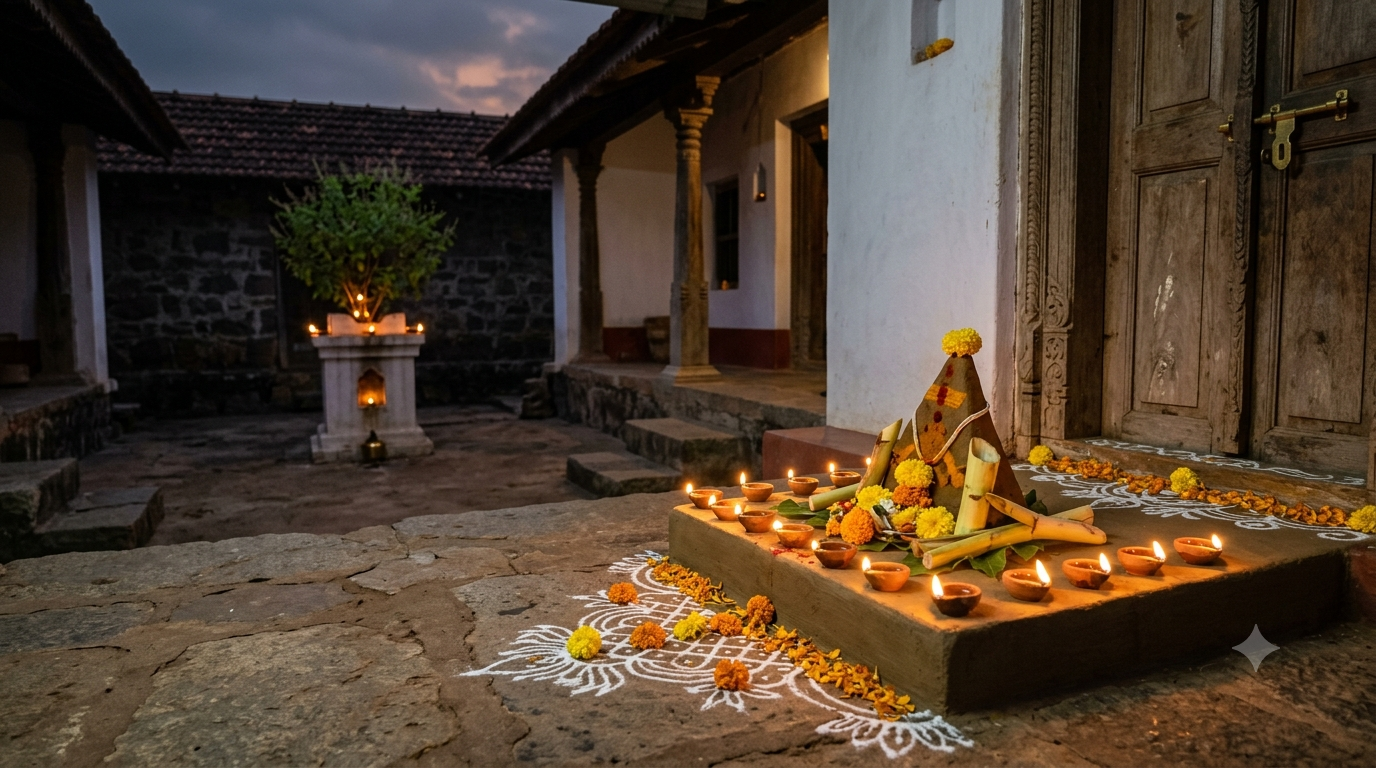
Balipadyami Pooja Vidhana in Karnataka falls on Tuesday, 10 November 2026. Do not confuse that festival date with one fixed statewide pooja time. Karnataka households follow local panchanga calculations and family custom. So Bengaluru, Mysuru, Udupi, Hubballi and other places may use slightly different clock times.
TemplesMap.com is an independent festival and temple guide. We are not affiliated with any temple, trust or government department, and we do not accept pooja bookings, donations or payments.
The safest plan is simple. Keep 10 November as the Karnataka Bali Padyami date, then confirm the local muhurta from a city-specific panchanga or your family priest. This Balipadyami Pooja Vidhana explains the home sequence, samagri and Balindra tradition. It also clears up the timing issue that causes most online confusion.
Balipadyami Pooja Vidhana 2026 at a Glance
Karnataka observes Bali Padyami on Tuesday, 10 November 2026. The day falls on Kartika Shukla Padya, also called Shukla Pratipada. However, the festival date and pooja clock time are separate questions. Muhurta calculations depend on location, sunrise and the panchanga method followed by the household.
| Point | Karnataka guidance | What to do |
|---|---|---|
| Festival date | Tuesday, 10 November 2026 | Keep this as the Karnataka Bali Padyami date |
| Lunar day | Kartika Shukla Padya / Pratipada | Confirm with a Kannada panchanga |
| Pooja time | Location-specific | Use your city panchanga or family tradition |
| Main worship | Balindra or King Bali | Offer lamps, flowers and festive food |
| Regional customs | Vary across Karnataka | Follow inherited household practice first |
ISKCON Bangalore’s 2026 public-holidays calendar lists Balipadyami and Govardhan Puja on Tuesday, 10 November. A Kannada panchanga calculation for Byadgi, Karnataka, also places Shukla Padya on that date. Therefore, the date is much firmer than any single clock-time claim copied across cities.
Why Karnataka Bali Padyami Is on 10 November 2026
The 2026 Karnataka date is Tuesday, 10 November. This matters because several websites mix the Deepavali evening, the sunrise tithi and the next civil day. ISKCON Bangalore’s 2026 calendar places Balipadyami and Govardhan Puja on 10 November, while Karnataka-based panchanga data places Kartika Shukla Padya on the same date.
Drik Panchang’s Kannada daily panchanga for Byadgi, Karnataka shows Padya continuing until 14:00 on 10 November. It also calculates the calendar for the selected location. That is why a festival can have one accepted Karnataka date while precise sunrise, Godhuli or other muhurta windows still differ by city.
For broader Karnataka context, Karnataka Tourism describes Bali Pratipada as a distinct concluding Deepavali observance that honours King Bali. Akashvani News also records Karnataka traditions of Balindra images, lamps and household worship.
Balipadyami Pooja Vidhana: Date Is Fixed, Local Time Is Not
The key Balipadyami Pooja Vidhana rule is to separate the civil festival date from the local worship time. Use 10 November 2026 for Karnataka Bali Padyami. Then use a local panchanga for the pooja window, because local solar and muhurta periods differ across the state.
Do not treat a Bengaluru time as a universal Karnataka time. Likewise, a timing copied from Mumbai, Hyderabad or a foreign city should not be used automatically. Drik Panchang calculates its daily panchanga for the selected location, so the city setting matters when you check its Byadgi Kannada Panchangam for 10 November 2026.
Many Karnataka families perform Balindra worship in the evening or around Godhuli, especially where the household tradition centres on lamps and the return of Balindra. Other families complete parts of the pooja earlier in the day. Since local sampradaya comes first, use your inherited practice when it is known.
Balipadyami Pooja Vidhana Samagri for a Simple Home Pooja
A simple Balipadyami Pooja Vidhana setup does not need an elaborate shopping list. Most families can use items already kept for Deepavali. However, some coastal and farming traditions use extra local materials. So follow your elders if your household has a fixed list.
- Oil lamps or diyas, cotton wicks and oil or ghee
- Turmeric, kumkum, sandal paste and akshata
- Fresh flowers and a small rangoli space
- Betel leaves, areca nut and seasonal fruits
- Coconut and a simple naivedya or festive food
- A clean plate or low platform for the Balindra representation
- Clay or cow dung only if your family tradition uses a Balindra figure
- Items for Go Pooja only where cattle worship is part of the household custom
Akashvani’s Karnataka report notes that some households make a triangular or symbolic image of King Bali from clay or cow dung and decorate it with flowers. That is a regional practice, not a compulsory rule for every home. If your family never followed it, a simple lamp-and-prayer observance is better than inventing a ritual from an online list.
Step-by-Step Balipadyami Pooja Vidhana at Home
Begin by cleaning the pooja area, courtyard or Tulasi space before the chosen local worship time. Then draw a simple rangoli and arrange the lamps safely. Keep the Balindra representation on a clean base if your family uses one.
- Prepare the space. Clean the area, place flowers and light the main lamp.
- Remember Ganesha first. Offer a short prayer before the main worship if this is your family custom.
- Invoke Balindra. Place the symbolic Balindra figure or image and offer turmeric, kumkum, akshata and flowers.
- Offer naivedya. Keep fruit, coconut, sweets or the festive food prepared in your home.
- Light the Deepavali lamps. Continue the lamp tradition around the threshold, courtyard or Tulasi area where it is safe.
- Perform Go Pooja if customary. Farming families may honour cattle with flowers and suitable feed.
- Offer namaskara. Pray for dharma, family welfare and prosperity, then conclude with arati.
- Share prasada. Distribute the offered food among family members after the pooja.
This Balipadyami Pooja Vidhana sequence stays simple because Karnataka practice is not uniform. A family may have a traditional Balindra song, paddana, flower, crop offering or cattle ritual. Keep that inherited form rather than replace it with a generic internet method.
What Is the Story Behind Bali Padyami?
Bali Padyami honours the legendary King Bali, also called Balindra or Mahabali. Hindu tradition connects the day with Lord Vishnu’s Vamana avatar. The story remembers Bali as a powerful and generous ruler whose devotion and gift-giving became central to his later veneration.
According to the familiar tradition, Vamana asked Bali for three paces of land. Vishnu then assumed a cosmic form and covered the worlds in two steps. Bali offered himself for the third, and the story ends with a boon that allows him to be remembered and welcomed by devotees.
Karnataka observance focuses less on fear of the asura king and more on the memory of a prosperous, generous ruler. Akashvani describes the day as symbolic of welfare and prosperity associated with Bali’s kingdom. Therefore, lamps, household decoration and welcoming gestures fit naturally into the festival’s local meaning.
Balipadyami Pooja Vidhana Across Karnataka
Karnataka does not have one identical Bali Padyami ritual for every district. Urban households may keep a short home pooja with lamps and naivedya, while rural families can connect the day with cattle, fields and agricultural tools. Coastal customs add another layer through Balindra songs and region-specific offerings.
Balindra worship in homes
Akashvani reports that some Karnataka homes prepare a symbolic figure of Bali from clay or cow dung and decorate it with flowers. The figure may stand in the courtyard or near the household worship area. Lamps and rangoli then create a welcoming setting for Balindra.
Go Pooja and agricultural households
In farming communities, cattle represent working wealth and livelihood, so Bali Padyami can include Go Pooja. Families may bathe or decorate cattle and offer suitable food. However, do not copy animal-handling steps from a generic article; use the safe local practice followed by experienced family members.
Coastal Karnataka and Tulu traditions
Coastal practice around Balindra has distinctive forms. Kerala Tourism’s account of the related Poliyindra tradition notes that Tuluva communities across the Kasaragod-Kundapura cultural belt light ritual lamps and call Mahabali. This helps explain why Udupi and Dakshina Kannada customs can look different from interior Karnataka practice.
Regional variation is normal, so a difference does not make one family’s pooja “wrong.” Geography, language and inherited custom all shape the observance. Therefore, the best guide is your household sampradaya backed by a reliable local panchanga.
Balipadyami Pooja Vidhana Timing on 10 November
There is no single clock time that should be printed for all of Karnataka. The festival date is 10 November 2026, while the worship window should come from a city-specific panchanga. If your family traditionally worships Balindra in the evening, check the local Godhuli or relevant evening period for your location.
For example, Drik Panchang’s Byadgi page for 10 November 2026 shows local sunrise at 06:27 and sunset at 17:57. Since solar events differ by location, copying a time from another city can create false precision. Confirm Bengaluru for Bengaluru, Mysuru for Mysuru, and so on.
If two panchangas differ by a few minutes, follow the one your family or priest normally uses. If they disagree on the ritual window more substantially, do not combine times from both. Instead, follow one recognised local calendar consistently.
Common Bali Padyami Mistakes to Avoid
The most common mistake is treating “10 November” and “pooja at exactly X:XX” as the same type of fact. They are not. The Karnataka festival date is a statewide planning fact, while the muhurta is a local calculation.
- Do not move the festival date just because a foreign-city panchanga shows another civil date. Use Karnataka sources for Karnataka observance.
- Do not copy a Bengaluru muhurta for the whole state. Local solar times differ.
- Do not treat every regional custom as compulsory. Tulu, rural and urban household practices can differ.
- Do not confuse Bali Padyami with Lakshmi Puja. They are separate Deepavali observances.
- Do not force unfamiliar cow-dung or cattle rituals. Follow them only when your household already knows the practice.
Another mistake is carrying forward last year’s Gregorian date. Hindu lunar dates shift each year, so always verify the current calendar. This is especially important in 2026 because the Deepavali sequence falls later in the Gregorian calendar than it did in 2025.
How Bali Padyami Fits Into the 2026 Deepavali Sequence
Bali Padyami closes the main Karnataka Deepavali sequence for many families. It comes after Naraka Chaturdashi and the Amavasya-linked Lakshmi worship. Therefore, each day has its own ritual meaning instead of being one long interchangeable “Diwali pooja.”
For the earlier observances, see the TemplesMap guide to Naraka Chaturdashi date and timings. The Dhana Lakshmi Pooja procedure explains the Amavasya evening worship. After Bali Padyami, the Karthika Masam guide helps readers follow the month that begins around this lunar transition.
| Observance | 2026 planning point | Main focus |
|---|---|---|
| Naraka Chaturdashi | Earlier in the Deepavali sequence | Abhyanga and Narakasura tradition |
| Amavasya / Lakshmi worship | Before Bali Padyami | Lamps and Lakshmi pooja |
| Bali Padyami | 10 November 2026 | Balindra, lamps and regional family customs |
What If Your Family Panchanga Shows a Different Time?
A different local time does not automatically mean the date is wrong. Panchanga services calculate sunrise, sunset and muhurta for a chosen location, while priests may also follow a particular siddhanta or household convention. Therefore, compare like with like before deciding there is a conflict.
First, make sure both sources are set to the same city. Next, check whether they are showing the same ritual window, because “Pratipada tithi,” “Godhuli” and “Bali Puja muhurta” are not interchangeable labels. Finally, follow the calendar your household normally trusts.
If you cannot resolve the difference, keep the 10 November festival date and ask your local purohit for the worship window. That is safer than choosing a random time from a national blog. The date is useful for planning leave and family gatherings, while the pooja time deserves local confirmation.
Balipadyami Pooja Vidhana: Practical Tips for Families
Prepare the Balipadyami Pooja Vidhana items before the local pooja period begins, because Deepavali evenings become busy. If children are helping, keep open flames on a stable surface and away from loose clothing. Also keep cattle worship calm and supervised where it forms part of the family custom.
Write down the source you used for the 2026 timing. That simple habit prevents confusion when relatives forward screenshots from another city. It also makes next year’s planning easier because you can return to the same panchanga system rather than mixing several calculators.
Above all, keep the ritual proportionate to your family’s tradition. A quiet lamp, prayer and naivedya can be more authentic than copying an elaborate procedure with unfamiliar local terms. Bali Padyami is a living Karnataka festival, so inherited practice matters as much as a checklist.
Before You Begin
For Karnataka, retain Tuesday, 10 November 2026 as the Bali Padyami festival date. Then confirm the pooja window for your own city rather than publishing or following one statewide clock time. Keep the worship simple, respect regional variations and give priority to your family tradition when it is known.
The clearest correction to older pages is this: a festival date can be statewide while a muhurta remains local. That distinction removes most of the confusion around Bali Padyami 2026.
Bali Padyami FAQs
When is Bali Padyami 2026 in Karnataka?
Bali Padyami in Karnataka falls on Tuesday, 10 November 2026. ISKCON Bangalore’s 2026 public-holidays calendar lists Balipadyami and Govardhan Puja on that date. The Byadgi Kannada panchanga also shows Kartika Shukla Padya on 10 November.
Is Balipadyami Pooja Vidhana the same across Karnataka?
No. Balipadyami Pooja Vidhana varies by household and region. Urban, rural and coastal Karnataka traditions can use different offerings, Balindra representations, songs or cattle-related customs, so inherited family practice should come first.
What is the Bali Padyami pooja time in Bengaluru?
Use a Bengaluru-specific panchanga for the exact worship window. Do not apply a time from Mysuru, Udupi, Mumbai or another city, because panchanga calculations depend on local sunrise, sunset and location settings.
Can Bali Padyami be celebrated without making a cow-dung Balindra figure?
Yes, if that figure is not part of your household tradition. Some Karnataka families make Balindra from clay or cow dung, while others keep a simpler lamp, flower, prayer and naivedya observance.
Is Go Pooja compulsory on Bali Padyami?
Go Pooja is important in several farming and temple traditions, but it is not identical in every household. Follow it when your family or local tradition observes it, and handle animals only with safe, familiar practices.
Is Bali Padyami the same as Govardhan Puja?
They can fall on the same Shukla Pratipada, but the emphasis differs by region. Karnataka Bali Padyami centres on King Bali or Balindra, while Govardhan Puja focuses on Lord Krishna and Govardhan in traditions where that observance is prominent.
Why do some websites show another Bali Padyami date?
Different locations and calendar rules can move a festival label across civil dates, especially on global panchanga sites. For a Karnataka article, use Karnataka-specific sources rather than a foreign-city calculation.
What should I do if two panchangas show different pooja timings?
First set both panchangas to the same city and compare the same type of muhurta. If they still differ, follow the recognised calendar your family or local priest normally uses instead of averaging the two times.