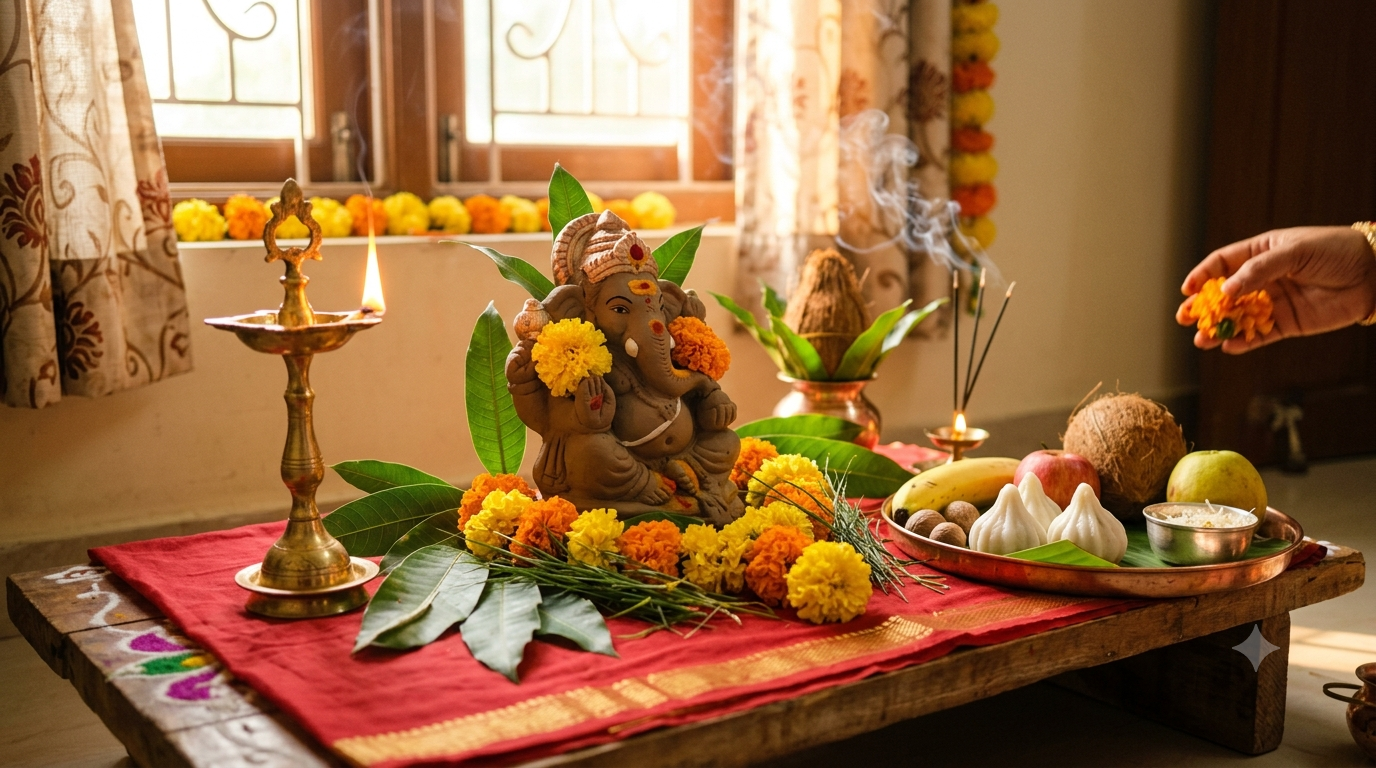
The Vinayaka Chavithi Vratha Kalpam is the traditional step-by-step worship procedure Telugu families follow when they install Lord Ganesha at home and perform the festival pooja. This guide walks you through the full Vinayaka Chavithi Vratha Kalpam for 2026 in simple language, so you can complete the pooja vidhanam confidently without a purohit reading over your shoulder. You will also find the 2026 date and muhurat, the sacred 21 patri (leaves), the naivedyam offerings, the moon-sighting rule most guides skip, and a Telugu PDF you can download and keep.
Temples Map is an independent devotional guide. We are not affiliated with any temple, trust, or government body, and we do not accept bookings, donations, or payments. Please confirm dates and timings on an official panchangam before your pooja.
Vinayaka Chavithi Vratha Kalpam at a Glance
- Festival 2026: Vinayaka Chavithi (Ganesh Chaturthi) falls on Monday, 14 September 2026.
- Sthapana muhurat: the midday (madhyahnam) window, roughly 11:02 AM to 1:31 PM by the New Delhi baseline — confirm your city’s exact timing.
- Immersion: Vinayaka Nimajjanam (Ganesh Visarjan) on Anant Chaturdashi, Friday, 25 September 2026.
- Core ritual: Shodashopachara pooja — sixteen steps of worship offered to Lord Ganesha.
- Special offering: Ekavimsati Patra Pooja, worship with 21 types of leaves.
- Telugu resource: a downloadable Vinayaka Chavithi pooja vidhanam PDF, linked below.
What is the Vinayaka Chavithi Vratha Kalpam?
The Vinayaka Chavithi Vratha Kalpam is the ordered set of prayers, offerings, and mantras used to worship Lord Ganesha on his birthday. “Vratha” means a devotional vow, and “kalpam” means the prescribed method. So the phrase simply describes the correct way to perform the vow at home. Families read it aloud step by step while the pooja is going on.
Ganesha is the son of Lord Shiva and Goddess Parvati. Because he is honoured as Pratham Pujya, the first deity worshipped before any auspicious act, this vratham carries special weight. Devotees believe that a sincere pooja clears obstacles from the year ahead.
Vinayaka Chavithi Vratha Kalpam 2026: Date and Muhurat
In 2026, Vinayaka Chavithi is on Monday, 14 September. The festival opens the ten-to-eleven-day Ganeshotsav, which closes with immersion on Anant Chaturdashi, Friday, 25 September 2026. The Bhadrapada Shukla Chaturthi tithi sets these dates, so they shift every year with the lunar calendar.
The idol installation, or Ganesha Sthapana, should happen during the madhyahnam (midday) period, since that is when the Chaturthi tithi is considered most auspicious for Ganesha. By the New Delhi baseline the window runs about 11:02 AM to 1:31 PM. Muhurat timings change from city to city, though, so check your local panchangam before you fix a time. Andhra Pradesh and Telangana readers should follow a Telugu panchangam for Hyderabad or Vijayawada rather than the North Indian timing.
The moon-sighting rule you should not ignore
Here is a detail many online guides leave out entirely. On Vinayaka Chavithi, tradition says you must avoid looking at the moon (Nishiddha Chandra Darshan). The Puranas tell that Lord Krishna was falsely accused of stealing the Syamantaka jewel because he glanced at the moon on this tithi. Because of this, a stray moon-sighting is said to bring a false accusation or bad name.
If you do see the moon by accident, do not panic. The traditional remedy is to recite the Syamantaka story, or the shloka beginning “Simha prasenam avadhit,” which is believed to cancel the effect. This small piece of the vratham matters deeply in Telugu households, yet most competing pages never mention it.
Vinayaka Chavithi Vratha Kalpam: Step-by-Step Pooja Vidhanam
The Vinayaka Chavithi Vratha Kalpam follows the Shodashopachara method, which means sixteen forms of service to the deity. You do not need Sanskrit fluency to perform it. A calm mind, clean surroundings, and sincere devotion matter far more than perfect pronunciation.
Bathe early and wear clean or new clothes before you begin. Then arrange the pooja space so everything is within reach.
Preparation and Sankalpam
Clean the pooja area and spread a fresh red cloth on a wooden plank (peeta). Place the clay Ganesha idol on it, along with turmeric, kumkum, akshatalu (turmeric rice), flowers, and the patri. Light the deepam and the agarbatti first. Next, do a short achamanam and sankalpam, where you state your name, the date, and your intention to perform the vratham.
Prana Pratishtha and the sixteen upacharas
Invoke the Lord into the idol through Prana Pratishtha, then proceed through the sixteen upacharas in order. Each step is a simple act of hospitality offered to a divine guest.
- Avahanam — inviting Ganesha to be present.
- Asanam — offering a seat.
- Padyam and Arghyam — water for the feet and hands.
- Achamaniyam — water to sip.
- Snanam — a ceremonial bath, often with panchamrutam.
- Vastram and Yajnopavitam — cloth and sacred thread.
- Gandham — sandal paste.
- Akshatalu and Pushpam — turmeric rice and flowers.
- Patra Pooja — the 21 leaves, described below.
- Dhupam and Deepam — incense and lamp.
- Naivedyam — food offerings.
- Tambulam, Neerajanam, and Mantra Pushpam — betel, camphor aarti, and closing flowers.
Finish with the Ganesha aarti and pradakshina, the circular walk around the idol. Then distribute prasadam to everyone present.
The 21 Patri in the Vinayaka Chavithi Vratha Kalpam
This is the step the old version of this article got badly wrong, and it is worth correcting clearly. Lord Ganesha, not Lord Vishnu, is worshipped on this day. Devotees offer him 21 types of leaves, called patri, not “documents.” This offering carries the name Ekavimsati Patra Pooja, and you place each leaf while chanting one of Ganesha’s names.
The 21 patri include maachi patram, brihati, bilva, durvara (garika grass), datura, badari, apamarga, tulasi, chuta (mango), karaveera, vishnukranta, daadimi, devadaru, maruvaka, sindhuvara, jaaji, gandaki, shami, ashwattha, arjuna, and arka. Gathering every single leaf is hard in a city, so families use whatever they can source and substitute the rest with akshatalu. Interestingly, tulasi is normally never offered to Ganesha, yet it is allowed as an exception on Vinayaka Chavithi.
Naivedyam: Modakam and Undrallu
No Vinayaka Chavithi pooja is complete without naivedyam. Ganesha’s most loved offering is modakam, the sweet dumpling. In Andhra Pradesh and Telangana homes, undrallu (steamed rice-and-lentil dumplings) and kudumulu are also offered warm. Many families prepare 21 modakams to match the 21 patri and 21 durva blades.
Alongside the sweets, devotees place seasonal fruits, jaggery, and coconut before the idol. After the pooja ends, everyone shares this prasadam, since a common belief holds that eating it carries Ganesha’s blessing into the home.
Download the Vinayaka Chavithi Vratha Kalpam Telugu PDF
If you would rather read the full procedure in your own language during the pooja, a Telugu PDF makes it far easier. You can keep it on your phone and scroll through each step without losing your place. The download below covers the Vinayaka Chavithi Vratha Kalpam and the pooja vidhanam in Telugu script.
Download the Sri Vinayaka Chavithi Pooja Vidhanam Telugu PDF
Prefer Kannada? A separate Ganesha Chaturthi pooja vidhana in Kannada PDF is available too. For the authoritative step-by-step ritual and the full mantra list, the Drik Panchang Ganesha Chaturthi puja vidhi is a reliable reference.
Was the Festival Really Started by Tilak?
A popular claim says freedom fighter Lokmanya Bal Gangadhar Tilak “started” Ganesh Chaturthi. That is only half true, and the article you may have read before stated it as flat fact. Household worship of Ganesha is ancient and predates Tilak by centuries.
What Tilak actually did, in 1893 in Maharashtra, was transform the private pooja into a large public community festival, the Sarvajanik Ganeshotsav, as a way to unite people during the freedom movement. So he popularised the grand public celebration, while the vratham itself comes from a much older tradition. Getting this right is a small thing, yet it separates an accurate guide from a copied one.
Vinayaka Chavithi Vratha Kalpam: Common Mistakes
Even sincere devotees slip up on a few points every year. A quick checklist helps you avoid them before the pooja begins.
- Fixing the wrong time: installing the idol outside the madhyahnam window because they used a North Indian muhurat instead of a local Telugu one.
- Skipping sankalpam: starting offerings without stating the intention, which the vratham treats as the opening step.
- Forgetting the moon rule: glancing at the moon on Chaturthi night and then worrying needlessly instead of reciting the remedy.
- Rushing visarjan: immersing without a final aarti. Families immerse the idol on day 1.5, 3, 5, 7, or 11, and each choice works.
A Note on Fasting and Health
Many devotees keep a fast (upavasam) on Vinayaka Chavithi until the evening pooja. Fasting is a personal choice, and it is usually gentle.
Still, if you are pregnant, elderly, diabetic, or unwell, do not push through a strict fast. Eat fruit or a light meal, since devotion never requires harming your health. Please consult your doctor before a long fast if you have any medical condition.
Eco-Friendly Celebration
Clay (matti) Ganesha idols are the traditional and greenest choice, because they dissolve cleanly in water. Plaster-of-Paris idols and chemical paints pollute lakes and rivers during Nimajjanam. Many families now immerse a small clay idol in a bucket at home, then water their plants with it. This keeps the ritual intact while protecting local water bodies.
Before You Begin the Vinayaka Chavithi Vratha Kalpam
The Vinayaka Chavithi Vratha Kalpam is simpler than it looks once you have the date, the muhurat, the 21 patri, and the steps in front of you. Install the idol at midday on 14 September 2026, move through the sixteen upacharas with a calm mind, offer modakam, and remember the moon-sighting rule. Download the Telugu PDF so the whole family can follow along.
If you enjoy keeping vrathams through the year, our guide to the Anantha Padmanabha Swamy Vratham with its Telugu PDF follows a similar step-by-step format. The festival season rolls straight on into Navaratri and Durga Pooja soon after, so many families plan both together. For anything time-sensitive, cross-check the muhurat on a trusted panchangam for your own city before you begin.
Frequently Asked Questions
When is Vinayaka Chavithi in 2026?
Vinayaka Chavithi (Ganesh Chaturthi) falls on Monday, 14 September 2026. The festival ends with Vinayaka Nimajjanam on Anant Chaturdashi, Friday, 25 September 2026. Both dates follow the Bhadrapada Shukla lunar reckoning.
What is the correct muhurat for Ganesha Sthapana?
You should install the idol during the madhyahnam (midday) window, about 11:02 AM to 1:31 PM by the New Delhi baseline. Timings shift by city, so confirm the exact muhurat on a local Telugu panchangam for Hyderabad or Vijayawada.
How many leaves are used in Vinayaka Chavithi pooja?
The Ekavimsati Patra Pooja uses twenty-one types of leaves, called patri. You place each patram while chanting a name of Ganesha. If some leaves are unavailable, families substitute akshatalu (turmeric rice) instead.
Can tulasi be offered to Ganesha on this day?
Normally tulasi is never offered to Lord Ganesha, because of a Puranic legend. Vinayaka Chavithi is the one exception, when tulasi may be included among the patri. Practices vary, so follow your family purohit’s guidance.
Why should you not see the moon on Vinayaka Chavithi?
Tradition holds that seeing the moon on this Chaturthi brings a false accusation, based on the Syamantaka jewel story involving Lord Krishna. If you glance at it by accident, reciting the Syamantaka story or the related shloka is the accepted remedy.
What food is offered as naivedyam?
Modakam, the sweet dumpling, is Ganesha’s favourite offering. In Andhra Pradesh and Telangana, undrallu and kudumulu are also offered. Many homes prepare 21 modakams to match the 21 patri and 21 durva blades.
Where can I get the Vinayaka Chavithi Vratha Kalpam in Telugu?
You can download the Telugu PDF linked earlier in this guide and keep it on your phone during the pooja. It walks through the pooja vidhanam step by step in Telugu script. Always cross-check the current year’s date and muhurat on an official panchangam.
How many days does Ganeshotsav last?
Ganeshotsav runs up to eleven days, from Vinayaka Chavithi to Anant Chaturdashi. Households immerse the idol on day 1.5, 3, 5, 7, or 11 depending on family tradition. Tradition treats all of these immersion days as valid.