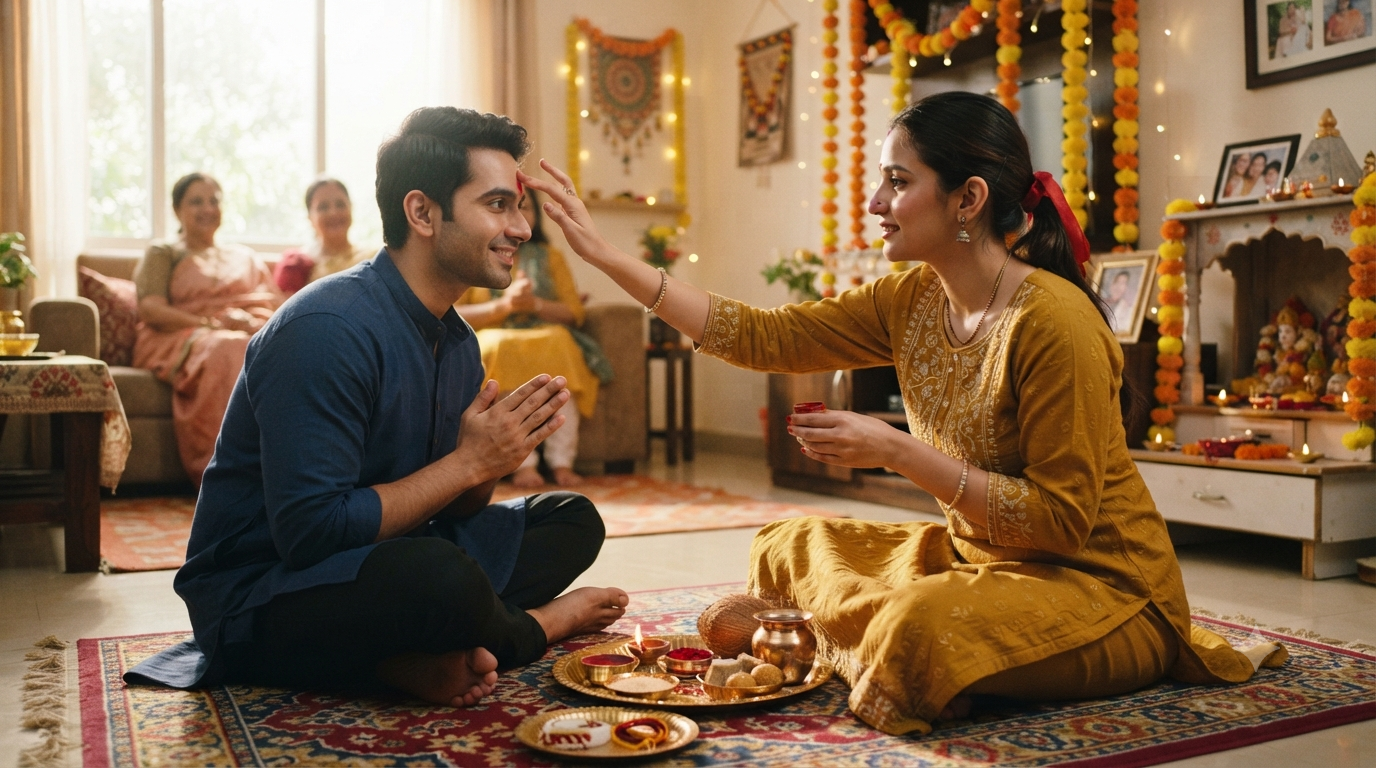
Bhai Dooj 2026 falls on Wednesday, 11 November in India, and the tilak ceremony is traditionally performed during Aparahna while Kartika Shukla Dwitiya is active. For New Delhi, Drik Panchang gives an Aparahna window of 1:10 PM to 3:20 PM. The exact clock time shifts by city, so use a local panchang before fixing a family ceremony.

Independent guide: Temples Map is an independent Hindu festival and temple information website. We are not affiliated with any temple, trust, panchang publisher or government department, and we do not accept bookings, donations or payments.
Quick Facts
- Main date in India: Wednesday, 11 November 2026.
- Tithi: Kartika Shukla Dwitiya.
- Dwitiya begins: 2:00 PM on Tuesday, 10 November 2026.
- Dwitiya ends: 3:53 PM on Wednesday, 11 November 2026.
- New Delhi Aparahna: 1:10 PM to 3:20 PM on 11 November.
- Ujjain reference: Prokerala lists 1:16 PM to 3:28 PM.
- Also called: Bhaiya Dooj, Bhau Beej, Yama Dwitiya, Bhai Tika and Bhai Phota.
Both Drik Panchang and Prokerala place the festival on 11 November 2026. They also agree on the Dwitiya start and end times. Their tilak windows differ by a few minutes because each page uses a different city.
Bhai Dooj 2026 Date and Tilak Muhurat
Bhai Dooj 2026 is observed on Wednesday, 11 November because Dwitiya continues through the relevant afternoon period on that day. Drik Panchang lists 1:10 PM to 3:20 PM for New Delhi. Prokerala lists 1:16 PM to 3:28 PM for Ujjain, which shows why a city name must accompany any muhurat.
| Festival detail | 2026 timing | Planning note |
|---|---|---|
| Dwitiya begins | 10 Nov, 2:00 PM | Same tithi start in both checked sources |
| Dwitiya ends | 11 Nov, 3:53 PM | Tilak should be completed before the tithi ends |
| New Delhi Aparahna | 11 Nov, 1:10-3:20 PM | Drik Panchang location setting |
| Ujjain tilak muhurat | 11 Nov, 1:16-3:28 PM | Prokerala location setting |
If you live outside these cities, do not simply copy either window. Panchang timings depend on local sunrise and longitude, so even nearby cities can differ by several minutes. Therefore, choose your city on a current panchang and use its Aparahna interval.
Is Bhai Dooj on 10 or 11 November 2026?
For India, the main Bhai Dooj observance falls on Wednesday, 11 November 2026. Dwitiya starts during the afternoon on 10 November and remains active until 3:53 PM on 11 November. Since the relevant Aparahna period is available on the 11th, current panchang sources place the festival there.
This distinction matters because some calendar pages list 10 November by looking only at the tithi start. A lunar festival date is not always the civil date on which its tithi begins. Instead, the festival rule and the tithi’s presence during the required period decide the observance.
Why Bhai Dooj 2026 Falls in November
The late 2026 date is not a typo. The Hindu lunar calendar contains an extra Adhika Jyeshtha month in 2026, and that insertion pushes later lunar months forward by roughly one cycle. Drik Panchang shows Jyeshtha Adhika ending in mid-June, while Temples Map’s own current Karthika calendar also reflects the later festival sequence.
That calendar shift is why old October patterns cannot be copied into 2026. If you are planning other observances, see the site’s Karthika Masam 2026 start and end dates and the full Karthika Masam 2026 festival list. Both pages place Yama Dwitiya on 11 November.
What Bhai Dooj Means
Bhai Dooj celebrates the bond between a sister and brother at the close of the Diwali festival sequence. Sisters traditionally welcome their brothers, perform aarti, apply tilak and offer sweets or a meal. Brothers then give gifts or another token of affection, although family customs vary widely across India.
The observance is also called Yama Dwitiya because a well-known tradition connects the day with Yama and his sister Yamuna. According to the story, Yamuna welcomed her brother with affection, food and a ceremonial tilak. Families remember that bond through the sibling ritual rather than treating the story as a literal promise of a particular outcome.
Puja Items You Need
A simple Bhai Dooj thali usually contains the items needed for tilak, aarti and a sweet offering. However, regional and family traditions differ, so you do not need to copy a long commercial checklist. Use your household custom first, especially if elders follow a specific sampradaya.
- A small diya with oil or ghee and a cotton wick.
- Roli, kumkum or another family tilak material.
- Akshat, meaning unbroken rice grains.
- Flowers or a small garland, if used in your home.
- Sweets, fruit or another food offered after the tilak.
- A small water vessel and the family puja thali.
Some homes also use a sacred thread, betel leaf, coconut or other regional items. Since these customs are not uniform, avoid treating any single checklist as mandatory for every family. The essential focus remains the sibling blessing, tilak and shared meal.
How to Perform Bhai Dooj 2026 Puja at Home
Bhai Dooj 2026 can be observed at home with a simple family ritual. The sequence below reflects common practice, while local customs may add or omit steps. If your family has an inherited procedure, follow that tradition rather than replacing it with an online checklist.
- Prepare the space. Clean the puja area and arrange the thali before the chosen muhurat begins.
- Light the diya. Then seat the brother comfortably and keep the puja items within easy reach.
- Perform aarti. Many families circle the light before applying the tilak.
- Apply tilak. Use roli or kumkum, then place akshat according to your household custom.
- Offer sweets or a meal. The shared food is a central part of many Bhai Dooj traditions.
- Exchange blessings and gifts. Brothers commonly give a gift, while both siblings express good wishes.
You do not need to rush through the ritual because a website prints a narrow national time. Instead, check your city and prepare before the local Aparahna interval. That gives the family enough time to perform the ceremony calmly.
Bhai Dooj 2026 Timing by City: What Actually Changes
Bhai Dooj 2026 has one festival date across most of India, yet the clock time is location-sensitive. Sunrise and sunset vary by longitude, so Aparahna also moves. That is why New Delhi and Ujjain show slightly different tilak windows even though both sources agree on the same civil date.
For New Delhi, Drik Panchang gives 1:10 PM to 3:20 PM. For Ujjain, Prokerala gives 1:16 PM to 3:28 PM. Therefore, readers in Mumbai, Hyderabad, Chennai, Kolkata, Bengaluru or another city should change the location on the panchang rather than using a Delhi time without adjustment.
This is also the safest way to handle overseas celebrations. In another time zone, the civil date can shift because the tithi and local day begin at different moments. Always use a panchang calculated for the place where you will perform the ritual.
Regional Names and Customs
The same sibling festival appears under different names across India. Maharashtra and parts of western India often use Bhau Beej, while some Bengali families call it Bhai Phota. Bhai Tika is common in other regional traditions, and Yama Dwitiya appears in many panchang listings.
The core idea remains similar, but the details can change. A family may use a different tilak pattern, meal, prayer or gift custom. Therefore, regional variation should be respected instead of presenting one household procedure as the only correct form.
Common Bhai Dooj Date Mistakes to Avoid
The most common mistake is copying the previous year’s Gregorian date. Hindu lunar festivals move each year, and 2026 is especially easy to misread because Adhika Jyeshtha shifts later months. A second mistake is quoting one city’s tilak muhurat as an all-India time.
- Do not reuse a 2025 or 2022 date for the 2026 festival.
- Do not choose 10 November only because Dwitiya begins that afternoon.
- Do not publish a muhurat without naming the city behind it.
- Do not confuse Bhai Dooj with Naraka Chaturdashi or Govardhan Puja.
- Do not treat a regional ritual item as compulsory for every family.
If you are following the wider Diwali sequence, Temples Map also has a current Naraka Chaturdashi 2026 date and timing guide. Cross-checking the sequence helps prevent one wrong date from shifting every later observance.
What If You Miss the Aparahna Muhurat?
Missing the published Aparahna window does not create a universal emergency rule because household practice differs. First, check whether Dwitiya is still running in your city. Then follow your family tradition or ask a trusted local priest if the ceremony must happen outside the preferred period.
There is no booking, quota or official slot to lose. The muhurat is a traditional timing reference, not a ticketed service. Therefore, avoid websites that turn a family ritual into a paid “Bhai Dooj booking” or claim that only their private service can make the observance valid.
Key Planning Points
Bhai Dooj 2026 is on Wednesday, 11 November, with Dwitiya ending at 3:53 PM. New Delhi’s Aparahna window is 1:10 PM to 3:20 PM, while other cities vary by a few minutes. Use a local panchang, prepare the thali before the window and keep the ritual simple.
Most importantly, do not carry old October dates forward into 2026. The extra lunar month changes the calendar pattern, so current year-specific verification matters. Once the date and local time are correct, follow the custom your family already knows.
Bhai Dooj 2026 FAQs
What is the Bhai Dooj 2026 date in India?
Bhai Dooj 2026 falls on Wednesday, 11 November in India. Drik Panchang and Prokerala both place the festival on that date. The Dwitiya tithi begins on 10 November and continues through the afternoon of 11 November.
What is the Bhai Dooj 2026 tilak muhurat?
For New Delhi, the Bhai Dooj tilak muhurat is 1:10 PM to 3:20 PM on 11 November 2026. Prokerala lists 1:16 PM to 3:28 PM for Ujjain. Since the window changes by city, use your local panchang for the final time.
When does Dwitiya tithi begin and end?
Kartika Shukla Dwitiya begins at 2:00 PM on 10 November 2026 and ends at 3:53 PM on 11 November 2026. Both checked panchang sources agree on these tithi boundaries. Small display differences can still appear because of rounding or location settings.
Why is Bhai Dooj on 11 November and not 10 November?
Dwitiya begins during the afternoon of 10 November, but the relevant Aparahna period is available on 11 November while Dwitiya still prevails. Therefore, current Indian panchang sources place the main observance on the 11th. Looking only at the tithi start can produce the wrong civil date.
Why is Bhai Dooj so late in 2026?
The 2026 Hindu lunar calendar includes Adhika Jyeshtha, an extra month inserted in the lunar cycle. Because of that adjustment, later lunar months and festivals shift forward. This is why copying an October pattern from another year gives the wrong 2026 date.
Does the Bhai Dooj time change from city to city?
Yes. Aparahna depends on the local day length, so the clock window moves with location. New Delhi and Ujjain differ by several minutes in the checked sources, even though both use 11 November as the festival date.
Is Bhai Dooj the same as Bhau Beej or Yama Dwitiya?
They are regional or traditional names for the same broad sibling observance. Bhau Beej is common in western India, while Yama Dwitiya reflects the Yama-Yamuna tradition. Bhai Phota and Bhai Tika are also used in different regions.
Can Bhai Dooj be celebrated if siblings live in different cities?
Families adapt the observance when siblings cannot meet in person. A video call, prayer or later family meal may be meaningful, although customs differ. If you want to follow a formal ritual rule, ask an elder or local priest who knows your family’s tradition.
Is there an official Bhai Dooj booking or paid puja slot?
No universal official booking is required for the home Bhai Dooj ritual. It is primarily a family observance, not a ticketed national ceremony. Be cautious with private pages that imply you must pay them to make the festival valid.