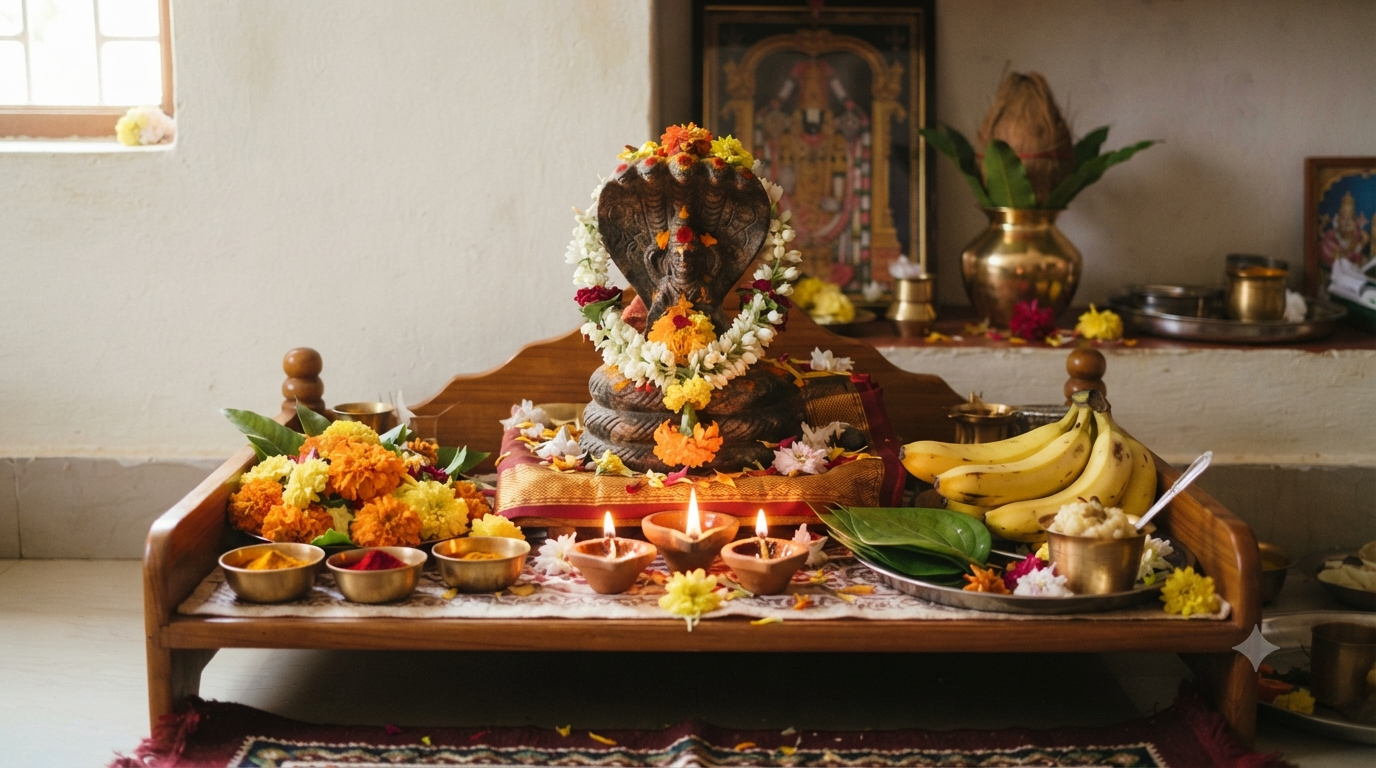
Nagula Chavithi 2026 falls on Friday, 13 November 2026, for Telugu devotees following the Karthika Shukla Chavithi observance. The Chavithi tithi begins at 6:09 PM on 12 November and ends at 8:42 PM on 13 November in Indian panchang calculations. This guide explains the date, puja timing, Telugu customs, and the important 12-versus-13 November confusion.
Temples Map is an independent devotional guide. We are not affiliated with any temple, trust, endowments department, or official body. We do not accept bookings, donations, or payments; use official or established panchang sources for final local timings.
Nagula Chavithi 2026 at a Glance
- Date: Friday, 13 November 2026
- Telugu tithi: Karthika Shukla Chavithi, also called Karthika Suddha Chavithi
- Chavithi begins: 6:09 PM on Thursday, 12 November 2026
- Chavithi ends: 8:42 PM on Friday, 13 November 2026
- Main region: Andhra Pradesh and Telangana, with observance in parts of Karnataka
- Main worship: Naga Devatas, usually through a Naga image, stone icon, temple shrine, or traditional putta worship
- Fasting: followed by many families according to household custom
The Drik Panchang Nagula Chavithi calendar and the Andhra Pradesh daily panchang from TeluguCalendar.org both support this date. Both place Chavithi across the evening of 12 November and most of 13 November.
Nagula Chavithi 2026 Date and Tithi Timings
Telugu families observe the festival on Karthika Shukla Chavithi, the fourth lunar day after Deepavali Amavasya. In 2026, the tithi starts on the evening of 12 November. However, it is still running at sunrise on 13 November, which is why Telugu calendars mark Friday, 13 November as the main observance.
| Detail | 2026 timing | What it means |
|---|---|---|
| Chavithi starts | 12 Nov, 6:09 PM | Tithi begins on Thursday evening |
| Main festival date | 13 Nov, Friday | Chavithi continues through sunrise |
| Chavithi ends | 13 Nov, 8:42 PM | Panchami follows after this time |
Indian panchang sources show these tithi times for the 2026 cycle. Still, sunrise, muhurat, and some city-level calculations can shift by a few minutes. If your family follows a particular panchangam or purohit, keep that local tradition for the final ritual time.
Why do some calendars show 12 November?
Some websites display 12 November because that is the civil date on which Chavithi begins. Telugu festival observance normally considers the tithi present at sunrise, so 13 November becomes the practical festival day in Andhra Pradesh and Telangana. This is a calendar-rule difference, not a second Nagula Chavithi.
The older version of this page listed the 2022 dates, when Nagula Chavithi fell on 28 October. Carrying that date pattern forward would be wrong. Panchang makers calculate lunar tithis afresh each year, especially when the Hindu calendar includes an extra month.
Nagula Chavithi 2026 Puja Timing
There is no single clock time that works for every city because panchang timings depend on location. The safest rule is to perform the puja on 13 November while Chavithi is active and according to your family’s local panchangam. Drik Panchang, for example, gives a Bengaluru puja muhurat of 10:55 AM to 1:13 PM.
That Bengaluru window offers a useful South India reference, but do not copy it as an exact Hyderabad, Vijayawada, Visakhapatnam, or Tirupati muhurat. If your household follows a local temple or priest, use that local timing. The tithi itself remains the more important anchor for the festival date.
Can the puja be done in the morning?
Yes. Many Telugu families complete the main worship after the morning bath and before the midday meal. If your tradition includes fasting, the fast may continue until the family puja is complete. However, customs differ by region and household, so there is no need to treat one internet time slot as universal.
How to Perform Nagula Chavithi Puja at Home
Families can keep Nagula Chavithi worship simple at home. The central idea is reverence for the Naga Devatas and respect for nature, not contact with a live snake. A Naga image, stone icon, framed picture, or established temple shrine is enough for a safe household observance.
- Begin with a bath and clean prayer space. Many families start early because they observe the day as a vratam.
- Place a Naga image or symbolic representation. Use an existing family idol, picture, or stone image rather than bringing in wildlife.
- Light a lamp and offer turmeric and kumkum. Flowers, akshata, fruits, and simple naivedyam may follow.
- Offer food according to family custom. Chalimidi, sesame sweets, jaggery preparations, bananas, or other traditional items vary by household.
- Recite Naga prayers or names. Families may chant the names of Ananta, Vasuki, Shesha, Takshaka, Karkotaka, and other Naga Devatas.
- Pray for family well-being. Married women traditionally observe the vratam for the welfare of children and the household.
- Complete the vratam in the way your family follows. Some break the fast after puja, while others follow a longer fast.
If you visit a temple, follow the shrine’s instructions about offerings. Avoid crowding around anthills or disturbing soil openings, because those places may shelter snakes and other wildlife. A devotional act should not put a person or an animal at risk.
Traditional Offerings and a Snake-Safe Correction
Older articles often say that devotees should pour milk directly into snake pits or make live snakes drink it. That practice deserves a careful correction. Snakes are reptiles, and milk is not part of their natural diet; Wildlife SOS explains that snakes normally drink water and do not digest milk properly.
You can preserve the devotional meaning without handling wildlife. Offer milk symbolically to a Naga idol, stone image, or temple representation if that is your family custom. Keep food offerings on a clean puja plate rather than pushing them into a burrow.
What should you offer instead of feeding a live snake?
Use symbolic offerings that remain within the ritual tradition. Turmeric, kumkum, flowers, lamps, fruit, chalimidi, sesame sweets, and prayers all keep the worship focused on the Naga Devatas. If a temple has a designated offering method, follow that system instead of improvising near a live snake.
This approach also avoids a common festival problem: people gathering around snakes for photographs or close contact. A wild snake should be left alone. If one appears near a home or temple, keep a safe distance and contact the local forest or trained wildlife-rescue service.
Why Nagula Chavithi Is Important in Telugu Tradition
Nagula Chavithi is one of the best-known serpent-worship festivals in Telugu culture. Devotees honour the Naga Devatas as sacred beings connected with fertility, water, agriculture, protection, and the divine stories of Shiva, Vishnu, and Subrahmanya. The festival also reflects an older rural respect for snakes as part of the farm ecosystem.
Many married women observe the vratam while praying for the health and well-being of their children. Some families also connect the worship with Rahu, Ketu, or Sarpa Dosha in astrology. These are matters of religious belief and family tradition, not guaranteed outcomes.
The festival falls inside Karthika Masam, which is why it sits close to several other major observances. For the wider month, see the site’s Karthika Masam 2026 festival calendar. It places Nagula Chavithi on 13 November and Karthika Pournami on 24 November.
Nagula Chavithi 2026 and Naga Panchami Are Different
Nagula Chavithi and Naga Panchami both involve Naga worship, but they are not the same festival. Nagula Chavithi falls on Karthika Shukla Chavithi in the Telugu calendar. Naga Panchami is usually associated with the fifth lunar day and has different seasonal traditions across India.
| Festival | Main tithi | Regional emphasis |
|---|---|---|
| Nagula Chavithi | Karthika Shukla Chavithi | Especially Andhra Pradesh, Telangana, parts of Karnataka |
| Naga Panchami | Shukla Panchami, tradition varies | Observed widely across India |
In the 2026 Telugu Karthika calendar, Nagula Chavithi is on Friday, 13 November, while the following Panchami falls after Chavithi ends. This distinction matters because many search results mix the two names and copy rituals from one festival into the other.
Nagula Chavithi 2026 in Tirumala and Other Temples
Check household Nagula Chavithi and temple festival programmes separately. A family vratam follows the local panchangam, while a temple may publish its own procession or seva schedule. This is especially important at Tirumala, where Tirumala Tirupati Devasthanams may issue a specific notice for the Pedda Sesha Vahanam.
If you are planning Tirumala, use the separate Pedda Sesha Vahanam Nagula Chavithi guide for procession planning. Do not assume a household puja muhurat is the same as a temple vahana timing. Temple schedules can change, so check the official notice close to the event.
Wildlife and Personal Safety on Nagula Chavithi
Nagula Chavithi 2026 can be observed fully without handling wildlife. Do not catch, handle, display, or try to feed a wild snake. India’s Wild Life (Protection) Act, 1972 provides legal protection for wild animals, including scheduled snake species. The safest form of worship is symbolic or temple-based.
Fasting also needs common sense. If you are pregnant, diabetic, taking regular medication, elderly, or prone to low blood sugar, do not attempt a strict fast without medical advice. A modified family observance can preserve the religious meaning without creating a health risk.
What if a snake appears during the festival?
Move away slowly and give the animal space to leave. Do not touch it, block it, or gather a crowd around it. Keep children and pets indoors, then contact the local forest department or a recognised snake-rescue service if the animal remains in a risky location.
What If You Miss the Nagula Chavithi 2026 Puja Time?
Missing a preferred muhurat does not mean you should rush into an unsafe ritual. If Chavithi is still running, complete a simple prayer during the remaining tithi according to your local tradition. If the family’s customary window has passed, ask your family priest how your household normally handles a missed vratam.
Do not copy a timing from another city just to fit a schedule. Panchang calculations depend on location, and family customs can differ even within Andhra Pradesh and Telangana. The practical priority is the correct festival date, the correct tithi, and a respectful worship method.
Before You Observe Nagula Chavithi
For most Telugu families, the key date to remember is Friday, 13 November 2026. The Chavithi tithi starts the previous evening and lasts until 8:42 PM on the festival day. Use a city-specific panchang for the exact puja window, and keep live snakes out of the ritual.
If you are planning the rest of Karthika Masam, the site’s Karthika Pournami date and timings guide covers the next major full-moon observance. Together, these dates help families plan the month without relying on stale 2022 calendars.
Frequently Asked Questions
When is Nagula Chavithi 2026?
Nagula Chavithi 2026 falls on Friday, 13 November 2026 for the Telugu observance. Chavithi begins at 6:09 PM on 12 November and ends at 8:42 PM on 13 November. Since the tithi is present at sunrise on Friday, 13 November is the main festival day.
What is the Nagula Chavithi 2026 puja time?
The exact puja muhurat depends on location. Drik Panchang gives 10:55 AM to 1:13 PM for Bengaluru, while other cities can differ by several minutes. Use your city setting or family panchangam rather than copying one national timing.
Why does one calendar say 12 November 2026?
That calendar is probably using the civil date on which Chavithi begins. The tithi starts at 6:09 PM on 12 November, yet it continues through sunrise on 13 November. Telugu festival practice therefore places the main observance on Friday, 13 November.
What is Nagula Chavithi called in Telugu?
In Telugu, people write Nagula Chavithi as నాగుల చవితి. Telugu families observe it on Karthika Suddha Chavithi, also called Karthika Shukla Chaturthi. The festival centres on worship of the Naga Devatas.
Can I pour milk into a snake pit on Nagula Chavithi?
It is safer not to pour milk into a live snake burrow or force milk on a snake. Snakes do not naturally drink milk, and wildlife organisations warn against such feeding. If milk is part of your family custom, offer it symbolically to a Naga idol or temple image.
Is fasting compulsory on Nagula Chavithi?
No single fasting rule applies to every family. Many married women keep a vratam, but the form of that vratam varies by household and region. Anyone with a medical condition, pregnancy, or medication needs should avoid a strict fast without professional advice.
Is Nagula Chavithi the same as Naga Panchami?
No. Both festivals honour the Naga Devatas, but they fall on different tithis and follow different regional calendars. Nagula Chavithi is especially important in Telugu tradition and falls on Karthika Shukla Chavithi.
Where is Nagula Chavithi mainly celebrated?
The festival is especially associated with Andhra Pradesh and Telangana, and it is also observed in parts of Karnataka. Household customs vary, so offerings, fasting rules, and puja sequences may differ from one region or family to another.