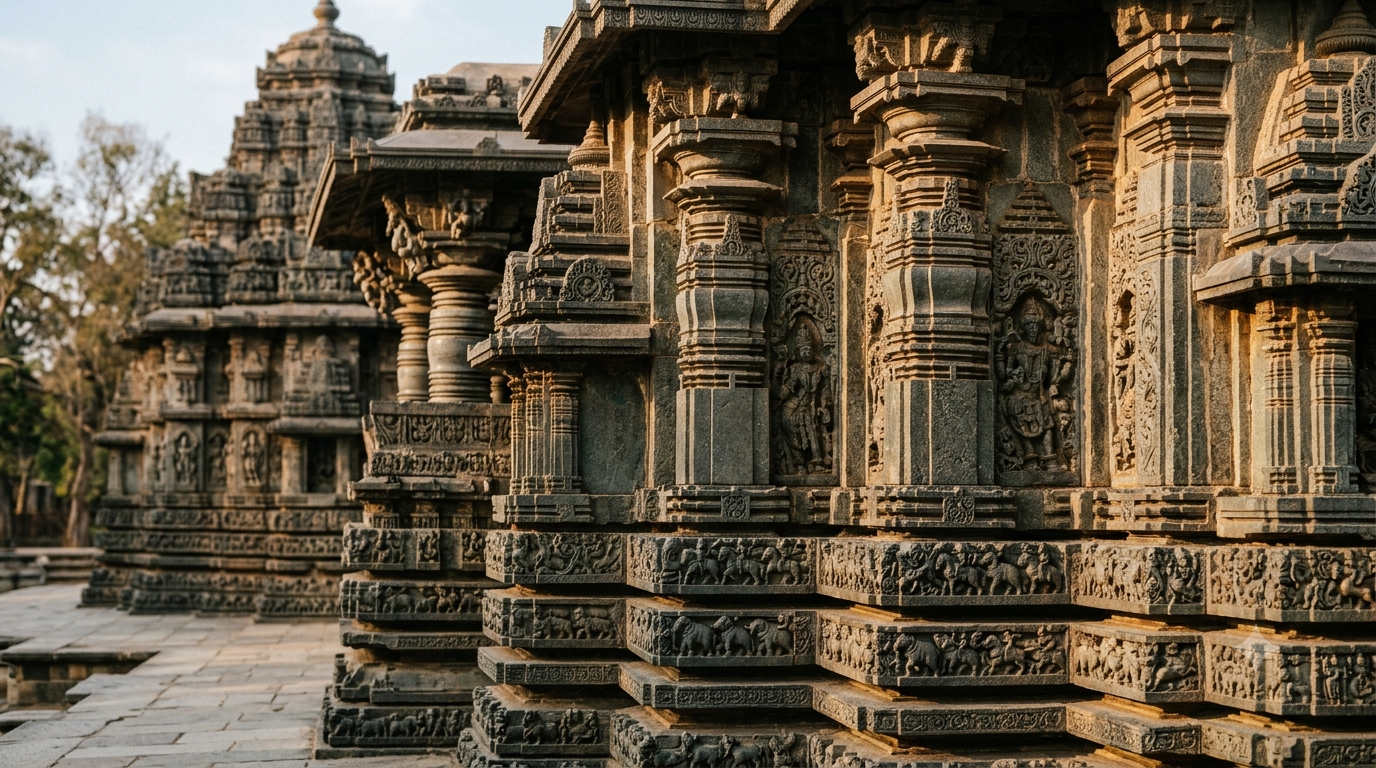
Belur Chennakeshava temple architecture turns a stone building into a gallery of moving figures, complex geometry and stories from Hindu tradition. In Karnataka’s Belur town, its star-like shrine plan and intricate reliefs reveal how Hoysala artists worked. The temple also remains an active place of worship, so visitors encounter both a historic monument and a living sacred space.
Independent guide: TemplesMap is not affiliated with UNESCO, the Archaeological Survey of India or the temple authorities. We do not take bookings, donations or payments; check authorised sources for official visitor information.
Belur Chennakeshava Temple at a Glance
- Location: Belur, Hassan district, Karnataka, near the Yagachi River.
- Principal deity: Chennakeshava, a form of Lord Vishnu.
- Historical foundation: Hoysala king Vishnuvardhana established the temple in 1117 CE.
- Architectural hallmarks: Faceted shrine walls, a raised jagati, sculptural bands, decorated pillars and stone screens.
- World Heritage status: Part of UNESCO’s Sacred Ensembles of the Hoysalas, inscribed in 2023.
- Heritage companions: Hoysalesvara Temple at Halebidu and Keshava Temple at Somanathapura.
What Makes Belur Chennakeshava Temple Architecture Special?
Belur Chennakeshava temple architecture combines an angular sanctuary plan with carved surfaces that unfold as visitors walk around the building. UNESCO identifies the raised platform, layered friezes, narrative sculpture and intricate stonework as defining Hoysala features. The arrangement makes movement around the shrine part of understanding its art.
The exterior does not offer one flat facade. Instead, projecting and recessed wall faces catch light differently, so the sculptures change appearance as you move. Inside, polished pillars and detailed ceilings also add another level of craft. Since plan, light and sculpture work together, Belur becomes more than a collection of decorative carvings.
A Temple Founded Under King Vishnuvardhana
Belur served as an important Hoysala centre, while royal patronage helped turn its principal Vishnu temple into a major artistic project. UNESCO records continuity of worship at Channakeshava from 1117 CE. The Hassan district administration also connects Vishnuvardhana’s patronage with his victories against the Cholas.
The name Chennakeshava means a beautiful or handsome form of Keshava, an epithet of Vishnu. This royal setting also explains why Belur Chennakeshava temple architecture became a statement of Hoysala identity. Older references also use Vijayanarayana for the shrine. Later additions changed the surrounding compound, so not everything visible belongs to the original building phase.
For a wider route covering this region, see our Karnataka temple pilgrimage guide. It places Belur among the state’s other major heritage and worship sites.
Belur Chennakeshava Temple Architecture: Star-Shaped Sanctuary
The temple’s most useful architectural clue lies close to the ground, so begin there. Its sanctum and outer walls form a series of angled projections rather than a plain box. Architects call this a stellate, or star-like, plan. The effect is clearest when you trace the changing outline along the base.
The jagati is a raised platform that follows those contours. This is central to Belur Chennakeshava temple architecture because the walking route repeats the shrine’s changing outline.
It supports the building and creates space to walk around the shrine. Therefore, the platform is not merely a pedestal for viewing the temple from afar. It ties architectural geometry to the experience of circumambulation.
Why the zigzag walls matter
Each projecting face gives sculptors another surface for a deity, frame or band of ornament. Meanwhile, recessed corners deepen the shadows around those figures. As daylight shifts, reliefs gain or lose contrast. That visual rhythm explains why the plan and sculptures should be studied together.
Soapstone in Belur Chennakeshava Temple Architecture
The builders used chloritic schist, a stone commonly called soapstone, while working across varied sculptural scales. UNESCO identifies this material across its three listed Hoysala complexes. Karnataka’s Hassan district administration likewise notes its suitability for intricate carving.
The fine-grained material helped skilled hands shape jewellery, hair, facial features and layered borders. The material is crucial to Belur Chennakeshava temple architecture, yet it does not explain the artistry alone. The carving also demanded planning, patient finishing and close coordination between builders and sculptors.
Look at an ornamented figure from several angles, rather than only from directly in front. Tiny undercuts create strong shadows, while smooth surfaces catch the light. For context on India’s varied building traditions, read our Indian temple architecture explainer.
Belur Chennakeshava Temple Architecture: Outer Wall Sculptures
The exterior is arranged like a gallery, with narrative panels above bands of repeated figures. This makes Belur Chennakeshava temple architecture especially rewarding when you follow the outer walls on foot. UNESCO highlights multi-tiered friezes and themes from religious stories as central to Hoysala design. Rather than treating each image in isolation, first notice how the sections relate.
Lower carved registers include animal processions and ornamental patterns, while larger niches display divine figures and story scenes. The subject matter also draws from Vaishnava and wider Hindu traditions. Because the temple has many later features, avoid assuming every carving shares one date or one patron.
Epics, deities and detailed jewellery
Scenes from the Ramayana, Mahabharata and Puranic traditions appear in the Hoysala sculptural programme. Look for repeated iconographic clues such as attributes, posture and attendant figures. A conch or discus may help identify Vishnu-related imagery, but an individual panel still needs careful reading.
To learn how symbols work across regions, consult our temple iconography and symbolism guide. It explains why a familiar motif can carry different meanings in different settings.
Madanikas in Belur Chennakeshava Temple Architecture
Among Belur’s most admired sculptures are the madanikas, elegant figures set near architectural supports. They give Belur Chennakeshava temple architecture its most recognisable human scale. They appear as dancers, musicians and women in expressive poses, with fine detail in clothing and ornaments. Their placement then turns structural edges into small theatrical stages.
A UNESCO nomination document describes 44 madanikas, including four inside, with the remainder on the outer walls. The Hassan district website gives a broader count of more than 80 madanika sculptures. These sources use different descriptions, so their totals should not be treated as interchangeable.
The mirror-bearing figure and Queen Shantala
The celebrated Darpana Sundari, or woman with a mirror, is often linked in local accounts to Queen Shantala. The Hassan district website presents that identification as tradition, not a proven portrait attribution. Her pose is worth studying for its balance, gesture and carefully modelled jewellery.
Other figures suggest music and dance, while their gestures reward close observation. Rather than inventing a story for every pose, use reputable site material when identifying specific panels.
Belur Chennakeshava Temple Architecture Inside the Hall
Belur Chennakeshava temple architecture continues inside the navaranga, the hall before the sanctum. Stone columns vary in profile and ornament, while the ceiling features carefully worked geometric compositions. The controlled interior light contrasts with the open sculptural walk outside.
Some shafts show a finely turned, polished appearance. Scholars discuss the techniques behind such work, but it is safer not to claim that a particular machine produced every pillar. Study the silhouettes first, then the bands of ornament around their shafts and capitals.
Stone screens, light and the sacred centre
Perforated stone screens, or jalis, filter daylight while preserving decorative detail. Their openings create a changing pattern of bright and dark surfaces across the hall. The transition then leads toward the inner sanctum of Vishnu.
Keep in mind that Belur is a working temple. Prayer and ritual take priority over close photography, while access to particular spaces may change. Follow instructions on site rather than treating the interior as an unrestricted museum.
Belur Chennakeshava Temple Architecture and UNESCO Recognition
UNESCO inscribed the Sacred Ensembles of the Hoysalas in 2023 under criteria (i), (ii) and (iv). The listing covers Belur, Halebidu and Somanathapura as one serial World Heritage property. It does not mean that every Hoysala temple in Karnataka received separate inscription.
The UNESCO announcement praises distinctive planning, intricate sculpture and inscriptions naming artists. It also explains how the Hoysala school adapted older traditions into a recognisable regional style. This matters because the builders were not simply copying one northern or southern template.
UNESCO’s evaluation also recognises the artists’ signatures as an unusual sign of individual craft identity. That detail makes the monuments a record of artistic labour as well as royal patronage.
The Missing Sanctum Tower and Later Gateway
A tall gateway is easy to mistake for the original tower above Belur’s main shrine. They are different elements, so their histories must remain distinct. The present entrance gopuram belongs to a later architectural phase, while UNESCO records the loss of the principal temple’s original superstructure.
The World Heritage decision states that the shrine’s upper tower was dismantled in the late nineteenth century and never rebuilt. Therefore, photographs of the gateway do not reconstruct the missing Hoysala tower. The surviving platform, walls and sculpture still reveal the building’s core design.
Belur, Halebidu and Somanathapura Compared
The three UNESCO temples show related ideas, but they are not identical. Belur retains active worship, while the other two mainly serve as historic monuments. Comparing them helps visitors see how one architectural school developed across different places and periods.
| Site | Main focus | What to study |
|---|---|---|
| Belur: Channakeshava | Vishnu temple; living worship | Bracket figures, hall pillars, faceted walls |
| Halebidu: Hoysalesvara | Shiva temple; non-worshipping monument | Dense wall reliefs and large sculptural panels |
| Somanathapura: Keshava | Vishnu temple; non-worshipping monument | Three-shrine plan and surviving temple towers |
UNESCO’s official heritage gallery offers helpful photographs of platforms, wall sculpture and bracket figures. Use it to compare architectural forms, not as proof of current opening times or visitor rules.
A Sculpture-First Walk Through Belur Chennakeshava Temple Architecture
A good visit begins by viewing the whole building before focusing on a single carved figure. This sequence helps reveal how architectural plan and sculpture reinforce each other. It is an observation route, not an official tour or guaranteed access path.
- Start near the entrance. Distinguish the later gateway from the older shrine beyond it.
- Follow the platform edge. Notice the star-like turns in the jagati and sanctuary walls.
- Read the lower bands. Compare animals, decorative patterns and large narrative panels above them.
- Look upward. Find madanikas beneath the projecting roof edges and note their poses.
- Observe the interior respectfully. Study columns, ceiling and jalis where access permits.
- Finish with the overall silhouette. Notice how the angular plan creates changing outlines from each side.
What Beginners Often Get Wrong
Calling it only Vesara. That broad term can be useful, but it hides the distinctive Hoysala plan and sculptural programme. UNESCO describes a specific Hoysala architectural achievement rather than reducing it to a fixed mixture of two styles.
Confusing sculptural counts. A count of bracket figures is not necessarily a count of every female sculpture in the complex. Compare like with like before repeating a number.
Assuming every tower is original. The gateway and vanished sanctuary tower have different histories. Likewise, the temple compound contains buildings and additions from several phases.
Forgetting worship continues. Quiet observation works better than treating sacred spaces as photo sets. Check access and photography rules locally, since they can change.
Visiting Belur for Architecture
Belur lies about 38 km from Hassan, according to the Hassan district administration. The town is reachable by road, and travellers often pair its temple with Halebidu. Leave ample time for close viewing instead of scheduling only a quick stop.
Wear footwear suitable for walking outside, but follow the local shoe-removal rules in sacred areas. Take water in hot weather, and avoid touching delicate carvings. Because ceremonies and conservation work can affect access, confirm current hours and photography rules with authorised sources before travelling.
Belur Chennakeshava Temple Architecture: Key Takeaway
Belur Chennakeshava temple architecture is best understood as a marriage of geometry, skilled carving and living worship. Begin with the jagati and angled walls, then follow the sculptural bands up to the bracket figures. UNESCO’s documentation provides the historical frame, while the building rewards careful looking at every scale.
Frequently Asked Questions
What style is the Chennakeshava Temple at Belur?
It is a major example of Hoysala temple architecture from medieval Karnataka. Its angled plan, raised platform, dense sculpture and refined stonework distinguish the style. The broad label Vesara does not explain every feature on its own.
Who built the Chennakeshava Temple?
Hoysala king Vishnuvardhana commissioned the temple, whose foundation dates to 1117 CE. Later generations expanded and altered the compound. The monument therefore reflects more than one building phase.
Why is Belur Chennakeshava Temple famous for sculptures?
Its walls and hall display detailed deity panels, narrative carvings, pillars and madanika bracket figures. The designers combined those images with the temple’s changing wall angles. Consequently, architecture and sculpture form one visual experience.
How many madanikas are there in Belur Temple?
A UNESCO nomination document describes 44 madanikas, including four inside the temple. Hassan district’s official tourism page refers to more than 80 madanika sculptures. These different descriptions should not be presented as the same count.
Is Chennakeshava Temple a UNESCO World Heritage Site?
Yes. It is one component of the Sacred Ensembles of the Hoysalas, inscribed by UNESCO in 2023. The other two components are Hoysalesvara at Halebidu and Keshava at Somanathapura.
What stone was used in Belur Chennakeshava Temple?
The builders used chloritic schist, widely called soapstone. It supported highly intricate carved forms, from miniature ornament to larger reliefs. The finished work also reflects the extraordinary skill of Hoysala artisans.
Is the Chennakeshava Temple still used for worship?
Yes. UNESCO describes Belur as a living temple with worship traditions continuing from its foundation. Visitors should therefore respect ritual spaces, current access restrictions and instructions from temple staff.
What is the difference between Belur and Halebidu temples?
Belur’s principal temple honours Vishnu and continues as a place of worship. Halebidu’s Hoysalesvara temple honours Shiva and functions mainly as a historic monument. Both demonstrate Hoysala sculptural excellence, but their layouts and surviving elements differ.