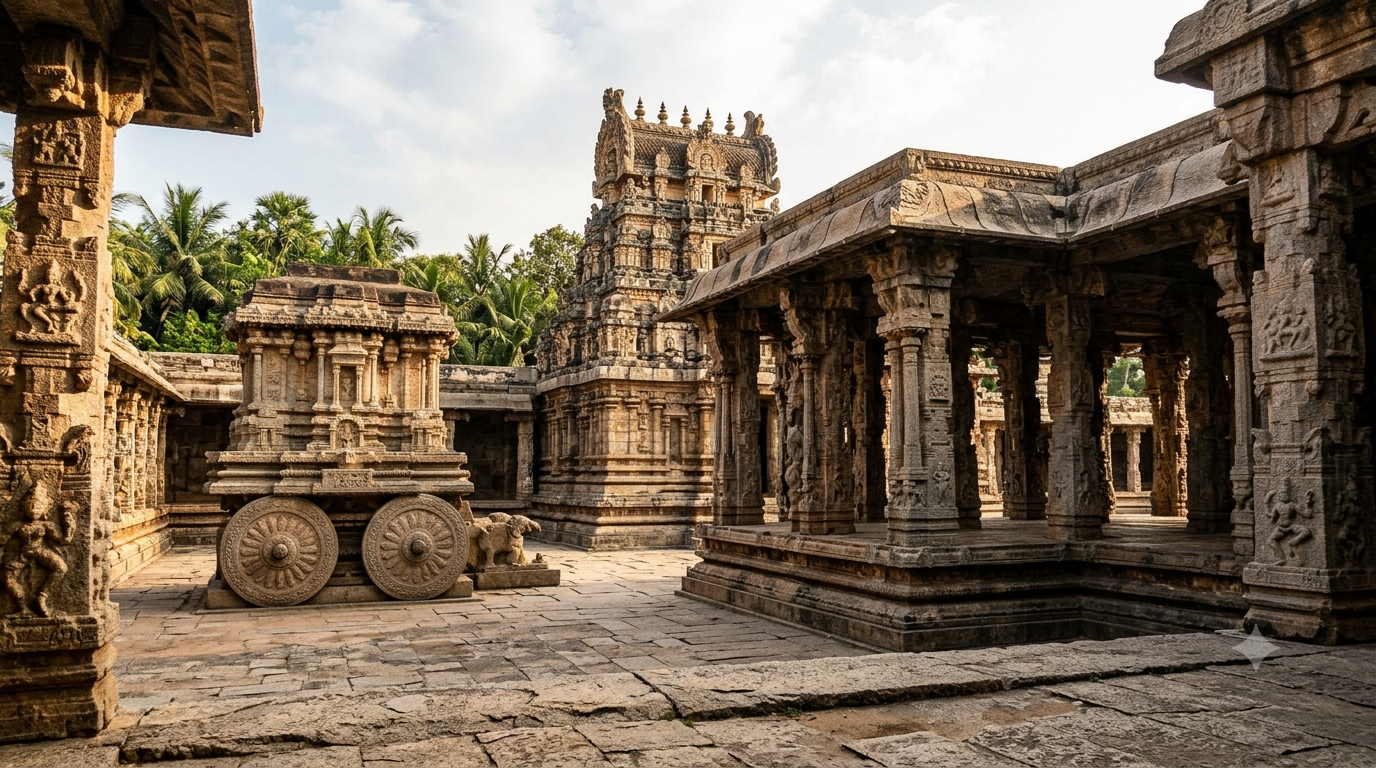
Darasuram Airavatesvarar temple history begins with the Chola king Rajaraja II, who commissioned this Shiva temple in the 12th century. The monument stands near Kumbakonam, but travellers should not rely on an unsourced 28 km distance in older guides. Its carved stone chariot, miniature sculptures and place in a UNESCO World Heritage group explain why it deserves a visit.
Independent guide: Temples Map is not affiliated with the temple, the Archaeological Survey of India or Tamil Nadu’s Hindu Religious and Charitable Endowments Department. We do not accept bookings, donations or payments. Use the official sources linked below for current visitor information.
Darasuram Airavatesvarar temple at a glance
- Location: Darasuram, near Kumbakonam, Thanjavur district, Tamil Nadu.
- Distance from Kumbakonam: Tamil Virtual Academy describes Darasuram as about 5 km west of Kumbakonam. This is a town-location reference, not a measured road journey from the railway station.
- Builder: Rajaraja II of the Chola dynasty, in the 12th century.
- Deity: Lord Shiva as Airavatesvara, also spelled Airavateswarar.
- Heritage status: one of the three Great Living Chola Temples on the UNESCO World Heritage List.
- Temple worship hours: 7:30 am–12:30 pm and 4:00 pm–8:00 pm, according to the Tamil Nadu HR&CE temple listing.
The main reason to visit is the stonework. In fact, Darasuram Airavatesvarar temple history comes alive in its pillars, narrative panels and carefully shaped mandapa. Unlike a temple that impresses mainly through scale, this one rewards close inspection.
Darasuram Airavatesvarar temple history: who built it?
Rajaraja II commissioned the Airavatesvara Temple during the later Chola period. UNESCO attributes the complex to this ruler and identifies it as a major 12th-century achievement. The monument belongs to a time when Chola builders used rich sculpture to add depth and movement to temple architecture.
Darasuram formed part of the historic landscape around Pazhaiyarai, an important Chola centre near Kumbakonam. This royal connection anchors Darasuram Airavatesvarar temple history in a documented regional setting. This setting matters because the temple was not an isolated village shrine. It belonged to a region closely connected with royal patronage, religious life and Tamil art.
The earlier page discussed the temple’s supposed seven streets and courts as settled history. That reconstruction needs more direct inscription evidence than the page supplied, so it is not treated here as a proven surviving plan. What visitors can study today is the standing sanctuary and its distinctive sculptural programme.
Chola-era names in Darasuram Airavatesvarar temple history
Historical accounts connect the site with Rajarajesvaram and Rajarajapuram, names that recall its royal patron. Spellings vary across inscriptions, translations and modern temple records. The familiar name Airavatesvara refers to the temple’s Shiva deity and the associated story of Airavata.
These names do different jobs: one signals the Chola court, while the other expresses the temple’s devotional identity. Keeping both in view helps explain Darasuram Airavatesvarar temple history without confusing a historical name with a legend.
Darasuram Airavatesvarar temple history and UNESCO recognition
UNESCO includes the Darasuram temple within the Great Living Chola Temples, together with the Brihadisvara Temple at Thanjavur and the temple at Gangaikondacholapuram. The original World Heritage inscription dates to 1987. Darasuram and Gangaikondacholapuram joined through the 2004 extension.
UNESCO describes a 24-metre-high vimana, the tower over the sanctuary, and exceptionally refined sculptural decoration. It also recognises the ongoing worship traditions across the three monuments. They are historic structures, yet they remain places of religious life rather than empty archaeological exhibits. Because of this, Darasuram Airavatesvarar temple history connects royal art with present-day worship.
How does Darasuram differ from the other Chola temples?
Darasuram is smaller than the monumental temple at Thanjavur. Its special strength is detail: the Chola artists packed fine figures and stories into pillars, walls and architectural edges. Therefore, a visitor should look closely at individual panels instead of judging the site by tower height alone.
The distinction also explains the UNESCO grouping. The three monuments show different stages and approaches within high Chola architecture. For more background on how scholars read such evidence, see our guide to temple inscriptions in India.
Darasuram Airavatesvarar temple history in stone
The Rajagambhiran Tirumandapam is the feature many visitors remember first. UNESCO notes that its design resembles a chariot, complete with sculpted wheels. Its ornate pillars make the hall look lively even though the whole structure is carved in stone.
Pay attention to the scale of the figures. Some are large enough to define a pillar, while others appear as small narrative scenes. The difference is deliberate: the artists used broad architectural forms and minute details together.
The stone chariot in Darasuram Airavatesvarar temple history
Stand far enough from the hall to understand the chariot outline before you inspect the wheels. From a closer view, the carvings reveal complex forms around the steps and supports. However, do not climb or touch restricted parts for a photograph, since this is a protected heritage monument.
The hall is more than an unusual decoration. It illustrates how Chola artists could make a fixed stone building evoke movement. That is one reason Darasuram Airavatesvarar temple history is also a story about engineering and artistic imagination.
The Nayanmar stories carved in miniature
UNESCO specifically highlights the miniature reliefs relating to the 63 Nayanmars, the Shaiva saints honoured in Tamil devotional tradition. Some scenes carry labels, which help connect the carvings with named lives and stories. These panels link stone art with the wider Bhakti movement. They also give Darasuram Airavatesvarar temple history a human dimension beyond rulers and dates.
Readers interested in history should look at the panels as a sequence of stories, not merely as decoration. Since some figures are small or weathered, visible details may be difficult to identify without an informed guide or scholarly reference.
Deivanayaki Amman and the temple’s layout
A separate shrine honours the goddess Deivanayaki Amman, also called Periya Nayaki. UNESCO notes that this shrine came slightly later than the principal temple. Its separate enclosure shows how goddess shrines became an important part of South Indian temple planning.
Notice that the sanctuary and the goddess shrine serve distinct roles in the complex. The relationship helps explain the development of Chola sacred space, while also reminding visitors that worship continues here.
The Airavata legend in Darasuram Airavatesvarar temple history
Hindu tradition links the temple’s name to Airavata, the white elephant of Indra. In the story, Airavata worships Shiva and regains his original colour after a curse. The deity is therefore called Airavatesvara, or the Lord worshipped by Airavata.
This is a sacred legend, not a verified episode of political history. Both kinds of account matter, although they answer different questions. The Rajaraja II attribution describes the building’s historical patron. The Airavata story explains its religious name and continuing appeal.
Darasuram Airavatesvarar temple history: the gopuram claims
There is no sound basis for claiming that both Darasuram gopurams recently collapsed. The previous article used that alarming wording without a date or supporting conservation report. UNESCO’s heritage assessment instead describes the monuments as preserved and monitored, while the Tamil Nadu HR&CE account refers to a renovated eastern gateway.
Parts of historic temple complexes can show loss, repairs or changes over many centuries. That is different from a newly reported structural collapse. So visitors should not read old descriptions of damaged gateway remains as proof of a recent disaster or present danger. Accurate Darasuram Airavatesvarar temple history separates old architectural changes from fresh conservation reports.
UNESCO explains that the Archaeological Survey of India oversees monument conservation, while Tamil Nadu’s HR&CE Department handles religious administration. Any claim about a new structural incident needs a dated report from the responsible authority.
How far is Darasuram from Kumbakonam?
Darasuram lies close to Kumbakonam. The Tamil Virtual Academy locates Darasuram about 5 km west of Kumbakonam. However, that description does not measure a road journey from Kumbakonam Railway Station or any particular hotel. The earlier article’s 28 km distance lacked a defined starting point and a reliable source, so it should not guide your trip.
There is no single road distance from an entire city. The HR&CE location information refers to the Kumbakonam bus station, not a 5 km measurement from Kumbakonam Railway Station. Therefore, enter Airavatesvara Temple, Darasuram as your destination and check the route from your actual pickup point. This keeps a general location description separate from the distance you will travel.
Distance and transport options
| Starting point | Distance guidance | Practical option |
|---|---|---|
| Kumbakonam town | Tamil Virtual Academy places Darasuram about 5 km west of the town; not a door-to-door road distance | Local bus, auto-rickshaw or taxi |
| Kumbakonam bus station | Check the road route from the bus station; do not substitute a railway-station figure | Local bus, auto-rickshaw or taxi |
| Kumbakonam Railway Station | No verified station-to-temple road distance given here | Check your route before arranging an auto-rickshaw or taxi |
| Thanjavur city | No sourced road distance retained | Check a current route via the Kumbakonam corridor |
The only numerical location reference above comes from the Tamil Virtual Academy, which describes Darasuram in relation to Kumbakonam town. It should not be read as an official road distance from a station. Route length also depends on your pickup point and road choice.
Can you take a train from Kumbakonam to Darasuram?
Darasuram has a local railway stop, but it is not sensible to promise a convenient train for every visit. Service availability and stopping patterns can change, so check the current timetable on Indian Railways’ train enquiry service before relying on rail travel. Do not use the previous article’s unsupported ₹200–₹240 fare.
For such a short local journey, an auto-rickshaw or road connection may be simpler. If you choose a train, check both station names and the onward distance from Darasuram station to the temple. Confirm any fare through the railway’s official channel.
Darasuram temple timings and visitor information
The Tamil Nadu HR&CE temple listing gives worship hours of 7:30 am to 12:30 pm and 4:00 pm to 8:00 pm. It also records a midday closure from 12:30 pm until 4:00 pm. These are the temple’s published worship hours, not a guarantee that every heritage area follows exactly the same access schedule.
The listed hours may change during festivals, maintenance or special ceremonies. Check the official temple page before travelling, especially if darshan is your main purpose. Heritage visitors should also follow signs from monument staff and any directions about restricted spaces. Checking these details first makes Darasuram Airavatesvarar temple history easier to enjoy without disrupting worship.
Is there an entry ticket or online booking?
Historic documentation describes the monument as having no general entry ticket, but current arrangements should be confirmed with the site authorities. This article does not sell admission, arrange darshan or collect payments. If you see a website claiming mandatory booking through a private agent, check the official HR&CE temple page first.
A worship visit and a special paid ritual, if offered, are not the same service. Do not assume either online availability or a particular fee from an undated blog post.
What to notice during a Darasuram visit
- Start with the overall outline. View the vimana and the main hall before moving close to the carvings.
- Examine the chariot-like mandapa. Look for the wheels, steps and the way the supports frame the entrance.
- Study two or three relief panels. Their small scale rewards a slower approach than a quick photograph.
- Look for Nayanmar narratives. These scenes explain how Tamil religious stories became part of the building.
- Respect the active shrines. Allow space for worshippers, and follow staff directions on photography and access.
Set aside roughly an hour if your aim is a relaxed look at the main architecture. A dedicated sculpture enthusiast may prefer longer. Since Darasuram Airavatesvarar temple history survives in tiny panels, a slower visit often gives you more. This is a suggested visit length, not an official tour duration or guaranteed entry slot.
Common mistakes when planning the trip
The biggest mistake is treating every figure on an older travel page as current. A railway fare, a temple closing time and a road distance change for different reasons. Check each one with the organisation that actually controls it.
Another mistake is assuming all World Heritage temples have identical entry rules. UNESCO recognises heritage value, while local monument and worship authorities manage the site. Even the three Great Living Chola Temples can require separate visit planning.
Finally, avoid touching carvings or testing the traditionally described musical steps. Stories about how stone sounds do not grant permission to strike historic surfaces. In warm weather, carry drinking water and take breaks during outdoor sightseeing.
Discovering Darasuram Airavatesvarar temple history from Kumbakonam
Darasuram is unusually convenient for travellers staying in Kumbakonam. Its proximity means a history-focused stop need not turn into a long intercity journey. Yet the temple offers a clear contrast to larger South Indian shrines because so much of its story lives in miniature art.
Our Tamil Nadu temple pilgrimage guide provides wider regional context. If your priority is Chola architecture, visit Darasuram with enough daylight to examine the stone surfaces. If your priority is worship, plan around the official HR&CE timings instead.
Darasuram Airavatesvarar temple history: the lasting lesson
Darasuram preserves the ambition of Rajaraja II’s Chola court in an exceptionally detailed Shiva temple. Its heritage story rests on documented architecture and UNESCO recognition, while the Airavata legend explains its devotional name. The temple is near Kumbakonam, so plan the actual route rather than relying on the older article’s unsupported distance.
Use the official HR&CE listing for worship hours and UNESCO for historical context. Then give the sculptures the time they deserve. The smallest panels often tell the richest stories.
Frequently asked questions
Who built the Airavatesvara Temple at Darasuram?
Chola king Rajaraja II built the temple in the 12th century. UNESCO confirms his patronage and places the complex within the later development of Chola architecture.
How many kilometres is Airavatesvara Temple from Kumbakonam?
The Tamil Virtual Academy describes Darasuram as about 5 km west of Kumbakonam. This is not a verified road distance from the railway station. Check directions from your own departure point; the older 28 km claim had no reliable route reference.
Is Darasuram Airavatesvara Temple a UNESCO World Heritage Site?
Yes. It is a component of UNESCO’s Great Living Chola Temples property. The original inscription was in 1987, and the World Heritage property expanded in 2004 to include Darasuram and Gangaikondacholapuram.
What makes the Darasuram stone chariot special?
The Rajagambhiran Tirumandapam resembles a chariot with carved wheels. Its finely detailed pillars and sculpted forms show the artistic skill of the Chola builders.
What are the official worship hours?
Tamil Nadu HR&CE lists 7:30 am–12:30 pm and 4:00 pm–8:00 pm. Check its official temple page for changes before travelling, since special events may affect access.
Is a direct train from Kumbakonam necessary?
No. Darasuram is nearby, so local road transport is often practical. If you prefer rail, use Indian Railways’ live timetable to confirm which trains currently stop at Darasuram.
Why is the temple named Airavatesvara?
According to Hindu tradition, Airavata, Indra’s white elephant, worshipped Shiva here. The name reflects this sacred story; it should not be confused with the historical evidence for the temple’s Chola construction.
Did the Darasuram temple’s gopurams recently collapse?
No reliable dated evidence supports that claim. Historic wear or older changes to gateway structures are not proof of a recent collapse. UNESCO and the responsible heritage authorities are the proper sources for conservation updates.