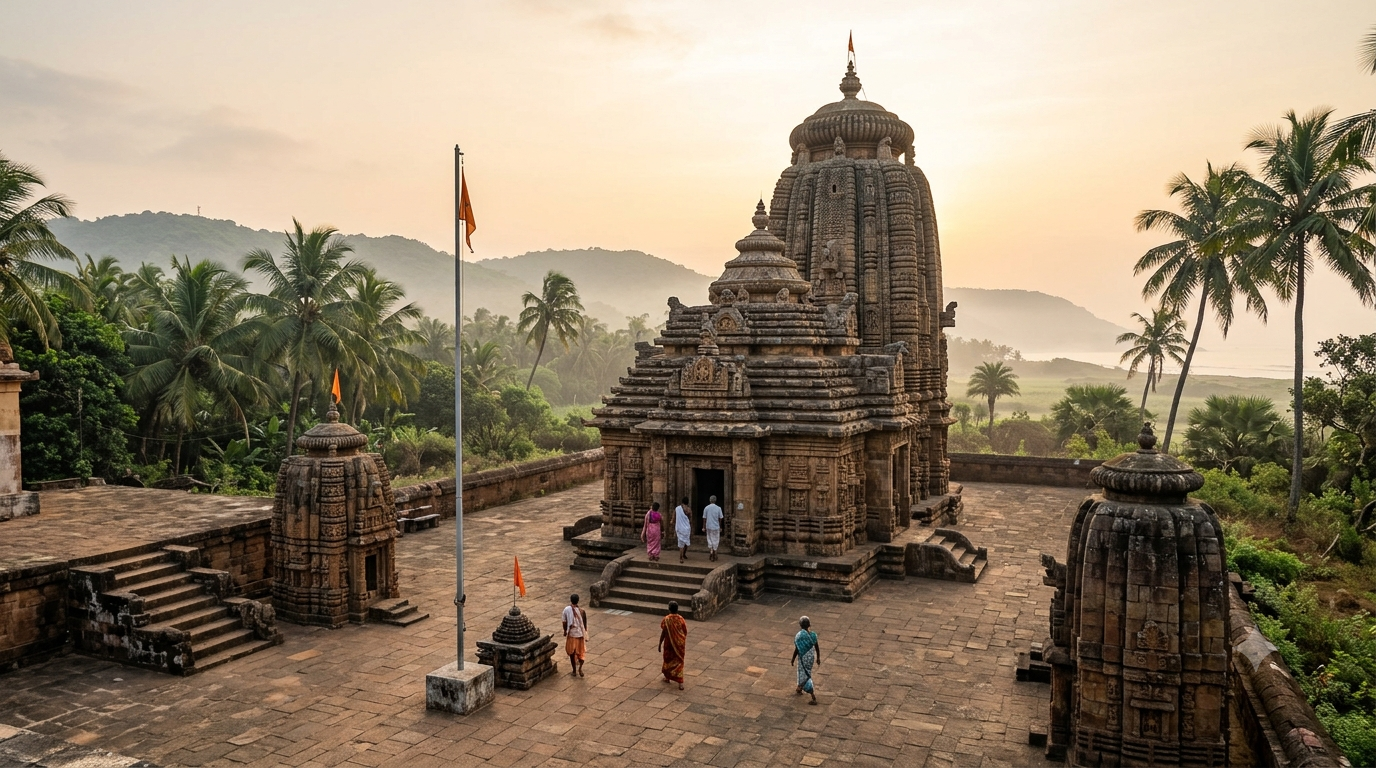
The Alarnath Temple timings run daily from about 6:00 AM to 9:30 PM. The shrine sits roughly 22–25 km from Puri, in Brahmagiri, Odisha. This ancient Vishnu temple draws its biggest crowds during Anavasara. That is the 15-day window when Lord Jagannath rests out of public view before Rath Yatra.
If you are planning a trip from the Jagannath Temple, this guide covers the exact distance, route, darshan schedule, legend, and the famous kheer prasad. You get the details in one place, so you never have to check back with Google. We start with the Alarnath Temple timings, then move on to distance, travel, and the story behind the shrine.
Temples Map is an independent pilgrim guide. We are not affiliated with the Alarnath Temple, the Shree Jagannath Temple, or the Government of Odisha, and this is not their official website. We do not accept bookings, donations, or payments. Please use official channels for any transaction.
Alarnath Temple at a Glance
- Location: Brahmagiri, Puri district, Odisha
- Main deity: Lord Vishnu, worshipped as Lord Alarnath (four-armed, holding conch, discus, mace, and lotus)
- Distance from Puri: roughly 22–25 km by road, about a 40–60 minute drive
- Timings: daily, around 6:00 AM to 9:30 PM (short midday break during rituals)
- Famous for: kheer (rice pudding) prasad and its role during Anavasara
- Peak season: the Anavasara period, roughly mid-June to mid-July
- Entry: free; no advance ticket needed
Alarnath Temple timings and daily darshan schedule
The Alarnath Temple timings are 6:00 AM to 9:30 PM on most days. The shrine also stays open right through the week. Devotees can walk in for darshan across most of that window.
Because priests close the sanctum briefly for rituals, expect a short pause around midday. Another brief pause follows late in the evening. So plan your darshan for the open stretches on either side.
The day starts with Baal Bhoga, an early morning offering. At midday, priests offer the deity rice, dal, vegetable curries, and payasam. At night, the temple serves pitha and khichudi with plantain fry. Since ritual slots shift a little with the season, confirm the exact darshan hours locally on the day you visit.
Overall, the Alarnath Temple timings give you a wide, flexible window for darshan across the day. Even a short visit fits easily into a Puri day trip. You rarely wait long outside the peak Anavasara weeks.
Alarnath Temple Distance and Route from Puri
The Puri Jagannath Temple to Alarnath Temple distance is about 22–25 km by road. The drive usually takes 40 to 60 minutes. The exact figure varies with your starting point.
Some maps measure from the Jagannath Temple, while others start from Puri town or the railway station. Most pilgrims travel along the Puri–Brahmagiri road, a straightforward and scenic route toward the coast.
Here is how Alarnath compares from a few common starting points, so you can plan a combined day trip.
| From | Approx. distance | Drive time |
|---|---|---|
| Puri (Jagannath Temple) | 22–25 km | 40–60 min |
| Sakhigopal | ~15 km | 25–30 min |
| Konark | ~50 km | 75–90 min |
| Bhubaneswar | ~67 km | 90–120 min |
Treat these figures as approximate. Road conditions and traffic near Puri change during festival season. When Rath Yatra crowds fill the city, allow extra travel time. It also helps to check the Puri Jagannath Temple timings and guide so both stops line up on the same day.
How to Reach Alarnath Temple from Puri
Reaching the temple is simple, because Brahmagiri lies on a well-connected road from Puri. You can hire a taxi, share an auto-rickshaw, or take a local bus toward Brahmagiri. The nearest bus stop sits about 1 km from the shrine. So the last stretch is a short walk or ride.
Travelling from farther away is easy too. The nearest railway station is Puri, roughly 22 km away. The nearest airport is Biju Patnaik International Airport in Bhubaneswar, about 76 km from the temple.
From either point, a road transfer through Puri is the usual route, and taxis are simple to arrange. Many visitors first sort out their Puri plan through the Puri Jagannath Temple online darshan booking details, then add Alarnath as a side trip.
Alarnath Temple becomes a major pilgrimage stop during Anavasara. This is the 15-day period after Snana Yatra when the deities rest in seclusion. Devotees believe Lord Jagannath falls ill with a fever and stays out of public view.
Because the main sanctum in Puri closes to darshan, pilgrims come here instead. Tradition holds that Lord Jagannath manifests as Alarnath Dev at Brahmagiri during these days. So devotees treat a visit as spiritually equal to seeing the Lord at Puri.
In 2026, Snana Yatra fell on 29 June. The Anavasara seclusion then ran roughly from 30 June to 15 July, and Rath Yatra took place on 16 July. These dates follow the Hindu lunar calendar, so they shift each year. Before planning an Anavasara visit, confirm the current dates on a reliable panchang such as Drik Panchang or the official temple sources.
History and Legend of Alarnath Temple
The present Alarnath Temple predates the Jagannath Temple at Puri, according to local tradition, and it carries deep Vaishnava roots. Legend says Lord Brahma worshipped Lord Vishnu on this hill. That is why people call the place Brahmagiri, or Brahma’s hill.
Devotees credit rulers linked to the Alwar saints of South India with founding the shrine. The name Alwarnath gradually became Alarnath over the centuries.
The temple also connects to the saint Ramanujacharya and, most famously, to Chaitanya Mahaprabhu. During his stay in Puri, Chaitanya visited the deity every day. When the Jagannath Temple closed for Anavasara, he could not bear the separation. So he travelled to Brahmagiri to see the Lord as Alarnath.
A stone slab in the temple, the Prema Sila, still bears what devotees believe are the impressions of his body. Pilgrims worship it to this day. You can read more temple background on the Alarnatha Mandira reference page.
Inside the compound, you will also find shrines to Lord Krishna’s consorts Rukmini and Satyabhama, a Lakshmi shrine, and a Chaitanya shrine. The main deity of Lord Alarnath is a four-armed form of Vishnu. He holds the conch, discus, mace, and lotus.
The Famous Kheer Prasad
No visit is complete without the kheer, a sweet rice pudding that draws devotees from across Odisha. A beloved legend explains its fame.
One day, while the head priest was away, his young son offered hot kheer to the deity in a hurry. Devotees say Lord Alarnath dipped his fingers into the kheer. They remember the mark of his touch in devotion ever since.
During Anavasara, the kheer bhoga here becomes especially sought after. Because demand runs high on peak days, arrive early if tasting the prasad is a priority for your visit.
Nearby Places Worth Combining
Alarnath sits within easy reach of several other stops, so you can build a rewarding day around it. Sakhigopal, home to a famous Gopinath shrine, lies about 15 km away. Baliharachandi, a Shakti shrine set on coastal sand dunes, sits around 10 km south of Brahmagiri. For a break from temples, Chilika Lake and the dolphin point at Satapada make a scenic add-on.
If you are basing yourself in Puri, the Konark Sun Temple pairs well on the same coastal circuit. A single taxi for the day usually covers Alarnath plus one or two of these stops comfortably. Just start early, since the road can get busy near Puri during peak season. A half-day plan works well for most families, leaving the afternoon free for Puri beach or the main Jagannath darshan.
Best Alarnath Temple timings and tips for your visit
For a calm darshan, the best Alarnath Temple timings are early morning, soon after the shrine opens. Crowds thin out on ordinary weekdays. So a mid-week visit is easier than a weekend one. On Anavasara days, however, the temple sees heavy footfall, and queues can stretch long.
- Dress modestly, as you would for any traditional Odisha temple.
- Carry water and sun protection, since Brahmagiri gets hot and humid in the June–July season.
- Elderly pilgrims and anyone with health concerns should pace the day carefully during peak Anavasara crowds.
- Combine the trip with nearby spots such as Sakhigopal or Baliharachandi to make the most of the route.
Remember that ritual and faith practices here are matters of tradition and devotion. They do not replace medical care. So plan your health needs independently, especially if you are travelling in the summer heat.
During the Anavasara and Rath Yatra season, the Alarnath Temple timings stay broadly the same. Crowds, however, swell dramatically. Because lakhs of devotees converge on the Puri region in these weeks, the shrine can feel packed from morning to night. Even so, the core Alarnath Temple timings do not change, so you simply pick a less busy hour.
Plan an early arrival, keep your group together, and build in extra time for both travel and the darshan queue. Once Jagannath returns to public view at Puri after Anavasara, footfall at Alarnath eases. For a quieter, more reflective visit, the weeks outside this peak window work best.
Before You Go
Alarnath Temple rewards both the casual visitor and the serious pilgrim. Plan for the 22–25 km road trip from Puri. Aim for the early-morning darshan window, and taste the kheer prasad that makes this shrine special.
If your trip falls during Anavasara, treat it as the peak season it is, and prepare for crowds and heat. For anything official — booking, donations, or confirmed festival dates — rely on the official temple and government sources rather than any third-party page. You can start with the Shree Jagannatha Temple official site.
What are the Alarnath Temple timings?
The Alarnath Temple timings are daily from about 6:00 AM to 9:30 PM, with a short break around midday for rituals. The shrine stays open through the week. Confirm the exact darshan hours locally, since ritual slots shift slightly by season.
How far is Alarnath Temple from Puri?
Alarnath Temple is about 22–25 km from Puri by road, roughly a 40–60 minute drive. The distance varies a little, depending on whether you measure from the Jagannath Temple, Puri town, or the railway station. Most pilgrims take the Puri–Brahmagiri road.
During Anavasara, the Jagannath Temple in Puri closes for 15 days while the deities rest. Devotees believe Lord Jagannath manifests as Alarnath Dev at Brahmagiri during this time. So devotees treat a visit here as equal to darshan at Puri when the main shrine stays shut.
What is the special prasad here?
The temple is famous for its kheer, a sweet rice pudding offered to Lord Alarnath. A beloved legend links it to the deity tasting hot kheer offered by a young devotee. During Anavasara, this kheer bhoga becomes especially popular.
Can I visit when Jagannath darshan is closed?
Yes, and that is exactly why many pilgrims come. When the Jagannath Temple shuts for Anavasara, Alarnath Temple stays open for darshan. It offers devotees a way to seek the Lord’s blessings during those 15 days.
How do I get there from Puri?
You can reach Alarnath Temple by taxi, auto-rickshaw, or local bus toward Brahmagiri. The nearest bus stop is about 1 km from the shrine. The nearest railway station is Puri, around 22 km away, and the nearest airport is Bhubaneswar, about 76 km away.
Is there an entry fee at Alarnath Temple?
No, entry to Alarnath Temple is free, and you need no advance ticket. You can simply walk in during darshan hours. As always, confirm any special arrangements locally during festival days.
What is the best time to visit?
Early morning, soon after the temple opens, is the best time for a peaceful darshan. Weekdays outside the Anavasara period stay quietest. If you want to experience the temple at its most vibrant, visit during Anavasara, but expect large crowds.