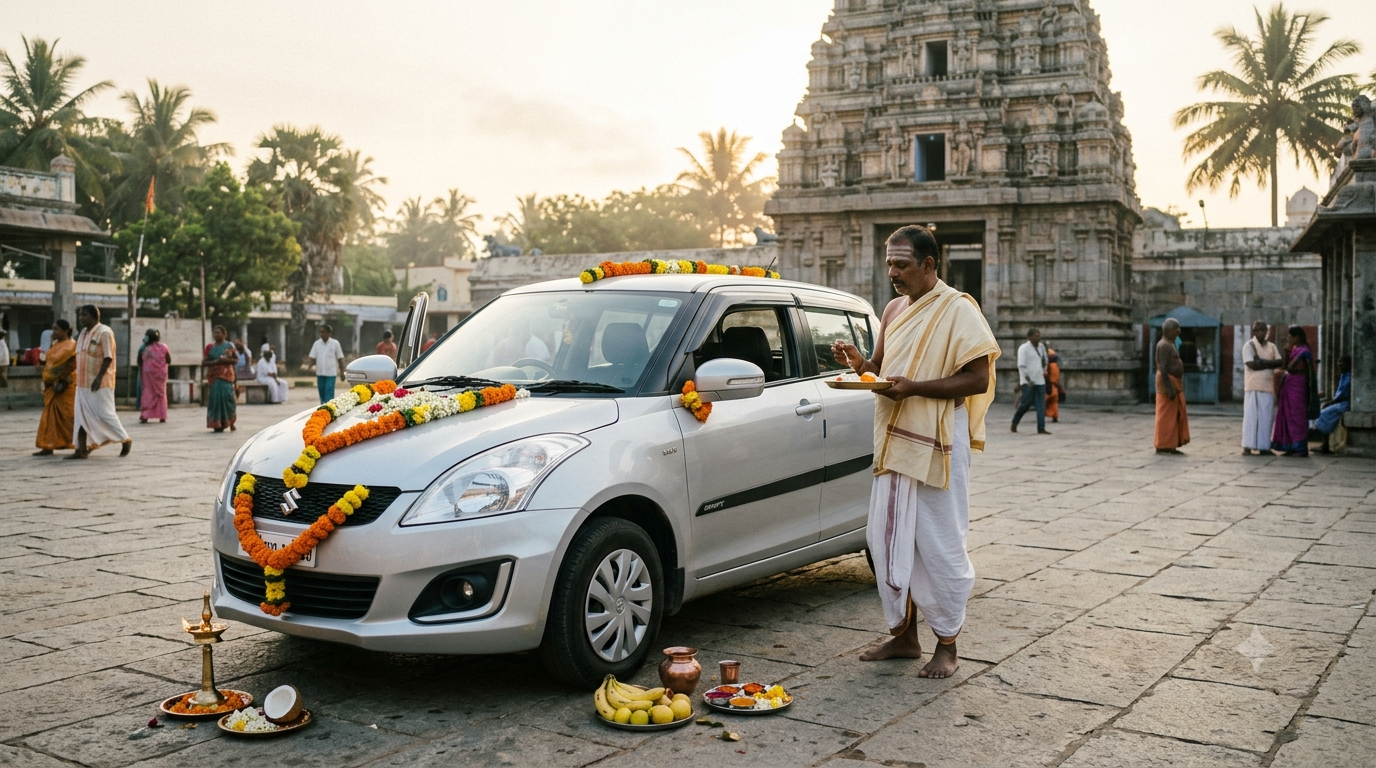
The Kanipakam vehicle pooja does not cost a flat ₹500, and you cannot lock a fixed online slot days in advance. Both claims float around travel blogs, yet neither matches how the temple actually runs it. At the Swayambhu Sri Varasiddhi Vinayaka Swamy Vari Devasthanam in Kanipakam, the vehicle blessing is a simple counter ticket, priced by the type of vehicle you bring.
Because prices are tiered, a scooter owner pays far less than a car owner, while a lorry owner pays a little more. So before you drive down, it helps to know the real cost bands, the timing, and the on-the-ground steps. This guide also flags the common mistakes that push devotees into the wrong queue.
Temples Map is an independent pilgrimage guide. We are not affiliated with, endorsed by, or the official website of the Kanipakam Devasthanam, and we take no bookings, donations, or payments. Please use the official portal linked below for tickets and confirmed details.
Kanipakam vehicle pooja at a glance
- What it is: a short priest-led blessing of your vehicle at Kanipakam’s Ganesha temple, seeking safe journeys.
- Cost: tiered by vehicle type — indicatively around ₹50 for two-wheelers, ₹125 for cars and jeeps, and ₹150 for larger four-wheelers. Confirm the current amount at the seva counter.
- Booking: counter ticket at the temple, on the day. There is no advance online slot for the vehicle pooja itself.
- Best time: morning, during regular darshan hours, when the queue is lighter.
- Bring: a clean vehicle, a coconut, a few lemons, and flowers.
What is the Kanipakam vehicle pooja?
The Kanipakam vehicle pooja is a vahana pooja, a short ritual in which a temple priest blesses your car, bike, auto, or lorry in Lord Vinayaka’s name for protection on the road. Since Ganesha is the remover of obstacles, devotees treat this blessing as an auspicious start for a new vehicle. Many also return before a long trip or during Ayudha Pooja.
Kanipakam sits on the banks of the Bahuda River in Chittoor district, Andhra Pradesh. The temple is famous for its Swayambhu, or self-manifested, idol of Ganesha that devotees believe is slowly growing in size. Because the shrine is linked with truth and justice, it draws lakhs of pilgrims every month, and a vehicle blessing here carries special meaning for them.
Who runs the temple and what the ticket covers
The temple is managed by the Kanipakam Devasthanam under the Andhra Pradesh Endowments Department, which appoints a trust board to run its daily affairs. Because it is a government-administered shrine, seva rates are fixed by the trust and printed on your ticket. The vehicle pooja ticket covers the priest’s archana and harati, while you supply the coconut, lemons, and flowers yourself.
This distinction matters, since it explains why prices stay modest and consistent. For the temple’s official profile and darshan details, you can also refer to the Government of India’s Utsav portal, which lists Kanipakam among the country’s notable shrines.
Kanipakam vehicle pooja cost by vehicle type
The single biggest myth to clear up is the price. Several pages quote a flat “₹500 per vehicle,” but that is not how the Kanipakam vehicle pooja is charged. The temple’s own seva list prices the vahana pooja in bands, so what you pay depends on the vehicle you bring.
| Vehicle type | Indicative cost | Notes |
|---|---|---|
| Two-wheeler (scooter, bike, auto) | ≈ ₹50 | Lowest band; most common at the counter |
| Car / jeep | ≈ ₹125 | Standard four-wheeler rate |
| Larger four-wheeler (van, lorry, bus) | ≈ ₹150 | Highest band for heavy vehicles |
Treat these figures as indicative, because temple trusts revise seva rates from time to time without much notice. As a result, the amount printed on your ticket may differ slightly on the day. Always confirm the current price at the seva counter before you pay, and ignore any third-party site that promises a fixed rate.
Kanipakam vehicle pooja timings
The vehicle blessing runs during the temple’s regular hours rather than in fixed, bookable slots. Kanipakam opens early in the morning and stays open late into the night, so you have a wide window. Still, the priests handle vahana poojas mainly through the forenoon, when the seva counters are busiest and staffing is fullest.
Mornings are the smart choice for two reasons. First, the queue is shorter before the mid-day rush. Second, parking near the temple fills up fast once tour buses arrive. If you plan the Kanipakam vehicle pooja for a weekday morning, you will usually finish quickly and still have time for darshan.
Weekends, Sankata Hara Chaturthi, and the 21-day Brahmotsavam around Vinayaka Chaturthi bring huge crowds. During those periods, timings shift and waits stretch, so check the official portal before you travel.
How the Kanipakam vehicle pooja is performed
The procedure is refreshingly simple, and it happens right at the temple. Here is the usual flow, step by step, so you know what to expect when you arrive with your vehicle.
- Reach the temple with your vehicle. Drive in and park in the designated area near the seva counters.
- Buy the vahana pooja ticket. Go to the seva counter, tell them your vehicle type, and pay the tiered fee.
- Bring the vehicle to the pooja spot. Staff will guide you to the marked area where the priest performs the ritual.
- The priest performs the archana. He chants, offers kumkum and turmeric, and does a short harati for Ganesha’s blessings.
- Break the coconut. A coconut is broken near the vehicle to symbolise the removal of obstacles.
- Collect prasadam. Take the prasadam, then head in for darshan if you wish.
What to bring for the vehicle pooja
Carry a coconut, a few lemons, and flowers, since these are the core offerings for a vahana pooja. Clean your vehicle beforehand, because a washed vehicle is customary for the ritual. Priests generally do not stick kumkum dots directly on paintwork, so do not expect that. If you want lemons placed under the tyres, mention it, although this varies by priest.
Online booking versus the counter: clearing the confusion
This is where most guides get it wrong. They claim you can book the Kanipakam vehicle pooja online in one of “three daily slots,” but the temple does not sell the vahana pooja as an advance online ticket. Instead, you take it at the counter on the day you arrive with your vehicle, which makes sense, because the vehicle has to be physically present.
The official portal at srikanipakadevasthanam.org does handle online booking for other sevas. You can reserve darshan, abhishekams, Ganapathi Homam, Aksharabhyasam, and accommodation there. For the vehicle blessing itself, though, plan to buy the ticket in person. If you want details on the temple’s full seva menu and daily schedule, our Kanipakam temple timings guide lays them out clearly.
Best day and muhurat for the vehicle pooja
In tradition, Thursday is considered especially auspicious for Ganesha-related rituals, and many devotees prefer it for vehicle blessings. Festival days like Vinayaka Chaturthi, Dussehra, and Akshaya Tritiya are also popular choices. By custom, some families avoid Saturday for a new-vehicle pooja, though this is a matter of belief rather than a temple rule.
If you are collecting a brand-new vehicle, pick a day that suits both the muhurat and your travel plan. That said, the temple performs the Kanipakam vehicle pooja on ordinary days too, so you are never forced to wait for a “special” date.
How to reach Kanipakam
Kanipakam is easy to reach, and it pairs well with a wider Tirupati circuit. The village lies about 11 to 12 km from Chittoor and roughly 68 to 70 km from Tirupati, so many pilgrims fold it into a Tirupati–Srikalahasti–Kanipakam trip.
- By road: APSRTC buses run frequently from Chittoor and Tirupati. Well-kept roads and parking make self-drive simple, which suits a vehicle pooja visit perfectly.
- By train: Tirupati is the nearest major railhead, about 70 km away, with wide connectivity across South India.
- By air: Tirupati (Renigunta) airport is the closest, roughly 80 km away, with flights from Hyderabad, Chennai, and Bengaluru.
Other Kanipakam sevas worth combining
Since you are already at the temple, consider adding a seva after the vehicle blessing. The Kanipakam Palabhishekam, where milk is poured over the deity, is among the most loved rituals here. Devotees seeking success in work or business often book the Ganapathi Homam, a powerful fire ritual performed each morning.
Insider tips most guides skip
A few practical pointers can save you time and stress on the day. These come from how the temple actually works on the ground, not from a template.
- Go early on weekdays. Because forenoon slots move faster, you avoid the tour-bus crush after 11 AM.
- Keep small change ready. Counter tickets are cheap, so exact cash speeds things up.
- Park sensibly. Coconut-breaking areas get slippery and busy, so follow the staff’s directions.
- Do not chase a fixed online slot. There isn’t one for the vehicle pooja, so plan a counter visit instead.
- Combine with darshan. Since free Sarva Darshan is available, finish the blessing and then join the darshan line.
One honest note on expectations. A vehicle pooja is a devotional tradition for peace of mind, not a substitute for careful driving, valid insurance, and regular maintenance. Treat the blessing as one part of a safe journey, and keep your paperwork and servicing up to date as well.
The bottom line before you go
The Kanipakam vehicle pooja is quick, affordable, and meaningful, provided you arrive with the right expectations. Remember the tiered pricing rather than a flat ₹500, remember that it is a counter ticket rather than an online slot, and remember to bring your coconut and lemons. Do those three things, reach early, and you will drive home with Ganesha’s blessing and a smooth temple visit behind you.
Frequently asked questions
How much does the Kanipakam vehicle pooja cost?
It is tiered by vehicle type, not a flat fee. Indicatively, two-wheelers pay around ₹50, cars and jeeps around ₹125, and larger four-wheelers around ₹150. Confirm the current amount at the seva counter, since temple rates change periodically.
Can I book the vehicle pooja online in advance?
No. The vahana pooja is a counter ticket you buy on the day, because the vehicle must be present. The official portal does allow online booking for darshan, abhishekams, homam, and accommodation, but not for the vehicle blessing itself.
What are the timings for the Kanipakam vehicle pooja?
It runs during regular temple hours, mainly through the forenoon when counters are fully staffed. Mornings are best for shorter queues and easier parking. Timings shift during festivals and Brahmotsavam, so check before travelling.
What should I bring for the vahana pooja?
Bring a clean vehicle, a coconut, a few lemons, and flowers. The priest handles the archana and harati. You can request lemons under the tyres, though practice varies.
Which day is best for a new-vehicle pooja at Kanipakam?
Thursday and festival days like Vinayaka Chaturthi and Dussehra are popular by tradition. Some families avoid Saturday for new vehicles, as a matter of belief. The temple performs the ritual on ordinary days as well.
Is the vehicle pooja available every day?
Yes, the temple performs vehicle blessings daily during darshan hours. Crowds are heaviest on weekends and festivals, so weekday mornings are calmer and quicker.
How far is Kanipakam from Tirupati?
Kanipakam is about 68 to 70 km from Tirupati and roughly 11 to 12 km from Chittoor. APSRTC buses, trains to Tirupati, and self-drive are all convenient options for reaching the temple.
Do I need documents for the vehicle pooja?
No documents are formally required for the blessing itself. Still, carry your basic vehicle papers as a matter of routine, especially if you are driving a newly delivered vehicle home.
Can the vehicle pooja be done for a lorry or commercial vehicle?
Yes. Larger four-wheelers such as vans, lorries, and buses fall in the highest cost band, indicatively around ₹150. Simply drive the vehicle to the temple, take the counter ticket for its category, and the priest performs the same blessing as for a car or bike.