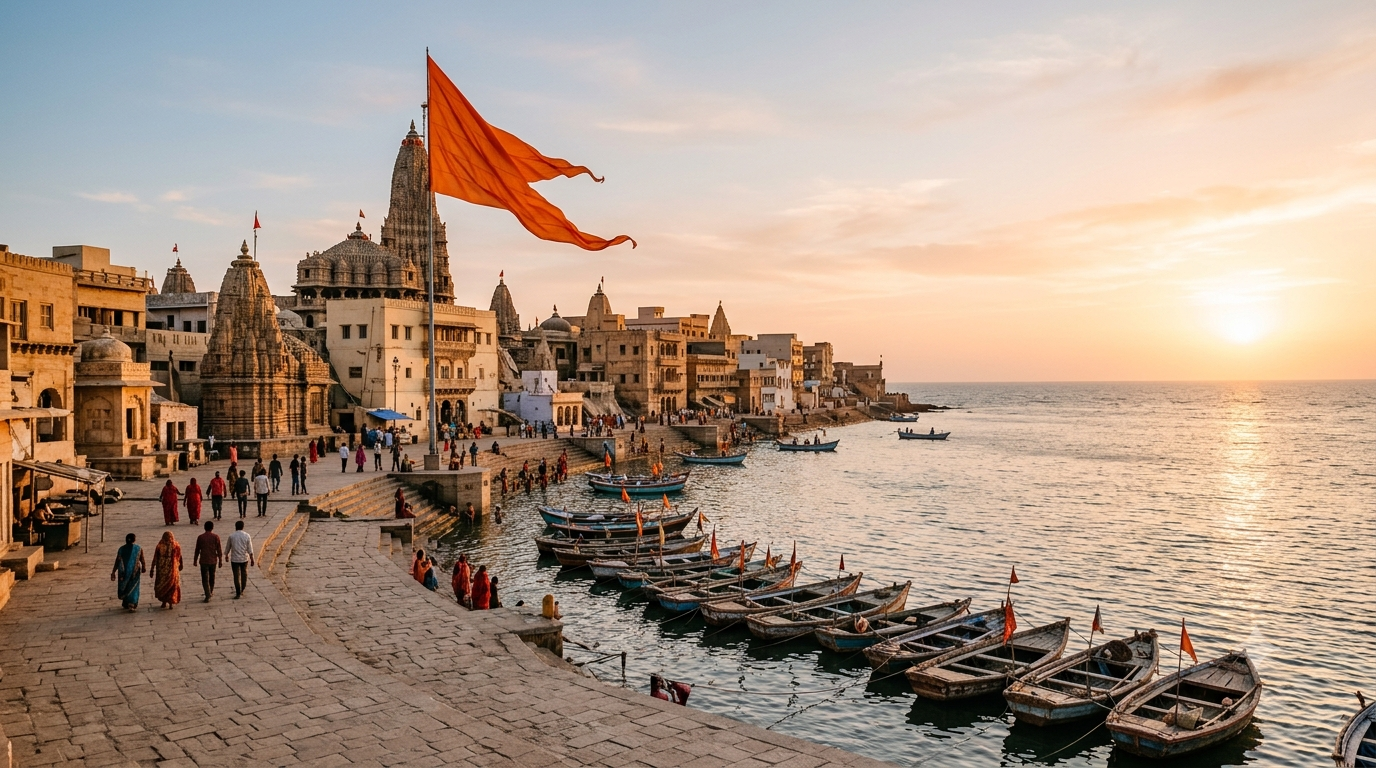
The best time to visit Dwaraka is between October and March, when cool, dry weather makes darshan at the Dwarkadhish Temple and the sea breeze off the Arabian Sea genuinely pleasant. Dwaraka (also spelled Dwarka) sits on the western tip of Gujarat, and its coastal climate swings hard between seasons.
So the month you choose shapes everything, from how long you stand in the darshan queue to whether you can cross to Bet Dwarka in comfort. This guide covers the season-by-season weather, current temple timings, every major attraction, and how to reach the town.
Temples Map is an independent pilgrimage guide. We are not affiliated with, endorsed by, or the official website of the Dwarkadhish Temple or the Devasthanam. We take no bookings or donations. Always confirm live timings and fees on the official temple and Gujarat government portals linked below before you travel.
Best Time to Visit Dwaraka at a Glance
- Best time to visit Dwaraka: October to March (cool and dry); November to February is the sweet spot.
- Main shrine: Dwarkadhish Temple, also called Jagat Mandir, an abode of Lord Krishna.
- Darshan timings: roughly 6:30 AM to 1:00 PM and 5:00 PM to 9:30 PM, with short aarti breaks.
- Entry: free; no advance booking is needed for regular darshan.
- Nearest airports: Jamnagar (around 130 km) and Porbandar (around 100 km).
- Nearest station: Dwarka Railway Station (DWK), about 2 km from the temple.
- Don’t miss: Bet Dwarka via the new Sudarshan Setu bridge, and Nageshwar Jyotirlinga.
Best Time to Visit Dwaraka: Season by Season
Because Dwaraka is a coastal desert town, its comfort level changes sharply through the year. The table below breaks down what each season actually feels like on the ground. It helps explain why the best time to visit Dwaraka lands squarely in the cooler months.
| Season | Months | Weather & experience |
|---|---|---|
| Winter | October–March | Cool 12–28°C days, dry and breezy. The most comfortable window for darshan and sightseeing. |
| Summer | April–June | Hot and humid, often 35–40°C. Coastal humidity makes it feel harsher; early mornings only. |
| Monsoon | July–September | Warm, humid, with heavy spells. Sea can be rough, though the landscape turns green. |
If you want one clear answer, aim for the winter months. During this period the days stay mild, the evenings turn cool, and long temple queues move without leaving you drained by the heat.
Why October to March Is the Best Time to Visit Dwaraka
October to March is the best time to visit Dwaraka because the weather finally cooperates with a pilgrimage schedule. Daytime temperatures settle into a comfortable range, so you can walk between the temple, the ghats, and the beach without wilting. Evenings are cool enough to enjoy the Sandhya aarti and a stroll along Gomti Ghat. Since this is peak season, book your stay a little ahead, especially around weekends and festival dates.
When It Is Not the Best Time to Visit Dwaraka
Summer, from April to June, brings strong heat and sticky coastal humidity. If you must travel then, restrict sightseeing to early morning and after sunset.
Monsoon, from July to September, cools things a little, yet sudden downpours and a choppy sea can disrupt boat trips to Bet Dwarka. That said, the ferry service and the new bridge keep the island accessible even in the rains. Still, for most pilgrims the best time to visit Dwaraka remains the dry winter window.
Best Time to Visit Dwaraka for Festivals and Darshan
The best time to visit Dwaraka for a festival is around Janmashtami, when the whole town lights up for Lord Krishna’s birthday. In 2026, Janmashtami falls on Friday, September 4, though some communities observe it on September 3, since the tithi spans both days. Festival dates shift every year with the Hindu lunar calendar, so always reconfirm closer to your travel date.
Holi, Diwali, and Kartik Purnima also draw big crowds. On Kartik Purnima, thousands take a holy dip in the Gomti river before darshan. Because these dates bring heavy footfall, arrive early and expect longer queues if you visit then.
Dwarkadhish Temple Timings and Aarti Schedule
The Dwarkadhish Temple, also known as Jagat Mandir, opens early and runs in two main sessions with a midday break. Regular darshan is free, and no online ticket is required for standard entry. Photography and videography are not permitted inside the sanctum, so leave the camera in your bag.
The timings below are the schedule commonly followed. However, exact aarti times shift on festival days and by temple administration decisions, so treat these as a guide and confirm on the day.
| Ritual / session | Approximate time |
|---|---|
| Mangala Aarti | 6:30 AM |
| Morning darshan | 6:30 AM – 1:00 PM |
| Shringar Aarti | around 10:30 AM |
| Midday break | 1:00 PM – 5:00 PM |
| Evening darshan | 5:00 PM – 9:30 PM |
| Sandhya Aarti | around 7:30 PM |
| Shayan Aarti | around 8:30 PM |
Best Time to Visit Dwaraka for Daily Darshan
For the calmest darshan, arrive for the Mangala aarti at dawn or just after the temple reopens at 5:00 PM. Both windows carry the most devotional energy, and the crowd is thinner than late morning.
Dwaraka Top Attractions
Dwaraka packs an unusual number of sacred and scenic sites into a small area. Most of the core attractions sit within a couple of kilometres of the main temple, while a few others are a short drive away. Here are the ones worth your time.
Dwarkadhish Temple (Jagat Mandir)
The Dwarkadhish Temple is the beating heart of the town and one of the four sacred Char Dham sites. Its five-storey spire rises about 72 metres above the Gomti creek, crowned by a huge flag that is changed several times a day. The current structure reflects centuries of Chalukya-era and later architecture, so the carving alone rewards a slow look.
Rukmini Devi Temple
About 2 km from the main shrine stands the Rukmini Devi Temple, dedicated to Krishna’s queen. Its intricately carved exterior and the legend behind its separate location make it a meaningful short stop. You can pair it easily with the main darshan; see our guide to the Rukmini Devi Temple darshan timings for details.
Nageshwar Jyotirlinga
Roughly 15 to 18 km from town, Nageshwar Jyotirlinga is one of the twelve sacred Jyotirlingas of Lord Shiva. A towering 80-foot statue of a seated Shiva marks the site, visible from a distance. Since it lies on the road toward Bet Dwarka, most pilgrims combine the two in a single half-day trip.
Bet Dwarka and the New Sudarshan Setu
Bet Dwarka, an island revered as Krishna’s ancient residence, sits about 30 km from Dwaraka town near Okha port. Until recently, pilgrims reached it only by ferry. Now the Sudarshan Setu, India’s longest cable-stayed bridge at 2.32 km, connects Okha to the island.
Prime Minister Narendra Modi inaugurated the bridge on February 25, 2024. Its footpath carries verses from the Bhagavad Gita, so the crossing itself feels like part of the pilgrimage. Ferries still run for those who prefer the traditional boat approach.
Gomti Ghat, Sudama Setu and Panchkui
Gomti Ghat is where the Gomti river meets the sea, and many devotees take a ritual dip here before darshan. From the ghat, the Sudama Setu, a pedestrian bridge named after Krishna’s childhood friend Sudama, leads across the creek to Panchkui Tirth. The walk offers lovely water views, especially in the soft morning light.
Beaches, Bhadkeshwar Mahadev and Gopi Talav
Dwarka Beach near Gomti Ghat is a quiet spot to watch the sunset after temple hours. For something more special, Shivrajpur Beach, about 12 km away, is one of India’s Blue Flag certified beaches, known for clean white sand and clear water. It makes a relaxed half-day break from the temple circuit.
Bhadkeshwar Mahadev is a small Shiva temple set on a rock in the sea, reachable on foot at low tide. Gopi Talav, a serene lake linked to the Gopis of Krishna lore, lies on the Bet Dwarka road. Both add quiet, less-crowded moments to a busy itinerary.
How to Reach Dwaraka
Dwaraka is well connected by rail and road, though it has no airport of its own. Choosing the right route mainly depends on where you start and how much time you have.
By air: The nearest airports are Jamnagar (around 130 km) and Porbandar (around 100 km), according to the Devbhumi Dwarka district administration. Both are small airports with limited flights. Rajkot, about 225 km away, offers more connections. From any of these, taxis and buses run to Dwaraka, with the Jamnagar drive taking roughly 2.5 to 3 hours.
By train: Dwarka Railway Station (DWK) sits on the Ahmedabad–Okha broad-gauge line, only about 2 km from the temple. Direct trains connect it to Ahmedabad, Rajkot, Mumbai, and other major cities. The overnight train from Ahmedabad takes roughly 9 to 10 hours, which makes rail the most convenient option for most pilgrims.
By road: Good highways link Dwaraka to Jamnagar, Rajkot, Porbandar, and Ahmedabad, and state buses serve all these routes. For local sightseeing, hiring a taxi for the day is the easiest way to cover Bet Dwarka, Nageshwar, and Rukmini Temple together. Auto-rickshaws work well for short hops within town.
Insider Tips Most Guides Miss
A few practical habits make a Dwaraka trip smoother. These come from how experienced pilgrims actually plan the visit, not from the brochure version.
- Dress modestly for the temple; cover shoulders and knees, as this is an active place of worship.
- Do the far sites first. Combine Bet Dwarka and Nageshwar in one half-day, then keep the main temple for early morning or evening.
- Carry water and a hat if you travel outside winter, because the coastal sun is stronger than it looks.
- Deposit phones and cameras before the sanctum, since photography is not allowed inside.
- Check tide timing before walking out to Bhadkeshwar Mahadev, as the rock is cut off at high tide.
A brief health note: elderly pilgrims and anyone with mobility concerns should pace the walking between ghats and bridges, and stay hydrated in warmer months. If you plan to fast during a festival, and you have a medical condition, check with a doctor first.
What If the Darshan Queue Is Long?
Regular darshan at Dwarkadhish is not ticketed, so entry is not guaranteed a fixed slot; it simply depends on the crowd. On Janmashtami, Kartik Purnima, weekends, and Ekadashi, queues stretch much longer. If you hit a heavy rush, you have a few sensible fallbacks.
- Return for the evening session after 5:00 PM, when late-morning crowds have thinned.
- Come back for the next day’s Mangala aarti at dawn, usually the quietest window.
- Use the wait to cover nearby sites like Gomti Ghat or Sudama Setu, then re-join later.
There is no official paid queue-jump for standard darshan, so be wary of anyone promising fast-track entry for a fee. When in doubt, ask temple staff on site or check the official portal.
Best Time to Visit Dwaraka: Before You Go
To sum up, the best time to visit Dwaraka is the cool October-to-March window, with November and February the most comfortable. Plan the main darshan for early morning or evening, keep Bet Dwarka and Nageshwar for a half-day trip, and build in extra time around Janmashtami if you want the festival energy. Above all, reconfirm timings and festival dates on the official sources before you set out, since they can change. For authoritative information, see the Gujarat Tourism website and the Devbhumi Dwarka district administration portal.
Frequently Asked Questions
What is the best time to visit Dwaraka?
The best time to visit Dwaraka is October to March, when the weather is cool and dry. November to February is the most comfortable stretch. Summer is hot and humid, while monsoon brings heavy spells and a rough sea.
What are the Dwarkadhish Temple darshan timings?
Darshan is generally open from about 6:30 AM to 1:00 PM and again from 5:00 PM to 9:30 PM, with short aarti breaks. Timings can shift on festival days. Always confirm on the day, as the temple adjusts hours during major events.
Is there an entry fee or online booking for darshan?
Regular darshan is free, and no advance online booking is required for standard entry. Some special sevas may have their own arrangements. For anything ticketed, use only the official temple channels and avoid third-party booking sites.
How do I reach Bet Dwarka now?
You can now drive across the Sudarshan Setu, the cable-stayed bridge that connects Okha to Bet Dwarka, which opened in February 2024. Bet Dwarka is about 30 km from Dwaraka town. Traditional ferries also still operate from Okha jetty.
Is Janmashtami the best time to visit Dwaraka?
Janmashtami is the most vibrant time to visit Dwaraka, though it is also the most crowded. In 2026 it falls on Friday, September 4, while some communities observe September 3. Go then for the festival energy, but book early and expect heavy queues.
How many days do I need for Dwaraka?
Two days is comfortable for most pilgrims. One day covers the Dwarkadhish Temple, Gomti Ghat, and Rukmini Temple, while the second handles Bet Dwarka, Nageshwar Jyotirlinga, and a beach. Add a day if you want a relaxed pace.
What is the nearest airport to Dwaraka?
The nearest airports are Jamnagar, around 130 km away, and Porbandar, around 100 km away. Rajkot airport, about 225 km away, has more flight options. From each, taxis and buses run to Dwaraka.
What should I wear at the Dwarkadhish Temple?
Wear modest, traditional clothing that covers the shoulders and knees. This is an active place of worship, so neat and respectful attire is expected. Comfortable footwear that is easy to remove also helps, since shoes come off before entry.