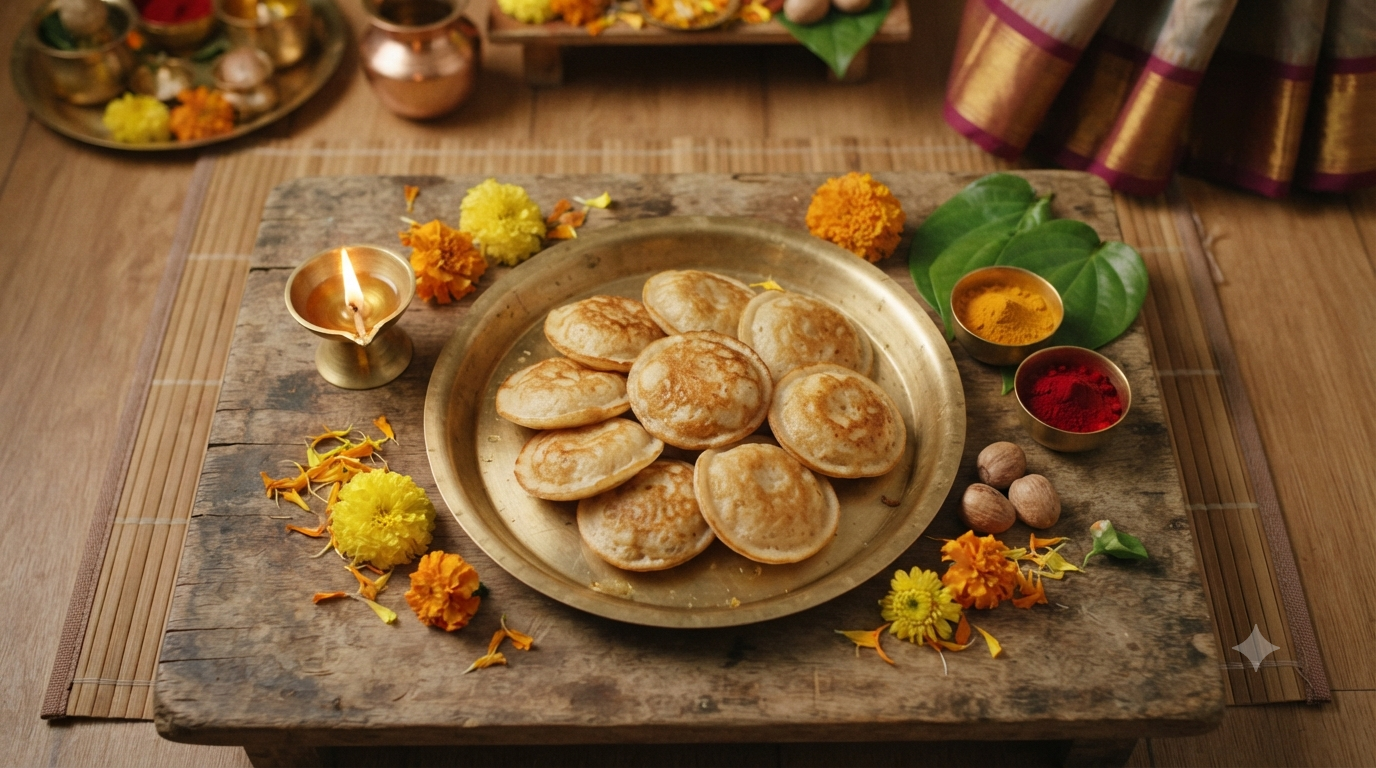
Atla Taddi dosa prasadam is the small atlu offering prepared for Goddess Gowri during the Telugu Atla Taddi nomu, and the recipe is simpler than many older guides make it sound. The key is to follow one batter method consistently, keep the atlu small and soft, and respect your family custom for the number offered.
Temples Map is an independent festival and temple guide. We are not affiliated with any temple, trust, priest, or religious body, and we do not accept puja bookings, donations, or payments.
Atla Taddi Dosa Prasadam at a Glance
- Main offering: small atlu, or mini dosas, offered to Goddess Gowri.
- Traditional base: urad dal with rice flour, or a whole-rice and urad-dal batter in some homes.
- Common count: 10 or 11 atlu, depending on family and regional tradition.
- When offered: during the evening Gowri puja, usually around the moonrise observance.
- 2026 date: Wednesday, 28 October 2026. Moonrise varies by city.
- Best rule: follow the method and count your family has traditionally used.
The most useful correction is also the simplest: rice flour and whole rice are two different batter methods. Do not list rice flour and then instruct the cook to soak that flour like grain. Choose one method from the start, because each needs different preparation.
What Is Atla Taddi and Why Are Atlu Offered?
Atla Taddi, also written Atla Tadde, is a Telugu women’s observance linked with Goddess Gowri. Married women traditionally keep the nomu for family and marital well-being, while unmarried girls may observe it according to family custom. These are matters of faith and tradition, not guaranteed outcomes.
The word atlu refers to dosas or pancakes, so the food offering gives the festival its familiar name. The evening puja often includes Gowri worship, atlu naivedyam, a sacred thread, and vayanam for a married woman. However, the exact count and sequence differ between households.
That variation matters because older web pages often present one household’s practice as a universal rule. In reality, some families offer 10 atlu while others use 11. Follow your mother, grandmother, family priest, or established household tradition when it differs from a general guide.
Atla Taddi 2026 Date and Moonrise Note
Atla Taddi falls on Wednesday, 28 October 2026. Drik Panchang lists the observance on that date for Hyderabad, and its Hyderabad calendar shows moonrise at 7:39 PM. Hindu Calculator also places Atla Taddi on 28 October 2026.
Moonrise is location-specific, so do not copy Hyderabad’s time if you live elsewhere. Check a city-based panchang before the festival evening. You can verify the date and local timings on Drik Panchang’s Atla Tadde calendar and compare the day on the Telugu Panchangam calendar.
This page stays focused on the prasadam recipe rather than turning into a second date-and-muhurtam article. That keeps the search intent clear and avoids mixing the cooking steps with a long panchang discussion.
Atla Taddi Dosa Prasadam Ingredients
For a traditional rice-flour version of Atla Taddi dosa prasadam, use urad dal as the ground base and mix in rice flour after grinding. This method is practical because only the dal needs soaking. It also matches a common Telugu household method used specifically for Atla Taddi atlu.
| Ingredient | Suggested quantity | Purpose |
|---|---|---|
| Urad dal | 1 cup | Gives softness and body |
| Rice flour | 3 cups | Forms the main batter |
| Water | As needed | Adjusts dosa consistency |
| Salt | To taste | Seasoning |
| Ghee or oil | Small amount | For cooking the atlu |
The 1:3 urad-dal-to-rice-flour ratio is a useful starting point, not a religious requirement. Flour brands absorb water differently, so add water slowly. The finished batter should pour easily from a ladle without becoming thin like water.
If your family uses whole rice instead, soak rice and urad dal together or separately, grind them, and follow your usual dosa-batter practice. That is a valid household variation. The important correction is not to confuse the two methods in the same recipe.
How to Prepare Atla Taddi Dosa Prasadam Step by Step
Atla Taddi dosa prasadam can be made with a rice-flour batter in five simple stages: soak the urad dal, grind it smoothly, mix in rice flour, rest the batter, and cook small atlu. Start early enough that the batter has time to settle before the evening puja.
- Soak the urad dal. Rinse 1 cup of urad dal well, then soak it in clean water for about 3 to 4 hours.
- Grind until smooth. Drain most of the soaking water and grind the dal to a soft paste. Add water little by little because a loose paste is harder to correct.
- Add rice flour. Mix in about 3 cups of rice flour. Add salt according to your family practice, then add enough water for dosa-batter consistency.
- Rest the batter. Let it stand for a short period so the flour hydrates evenly. If your family ferments the batter longer, follow that custom.
Cooking the Mini Atlu for Naivedyam
Once the batter is ready, the cooking stage should stay simple. Atla Taddi dosa prasadam is usually made as small atlu, so moderate heat gives you better control than a very hot tawa.
- Heat the tawa. Use a clean, well-seasoned dosa pan over medium heat. A very hot pan can make the small atlu dry before the centre sets.
- Make small atlu. Pour a small ladleful and spread it gently. Atla Taddi atlu are usually smaller than regular breakfast dosas.
- Cook with a little ghee or oil. Add only what you need around the edge. Cook until the surface sets and the bottom develops light colour.
- Set aside the naivedyam portion. Keep the required count on a clean plate before anyone eats from the batch.
For a visual reference to the rice-flour method, TeluguOne Food demonstrates an Atla Taddi batter using urad dal, rice flour, and salt. Treat any cooking video as a recipe reference, though, not as a rule for every family’s nomu.
How thick should the batter be?
The batter should be slightly thicker than a very thin restaurant dosa batter, yet it must still spread without force. If it falls from the ladle in heavy lumps, add a little water. If it runs across the pan immediately, mix in a small amount of rice flour and rest it again.
Medium heat works best because these atlu are small. High heat can brown the base too quickly, while low heat may make them rubbery. Wipe or cool the pan briefly between batches if the batter stops spreading cleanly.
Atla Taddi Dosa Prasadam: Rice Flour vs Whole Rice
Both approaches can produce suitable atlu, but they should not be mixed accidentally. The older version of this page listed rice flour among the ingredients and then told readers to soak rice. That creates confusion because flour needs mixing, while whole rice needs soaking and grinding.
| Method | Preparation | Best for |
|---|---|---|
| Rice flour + urad dal | Soak dal, grind, then mix flour | Faster home preparation |
| Whole rice + urad dal | Soak grains, grind, then rest | Families using regular dosa technique |
Neither method should be called the only authentic one, since household practice varies across Andhra Pradesh and Telangana. Use the version already followed in your family if you know it. When no family method exists, the rice-flour version is easier for a first attempt.
How to Offer Atla Taddi Dosa Prasadam as Naivedyam
Finish the atlu before the main evening offering so you are not rushing during the puja. Keep the prasadam plate separate from the family’s serving plates, and avoid tasting from the naivedyam batch before the offering if that is your household practice.
Place the required number of atlu on a clean plate and offer them during Gowri puja. Many families also include fruit, deepam, turmeric, kumkum, betel leaves, and other items. The exact set is not uniform, so your family procedure should take priority over a generic checklist.
After the puja, the offered atlu become prasadam and may be shared. Some households also prepare a separate vayanam set for a married woman. Because counts vary, do not panic if another family uses 10 while yours uses 11.
How Many Atlu Should You Make: 10 or 11?
There is no single number used by every Telugu household. Ten atlu are common in some family traditions, while eleven appear in others. The same variation can apply to the toram knots and the vayanam set.
This is one of the places where a family elder is more useful than a search result. Ask which count your household has followed in past years. If you are beginning the observance without an inherited custom, consult a trusted local priest or an elder familiar with Telugu nomu practice.
The count is ritual custom, while the recipe itself scales easily. Make a few extra atlu for breakage and for the meal after puja, but keep the intended naivedyam count clearly separated.
Atla Taddi Dosa Prasadam: Common Mistakes to Avoid
Atla Taddi dosa prasadam is forgiving, yet three mistakes cause most kitchen trouble: confusing flour with whole rice, making the batter too thin, and cooking on excessive heat. Fixing those three points gives more reliable atlu than chasing a complicated recipe.
- Do not soak rice flour. Soak urad dal for the flour-based method. Whole rice is soaked only in the whole-rice method.
- Do not make the pan smoking hot. Medium heat gives the small atlu time to cook through.
- Do not over-thin the batter early. Add water in stages because rice flour can loosen as it hydrates.
- Do not assume every family uses the same count. Ten and eleven both appear in household traditions.
- Do not mix the naivedyam batch with casual tasting. Keep the offering plate separate if your custom requires it.
Another common mistake is treating online ritual instructions like a single official manual. Atla Taddi is a living household tradition, so regional and family differences are normal. Clear labeling is better than pretending one version applies everywhere.
Fasting Safety and Practical Planning
Many families observe a fast until the evening moon-related ritual, but fasting practices vary. A strict food-and-water fast can be physically demanding, especially in warm weather. Tradition should not override medical safety.
Pregnant women, elderly devotees, people with diabetes, and anyone taking regular medication should seek medical advice before a strict fast. Do not skip prescribed medicine for a vrat. A puja is a devotional observance, not a medical treatment or a substitute for healthcare.
Practical planning helps, too. Measure the ingredients before noon, soak the dal on time, and keep the puja plate ready before evening. Then you can cook calmly instead of managing batter, moonrise, and ritual items at the same moment.
Other Telugu Festival Guides on Temples Map
If you also observe Gowri-related vrathams, the Kedara Gowri Vratham guide explains its date, fasting rules, and pooja sequence. It is a different observance, so keep its rules separate from Atla Taddi.
For the lunar month that follows, the Karthika Masam dates and pooja guide gives the current Andhra Pradesh calendar. That page is more useful for month-wide planning than an old 2022 festival list.
Before You Prepare the Prasadam
Choose your batter method first, then confirm your family’s customary count of atlu. For 2026, mark Wednesday, 28 October, and check moonrise for your city rather than copying a time from another location. Most importantly, treat family variations as normal instead of as mistakes.
The refreshed recipe fixes the biggest problem in the old version: rice flour and whole rice now have separate instructions. That small distinction makes the cooking steps much clearer, while the ritual notes stay respectful of regional practice.
Atla Taddi Dosa Prasadam FAQs
What is Atla Taddi dosa prasadam?
Atla Taddi dosa prasadam means the small atlu, or dosas, prepared as naivedyam for Goddess Gowri during Atla Taddi. Families commonly make them with urad dal and rice flour or with a whole-rice dosa batter. The offering count varies by household tradition.
Can I use rice flour instead of soaking rice?
Yes. In the rice-flour method, soak and grind the urad dal, then mix rice flour into that paste. Do not soak the flour like whole rice. If your family uses whole rice, follow that separate soaking-and-grinding method instead.
How many atlu are offered for Atla Taddi?
Many families offer 10 atlu, while others use 11. The number can also affect the vayanam set and sacred-thread custom. Since the practice differs by family and region, follow your household tradition rather than changing it to match a website.
Should Atla Taddi atlu be fermented overnight?
Not always. A whole-rice dosa batter may follow a longer fermentation method, while a rice-flour and urad-dal version can use a shorter rest. Climate and family practice also affect fermentation, so use the method that matches your batter.
When is Atla Taddi in 2026?
Atla Taddi falls on Wednesday, 28 October 2026. Panchang sources agree on the date, but moonrise changes by city. Check a location-based panchang on the day before deciding when to complete your evening observance.
Can I prepare the atlu before moonrise?
Yes, many households prepare the naivedyam before the moon-related part of the evening observance so the puja is not delayed. Keep the offering batch clean and separate until the puja. If your family follows a different timing, that custom should take priority.
What if my family uses a different Atla Taddi recipe?
Keep your established family recipe if it has been handed down through your household. Atla Taddi has regional and family variations, so one online recipe should not replace a known custom. Use this guide mainly to avoid ingredient-method confusion and kitchen mistakes.
Is a strict nirjala fast required for everyone?
No single online rule should override health needs. Some families keep a strict fast, while others follow a modified form. Anyone who is pregnant, elderly, diabetic, unwell, or taking medication should seek medical advice before fasting and should never stop prescribed treatment.