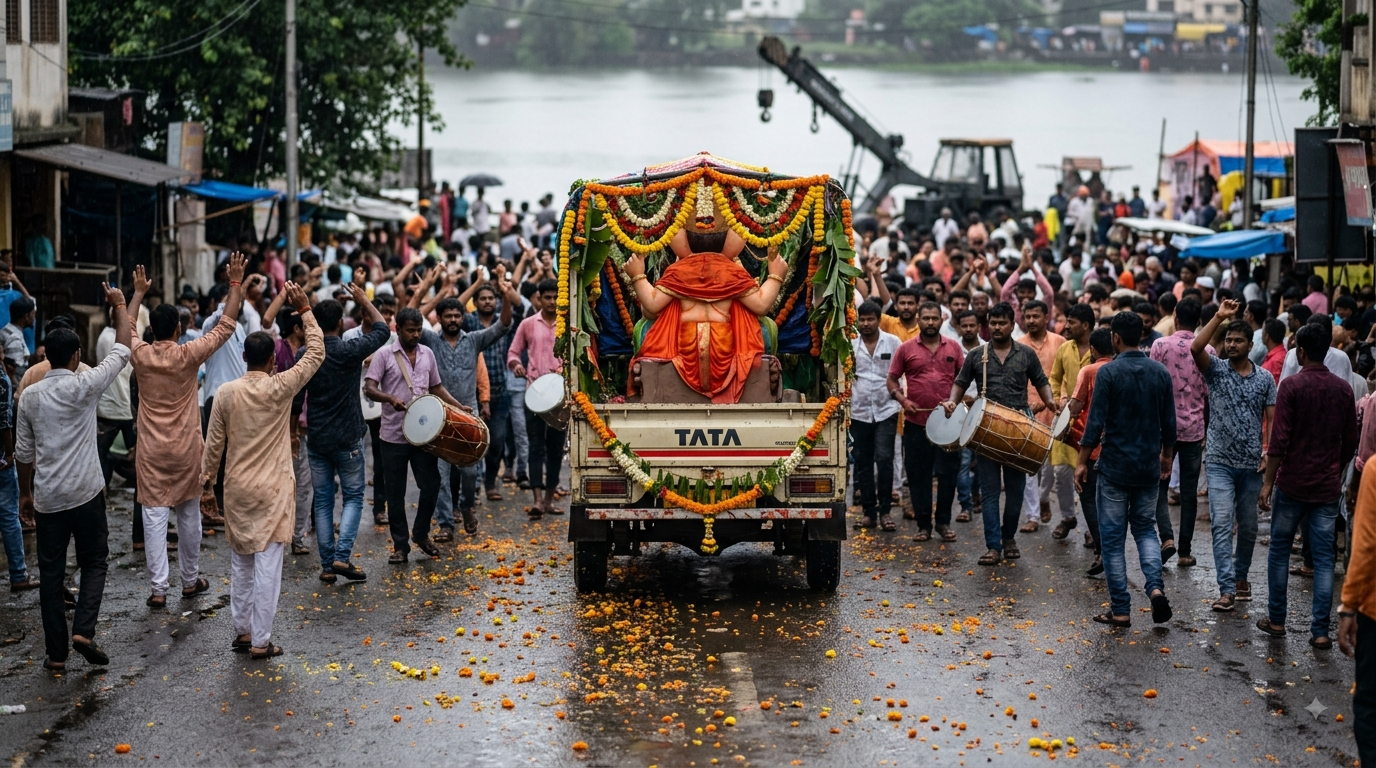
The Ganesh Visarjan 2026 date falls on Friday, 25 September 2026. That is Anant Chaturdashi, the day the long Ganeshotsav finally closes. Most Indian homes never wait that long, though, because families immerse on the 1½, third, fifth, seventh or ninth day instead.
So the useful question is which of those days is yours. This guide lists every Ganesh Visarjan 2026 immersion day with its weekday. It also covers the pond rules that changed since the last festival.
Temples Map is an independent temple and festival guide. We are not affiliated with any temple trust, municipal corporation or pollution control board, and we accept no bookings, donations or payments. Confirm immersion permissions, ponds and timings with your own civic body before you set out.
Ganesh Visarjan 2026 Date and Time at a Glance
- Ganesh Chaturthi 2026: Monday, 14 September 2026 (Bhadrapada Shukla Chaturthi).
- Final Ganesh Visarjan 2026 day: Friday, 25 September 2026, which is Anant Chaturdashi.
- Short observances: 1½ day on 15 September, third day on 16 September, fifth day on 18 September.
- Longer observances: seventh day on 20 September, ninth day on 22 September.
- Telugu regions call the rite Vinayaka Nimajjanam, while Maharashtra says Ganpati Visarjan.
- Most cities now route small idols to artificial ponds rather than lakes or rivers.
Ganesh Visarjan 2026 date for every immersion day
Households pick their immersion day by family custom, not by rule. Because of that, six different dates are all correct. The Ganesh Visarjan 2026 schedule below covers every one of them.
| Immersion day | Date in 2026 | Weekday |
|---|---|---|
| 1½ day | 15 September | Tuesday |
| 3rd day | 16 September | Wednesday |
| 5th day | 18 September | Friday |
| 7th day | 20 September | Sunday |
| 9th day | 22 September | Tuesday |
| 11th day (Anant Chaturdashi) | 25 September | Friday |
Stated plainly: the fifth-day rite is on Friday, 18 September 2026. The ninth-day rite is on Tuesday, 22 September 2026. Big public mandals hold on until Anant Chaturdashi, so 25 September is the day the streets fill.
How the Ganesh Visarjan 2026 date is calculated
Ganesh Chaturthi begins on Bhadrapada Shukla Chaturthi, the fourth day of the bright fortnight. The festival then closes on Chaturdashi, the fourteenth day of that same fortnight. Since the Hindu calendar runs on tithis rather than clock days, those markers do not sit a neat ten days apart.
Why the Ganesh Visarjan 2026 date is 25 September, not 24 September
Count eleven calendar days forward from Monday 14 September. You land on Thursday 24 September. Anant Chaturdashi 2026, however, is verified as Friday 25 September. The gap opens because one tithi stretches across two sunrises that week, so the lunar count runs a day behind the solar count.
This is exactly where older festival articles go wrong. They fix the start date, add eleven days, then publish a closing date that misses by a full day. Always take the Ganesh Visarjan 2026 closing date from a panchang rather than from arithmetic.
Ganesh Visarjan 2026 timings on the day itself
There is no single national visarjan muhurat. Families usually perform the final aarti in the morning and immerse before sunset. Mandals move in procession from late morning onward.
According to Drik Panchang, the Chaturdashi tithi opens in the early hours of 25 September and runs into the early hours of 26 September. So the whole of Friday sits inside it. Check a city panchang for sunrise-linked windows, because these shift by up to an hour between Mumbai and Kolkata.
What Nimajjanam means and why the day count varies
Nimajjanam is simply the Telugu word for the rite that north India calls visarjan. The ritual returns the clay form to water. It marks the truth that everything shaped in this world eventually dissolves.
The number of days is a household decision handed down through families. Some keep the idol for a single night, others for eleven days, and a few temples run a twenty-one-day cycle. At Kanipakam in Andhra Pradesh, for instance, the Vinayaka Brahmotsavam runs for roughly twenty-one days from Vinayaka Chavithi.
Is the Tuesday and Friday rule actually real?
No scripture forbids immersion on a Tuesday or Friday. The belief circulates widely in Telugu-speaking districts, where some families avoid moving the deity out on those two weekdays. Yet it is a regional custom rather than a shastric injunction. Priests in Maharashtra and Karnataka do not apply it at all.
The custom matters this year, because two Ganesh Visarjan 2026 immersion days fall on a Tuesday and two on a Friday. Families who follow it usually shift to the next day instead of the previous one. If your family keeps no such practice, no adjustment is needed.
Where you may legally immerse in 2026
This is the part that has genuinely changed, and most date articles still ignore it. The Central Pollution Control Board issued its Revised Guidelines for Idol Immersion on 12 May 2020. Those guidelines called for natural clay idols and banned Plaster of Paris. A CPCB expert committee then clarified in May 2025 that the guidelines are advisory rather than binding, so states may permit Plaster of Paris immersion under conditions.
Those conditions are strict. Plaster of Paris idols must go into designated artificial tanks or ponds, never into rivers, lakes, natural ponds or the sea. Civic bodies must also lift the deposited material afterwards and send it for recycling. The full text sits on the Central Pollution Control Board website.
Maharashtra: a rule still being decided
The Bombay High Court directed in July 2025 that every idol up to six feet, clay or Plaster of Paris, must go into artificial ponds statewide. Maharashtra then issued a policy on 1 August 2025 allowing larger Plaster of Paris idols into natural water bodies, with removal inside twenty-four hours. Petitioners challenged that policy. As of mid-August 2026 the High Court has reserved its judgment, so Mumbai and Pune households should confirm the final position with their corporation before 14 September.
Telangana and Andhra Pradesh
Hyderabad has moved steadily toward artificial ponds since the Telangana High Court restricted Plaster of Paris immersion in Hussain Sagar. For the 2025 festival the Greater Hyderabad Municipal Corporation opened around 74 artificial ponds alongside twenty major lakes. It also deployed 134 static and 259 mobile cranes at the immersion points, and over two lakh idols went into the water inside city limits. Watch the GHMC notification for the 2026 pond list, since ward allocations change every year.
Immersing at home
A bucket or drum of water at home is a fully valid option for small clay idols. Many families now choose it, because it avoids crowds, traffic and pond queues entirely. Afterwards the clay-rich water goes to garden soil or a potted plant rather than a drain.
How to perform the immersion, step by step
The sequence below suits a home Ganesh Visarjan 2026 as well as a pandal immersion.
- Complete the final Uttarpuja and aarti before you lift the idol, since the deity should not move mid-ritual.
- Offer modak, coconut and fruit, then ask forgiveness for any lapse during the days of worship.
- Pack the nirmalya — flowers, leaves and cloth — separately, because these must not enter the water body.
- Carry the idol out with the face turned toward the house as a mark of respect.
- Immerse gently in the designated pond, drum or tank while chanting the farewell line.
- Hand the collected nirmalya to the civic kalash or bin provided at the site.
If you want the full household ritual text in Telugu, our Vinayaka Chavithi Vratha Kalpam PDF guide sets out the vratha vidhanam in sequence.
What can go wrong on immersion day
Immersion is not a guaranteed, walk-up affair in a large city. Ponds fill, cranes queue and routes close. So it helps to know the failure modes before you leave home.
- The pond is full or shut. Move to the next allotted pond in your ward, since civic helplines publish the fallback list on immersion morning.
- Your idol exceeds the size cap. Larger idols need the crane points rather than neighbourhood ponds, and mandals must register in advance.
- The crane queue is hours long. Hyderabad and Mumbai both run immersions through the night, so a late slot is normal.
- Heavy rain or a route diversion. Traffic police reroute processions at short notice, and their official handle updates faster than any news site.
- You miss your chosen day. Immersing a day later carries no fault, so simply keep the daily aarti going until you can.
Where no pond is reachable at all, a home immersion in a drum is the accepted alternative. Never immerse in a storm drain, a canal or an unfenced lake. That is both unlawful in most cities and genuinely dangerous.
Safety notes worth reading first
Drowning is the single biggest risk of the day, and it rises after dark. Never enter deep water to push an idol out, because platforms and cranes exist so nobody has to. Keep children away from the water edge and let trained civic swimmers handle anything heavy.
Processions also mean long hours of standing, loud sound systems and September heat. Carry water and any regular medication, especially if elderly relatives are joining. Anyone with a heart or respiratory condition should avoid the loudest stretches of the procession.
Points most immersion guides miss
Buy the clay idol early, because genuine shadu-clay stock thins out in the fortnight before Chaturthi. Ask the artisan directly whether the paint is natural, since a clay body with chemical paint still pollutes the water.
Weigh the idol before you commit to a height. A five-foot clay idol is far heavier than a Plaster of Paris one of the same size. Note too that Pitru Paksha begins soon after Anant Chaturdashi, which is why many families finish auspicious purchases first. Our guide to the Mahalaya Pitru Paksha dates explains that overlap.
Before You Go
Lock your immersion day first, then work backwards from it. Anant Chaturdashi on 25 September 2026 is the headline date. Yet the third and fifth days, on 16 and 18 September, will carry most household immersions.
Confirm the closing date on a panchang rather than counting forward, because tithi and calendar drift apart this year. Then check your ward’s pond list a week ahead, since that one step removes most of the day’s stress. Devotees driving to a temple afterwards may also want our note on Kanipakam vehicle pooja timings and procedure.
Frequently Asked Questions
What is the Ganesh Visarjan 2026 date in India?
The final Ganesh Visarjan 2026 date is Friday, 25 September 2026, which falls on Anant Chaturdashi. Households that keep the idol for shorter periods immerse earlier, on 15, 16, 18, 20 or 22 September. Public mandals almost always immerse on 25 September.
When is Ganesh Chaturthi 2026?
Ganesh Chaturthi 2026 is on Monday, 14 September 2026. The sthapana happens during the madhyahna window, which sits roughly between 11:00 AM and 1:30 PM in most Indian cities. Confirm the exact minutes for your location on a city-specific panchang.
What is the 3rd day Vinayaka Nimajjanam date in 2026?
The third-day immersion falls on Wednesday, 16 September 2026. Counting starts from the sthapana day itself, so day one is 14 September. Many Telugu households pick this day because it fits a working week comfortably.
Can I immerse a Ganesh idol at home?
Yes, home immersion in a bucket or drum is fully accepted for small clay idols. Pollution control guidelines actively encourage it. Use the leftover clay water on plants or garden soil instead of pouring it into a drain.
Are Plaster of Paris idols allowed for Ganesh Visarjan 2026?
It depends on your state. The CPCB expert committee clarified in 2025 that its guidelines are advisory, and states may allow Plaster of Paris immersion only in designated artificial ponds. Immersion of such idols in rivers, lakes and the sea stays barred, while Maharashtra’s final rule remains before the Bombay High Court.
Why is Ganesh Visarjan done on Anant Chaturdashi?
Ganeshotsav opens on Bhadrapada Shukla Chaturthi and runs to Chaturdashi in the same bright fortnight. The immersion therefore lands on Anant Chaturdashi, a day otherwise dedicated to Vishnu in his infinite form. Both observances share the date without replacing each other.
Is immersion on Tuesday or Friday inauspicious?
No text prohibits it, though the belief is common in parts of Andhra Pradesh and Telangana. Families who follow it usually shift the immersion to the next day. Elsewhere in India the weekday carries no weight at all.
What should be done with flowers and decorations after Ganesh Visarjan 2026?
Collect the nirmalya separately, then hand it to the civic collection point at the site. Flowers, thermocol and plastic must never enter the water, since they cause most post-festival pollution. Many corporations compost the collected nirmalya afterwards.