The best places to visit in Vijayawada sit within a 40 km radius of the railway station. The city therefore works far better as a trip than its reputation suggests.
Most guides still open with Kanaka Durga Temple and stop three names later. Yet the Krishna River cuts through the Indrakeeladri hills here. You also get four sets of rock-cut caves, a 14th-century fort and a river island.
This guide covers the real timings, indicative costs and the closing days that quietly ruin itineraries. It also corrects two errors that most listings on places to visit in Vijayawada still repeat word for word.
Temples Map is an independent travel guide. We are not affiliated with Sri Durga Malleswara Swamy Varla Devasthanam. Nor are we linked to the Archaeological Survey of India or Andhra Pradesh Tourism. This is not their official website.
Because we accept no bookings, donations, or payments, please use the official portals linked below for tickets and current timings.
Places to Visit in Vijayawada at a Glance
- Where: NTR district, coastal Andhra Pradesh, on the banks of the Krishna River.
- Getting there: Vijayawada Junction is a major rail hub, while Gannavaram airport sits about 20 km out.
- Time needed: one day covers the city core, although two days let you add Kondapalli and Amaravathi.
- Best season: November to February, because summer here regularly crosses 40°C.
- Getting around: autos and app cabs work well, since most sights fall inside a 15 km ring.
- Watch out for: a long midday temple break, a Friday museum closure and a Tuesday hill closure.
The Best Places to Visit in Vijayawada: Quick Comparison
Slot these into a schedule before you book anything, since distances run from Vijayawada Junction. Treat every fee as indicative, because state and Archaeological Survey of India monuments revise them periodically.
| Place to visit | Distance | Typical hours | Time needed |
|---|---|---|---|
| Kanaka Durga Temple | 3 km | Early morning to night, midday break | 2–3 hrs |
| Prakasam Barrage | 2 km | Open access, best after dark | 30 min |
| Mogalarajapuram Caves | 3–5 km | Daylight hours | 30 min |
| Gandhi Hill | 1 km | Evenings, closed Tuesday | 1–2 hrs |
| Bapu Museum | 2 km | 10.30 am–5 pm, closed Friday | 1–2 hrs |
| Statue of Social Justice | 3 km | Afternoon to evening | 1 hr |
| Bhavani Island | 6 km + ferry | Daytime, ferry dependent | 3–4 hrs |
| Undavalli Caves | 8 km | Roughly 9 am–5.30 pm | 1 hr |
| Kondapalli Fort | 18–24 km | Roughly 10 am–5 pm | 2–3 hrs |
| Amaravathi Mahachaitya | 40 km | Daylight, museum shut Friday | Half day |
Kanaka Durga Temple, Indrakeeladri
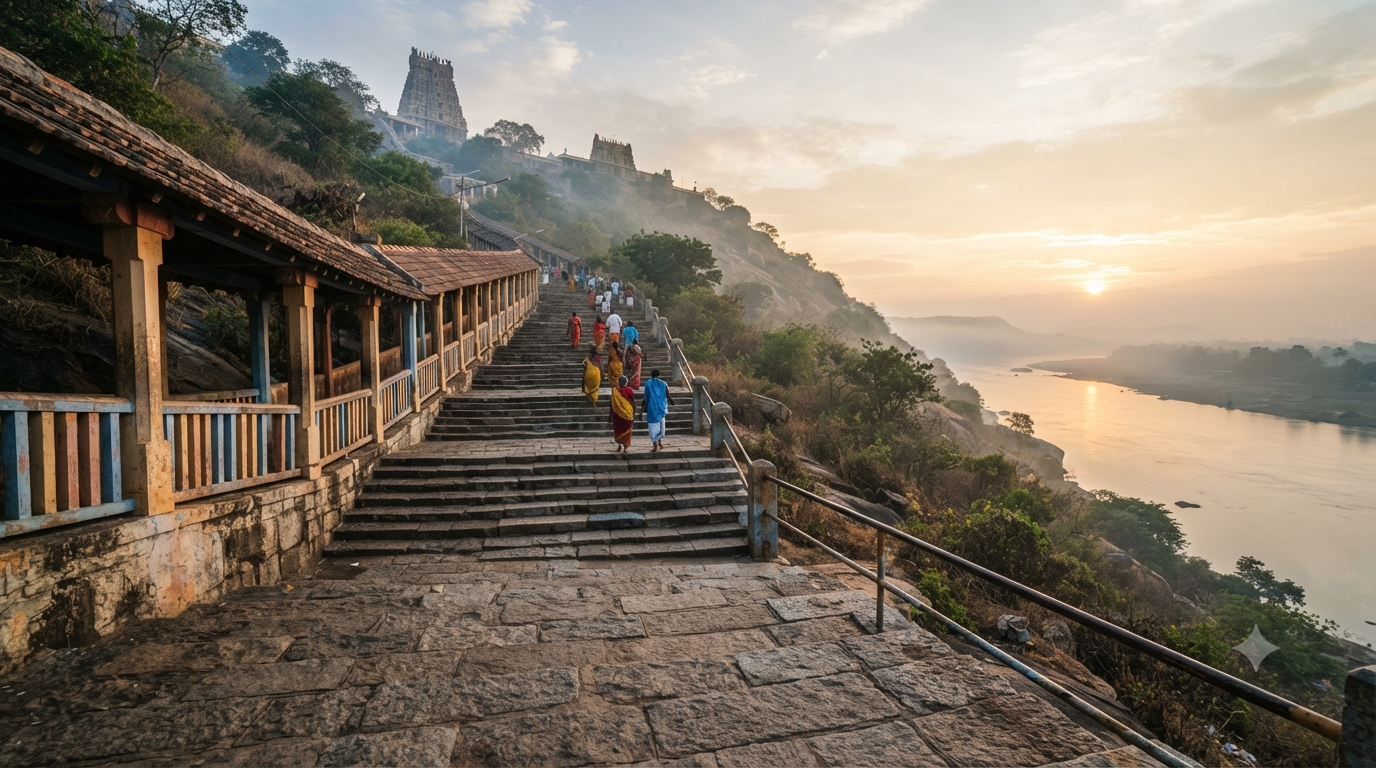
Sri Durga Malleswara Swamy Varla Devasthanam crowns Indrakeeladri hill above the river. It naturally heads every list of places to visit in Vijayawada. Devotees revere the goddess as swayambhu, or self-manifested.
The shrine is unusual too, because Durga stands to the right of Malleswara Swamy. Vehicles reach the top by ghat road, although the traditional approach still climbs roughly 400 steps.
Here is what most guides get wrong. Aggregator sites publish flatly contradictory hours, so some claim a 5.45 pm close while others say 10 pm. The dependable pattern is an early opening near 4 am. Then comes a long midday break, before evening darshan that runs late.
That break commonly falls between 1 pm and 4 pm. An afternoon arrival is therefore the city’s most common wasted trip. Confirm the day’s schedule on kanakadurgamma.org before you travel.
Free Dharma Darshanam needs no ticket, while paid queues such as Mukhamandapa and Antaralaya darshanam carry separate fees. Reported rates vary wildly across third-party sites, so check the current amounts on the official portal. Our Kanaka Durga Temple timings guide and our darshan ticket walkthrough go deeper.
Safety note: the step route is steep and exposed. If you are elderly, pregnant or fasting, take the ghat road instead. Carry water. If you manage a heart condition, talk to your doctor before climbing during summer heat.
Undavalli Caves: The Statue Is Vishnu, Not Shiva
Undavalli lies about 8 km southwest, across the river in Guntur district. Artisans cut these caves from sandstone during the 4th and 5th centuries CE, largely under Vishnukundina rule. Today it ranks as a centrally protected monument of national importance.
Now the correction. Dozens of pages, including this one until today, call the famous monolith here a statue of Lord Shiva. Yet it is nothing of the sort.
The centrepiece on the second storey is a reclining Vishnu, Anantha Padmanabha Swamy, resting on the serpent Ananta. Sculptors carved it roughly five metres long from a single block.
The lower storey holds shrines linked to the Trimurti, so the confusion is at least understandable. Among the oldest places to visit in Vijayawada, this one still rewards a slow look.
Plan about an hour. Entry needs a nominal Archaeological Survey of India ticket, typically in the ₹25–₹30 band for Indian visitors. Foreign nationals pay more, so confirm the current amount at the counter. The four-storey climb pays off because the top terrace overlooks the Krishna.
Mogalarajapuram and Akkanna Madanna Caves
The second correction concerns distance. Many pages list Mogalarajapuram Caves as 11 km out. In truth they sit barely 3 to 5 km from the centre, around Kasturibaipet and Buckinghampet. You can therefore fold them into a morning without a dedicated trip.
Artisans excavated five rock-cut sanctums here around the 5th century CE, yet only a couple survive in reasonable condition. The star is an Ardhanarishvara relief, the combined Shiva-Parvati form. Historians widely describe it as the earliest of its kind in South India. Nataraja and Vinayaka images also survive in an adjoining cave.
Set expectations, though. These ruins fall under Archaeological Survey of India protection. Grilles often stay locked, since no guide operates on site. Visitors regularly arrive to find the gates shut, and there is no workaround beyond trying again.
Treat it as a 20-minute heritage stop rather than a headline attraction. Since the Akkanna Madanna caves sit at the foot of Indrakeeladri, they pair naturally on the same run.
Kondapalli Fort and the Toy Village
Kondapalli Fort stands 18 to 24 km west, depending on your route. King Prolaya Vema Reddy of the Kondaveedu line built it in the 14th century. After that it passed through Gajapati, Vijayanagara, Qutb Shahi, Mughal and British hands.
The British later ran it as a barracks, so you will still find an eight-room block and a cemetery. The main gateway, Dargah Darwaza, came out of a single granite boulder.
Hours run roughly 10 am to 5 pm. Reported entry fees range from a token ₹5 to about ₹30 per adult. That range reflects genuine revisions over the years, so carry small change. This is also one of the few places to visit in Vijayawada that genuinely needs half a day.
Stop in Kondapalli village at the foot of the hill. The soft tella poniki wood toys made here carry a Geographical Indication tag. Buying straight from a workshop also costs less than any city showroom.
Riverside Places to Visit in Vijayawada: Island and Barrage
Bhavani Island covers roughly 133 acres in the Krishna, upstream of Prakasam Barrage. That makes it one of India’s largest river islands. Andhra Pradesh Tourism Development Corporation runs it. Attractions now also include a robotic dinosaur park, mazes, simulators, water sports and Haritha resort cottages.
Older guides place the island 9 km out, but the ferry ghat sits far closer. You cross from the Punnami Ghat and Berm Park side. Boat tickets stay modest, while activity combos sell as bundles. Check current rates and sailing times on the Andhra Pradesh Tourism portal, because river conditions can suspend services.
Prakasam Barrage itself deserves 30 minutes at dusk. The 1,223.5-metre structure spans the Krishna and carries a road bridge. Engineers completed it in 1957, then named it after Tanguturi Prakasam.
Its ancestor was the anicut of the 1850s. Lit up after dark, it makes the easiest evening stop of all the places to visit in Vijayawada.
Bapu Museum: The Name Changed in 2015
Looking for the Victoria Jubilee Museum? You want the Bapu Museum instead. The Andhra Pradesh Department of Archaeology and Museums renamed it in 2015. The new name honours the illustrator and film-maker Sattiraju Lakshminarayana, known as Bapu.
After renovation it reopened with augmented and virtual reality displays.
Robert Sewell laid the foundation stone in June 1887 for Queen Victoria’s Golden Jubilee. The ashlar masonry building still shows a clean Indo-European style. Inside you will find prehistoric tools, coins, arms, bronzes and terracotta. A limestone Buddha from Nelakondapalle, dated to the 3rd century CE, also anchors the collection.
The detail that saves your day: it closes on Fridays and public holidays. Otherwise the department lists 10.30 am to 5 pm.
Older listings still show free entry, although the department now lists ₹50 for adults and ₹30 for children. Check the current figure on the Department of Archaeology and Museums page before you travel. Among indoor places to visit in Vijayawada, this is also the strongest wet-weather option.
Gandhi Hill and the Statue of Social Justice
Gandhi Hill, once called Orr Hill, rises behind the railway station. It holds the first Gandhi memorial in India built on a hillock. President Zakir Husain unveiled the 52-foot stupa on 6 October 1968. It still remains the only Gandhi memorial with seven stupas.
A memorial library, a planetarium, a sound and light show and a toy train share the summit. The city view at dusk is still the real draw. The hill generally opens in the late afternoon, and it closes on Tuesdays.
The newest landmark postdates most listicles entirely. The Statue of Social Justice opened at Swaraj Maidan on 19 January 2024. It pairs a 125-foot bronze of Dr Bhimrao Ramji Ambedkar with an 81-foot pedestal.
Because it reaches 206 feet overall, it is the tallest Ambedkar statue in the world. Ram Vanji Sutar sculpted it for the 18.81-acre Ambedkar Smriti Vanam. Visit in the evening, when the water features and lighting come alive.
Amaravati: Two Different Places, One Name
This trips up more travellers than anything else on the list. Yet older guides merge the two Amaravatis into a single entry.
The capital region, Amaravati, is a planned city rising across Thullur, Tadepalle and Mangalagiri. It sits roughly 10 to 20 km southwest. It has government complexes and a riverfront, yet no ancient stupa.
The Buddhist site is Amaravathi village in Palnadu district, about 40 km west by road. That is where the Mahachaitya, or Great Stupa, stands. The Archaeological Survey of India museum, the Dhyana Buddha statue and the Amareswara temple share the village. Amareswara is also one of the five Pancharama shrines.
The stupa’s history also gets garbled. Builders founded it around the 3rd to 2nd century BCE, in the Mauryan period. Satavahana and Ikshvaku patrons then expanded it over later centuries.
Acharya Nagarjuna was a patron linked to the site. Yet his name properly attaches to Nagarjunakonda, so he did not build this stupa.
Manage expectations too, since most original sculptures now sit in the Government Museum in Chennai and the British Museum. What survives on site is the ruined base plus an excellent museum. See the Incredible India listing for background.
Which Places to Visit in Vijayawada Suit Your Trip?
Pick a track instead of chasing everything, because the sights pull in different directions across the river.
One day, temple-first
Start at Kanaka Durga before 8 am, then take Mogalarajapuram and the Bapu Museum before lunch. Cross to Undavalli in the afternoon, and finish at Prakasam Barrage after dark.
Two days, heritage-first
Keep day one in the city, as above. Give day two to Kondapalli Fort and the toy workshops. Then drive out to Amaravathi for the stupa and museum. Remember the Friday closure before you commit.
Places to visit in Vijayawada with children
Bhavani Island fills a whole day on its own, since the mazes, simulators and boat rides suit mixed ages. Add the Gandhi Hill toy train and planetarium in the evening. Skip the caves, though, since they reward patience more than energy.
Places to visit in Vijayawada in half a day
Gandhi Hill sits a kilometre from the station, while the Bapu Museum is about two. Add the barrage walk, and you have a comfortable four hours without leaving the centre.
What Goes Wrong at Popular Places to Visit in Vijayawada
Not one of these places to visit in Vijayawada is guaranteed to be open. Plan around five failure points before you set out.
- The midday temple break. Arriving at Indrakeeladri between roughly 1 pm and 4 pm often means a closed sanctum. Shift darshan to early morning or evening instead.
- Friday. The Bapu Museum and the Amaravathi museum both shut, so a heritage day can collapse. Move museums to another weekday.
- Tuesday. Gandhi Hill closes, so swap in the Statue of Social Justice for that evening.
- Locked cave gates. Since Mogalarajapuram runs unstaffed and frequently stays shut, treat Undavalli as the dependable alternative.
- Monsoon and heat. Heavy Krishna inflows can suspend ferries to Bhavani Island, while May afternoons make the fort climb genuinely risky. Neither has a workaround beyond changing dates.
During Dasara Navaratri the temple draws enormous crowds and the city fills up. Avoid that window if you want quiet darshan. If you want the spectacle instead, read our guide to the Navaratri alankarams and prasadam list first.
What First-Time Visitors Get Wrong
Locals plan by riverbank, not by category. That habit changes how you sequence the places to visit in Vijayawada. Undavalli, Amaravati and the capital area lie south and west. The temple, museum, hills and fort lie north and east, so crossing the barrage twice wastes an hour nobody budgets for.
Buy your Kondapalli toys at the village rather than the airport. Also eat at the old mess-style joints near the Bapu Museum, not hotel restaurants. Carry cash, because several monument counters and ferry desks still prefer it.
Finally, treat every fee and timing you read online, including ours, as indicative. Andhra Pradesh revises monument tickets and darshan rates without much notice. A two-minute check on the official portal still beats a wasted journey.
Before You Go: Choosing Places to Visit in Vijayawada
Vijayawada rewards a two-day plan far more than a rushed afternoon. Anchor the trip on Kanaka Durga Temple. Then give the caves, the fort and the island equal weight. They are what separate a real visit from a photo stop.
Verify the temple’s darshan window and the Friday and Tuesday closures before you finalise anything. If you only have one day, run the city core and save Amaravathi for a return trip.
Frequently Asked Questions
What are the top places to visit in Vijayawada in one day?
Kanaka Durga Temple, Mogalarajapuram Caves, the Bapu Museum, Undavalli Caves and Prakasam Barrage fit comfortably into one day. Start at the temple before 8 am, then keep the museum for late morning. Finish at the barrage after dark, when it is lit.
Which places to visit in Vijayawada are free?
Prakasam Barrage, the Statue of Social Justice grounds and free Dharma Darshanam at Kanaka Durga Temple cost nothing. Mogalarajapuram Caves have no staffed ticket counter either, although access there depends on whether the gates are open that day.
Is the Undavalli statue Shiva or Vishnu?
It is Vishnu. The monolith on the second storey shows a reclining Anantha Padmanabha Swamy, carved from a single block of stone. Because shrines linked to Shiva and Brahma sit on the lower level, many guides mislabel the main figure.
How many days do you need in Vijayawada?
Two days is the sweet spot for the places to visit in Vijayawada. One day covers the temple, the city caves, the museum and the barrage. A second day then frees you to add Kondapalli Fort, Bhavani Island or the Amaravathi stupa.
What is the best time to visit Vijayawada?
November to February. The city sits in a heat-trapping river basin, so April and May routinely cross 40°C. Monsoon months also bring high Krishna inflows that can interrupt ferry services to Bhavani Island.
Is Kanaka Durga Temple open in the afternoon?
Usually not for the full afternoon. The shrine takes a long midday break, commonly between 1 pm and 4 pm, before evening darshan resumes. Since published timings differ across sites, confirm on the official devasthanam portal on the day you travel.
How far is Amaravati stupa from Vijayawada?
About 40 km by road, or roughly an hour each way. Note that the ancient stupa stands at Amaravathi village in Palnadu district. That is a different place from the Amaravati capital area, which lies 10 to 20 km away.
Are the Vijayawada caves suitable for elderly visitors?
Undavalli involves four storeys of steep internal steps with no lift, so it is demanding. Mogalarajapuram is easier to reach, although it is often locked. Elderly visitors usually do better with the museum, the barrage and the ghat road to the temple.