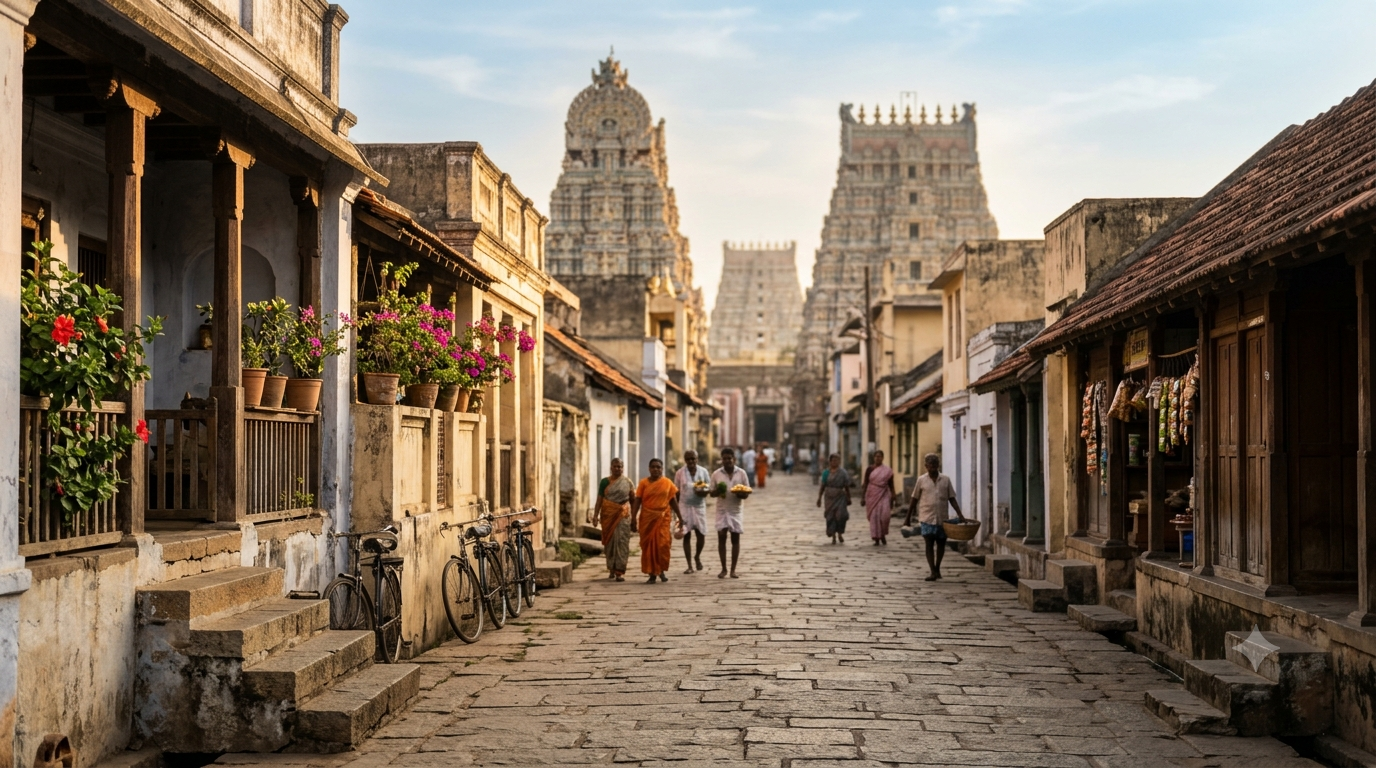
The best places near Ekambareswarar temple fall into four easy groups: central Kanchipuram shrines, a western Pallava monument, eastern Vishnu temples and a southern Jain heritage stop. Start with nearby Kamakshi Amman and Kumarakottam. Then choose the wider route that fits your interests and time.
Independent guide: Temples Map is not affiliated with these temples or their managing authorities. We do not arrange darshan, accept bookings or collect payments. Check temple notices and official sources before visiting.
Places near Ekambareswarar temple: a quick route guide
The places near Ekambareswarar temple are not all lined up on one road. Some lie in the old town, while others need a short auto-rickshaw ride. Grouping visits by area saves time, especially when shrines close during the afternoon.
| Area | Temples and landmarks | Best for |
|---|---|---|
| Central old town | Ekambareswarar, Kumarakottam, Kamakshi Amman, Ulagalantha Perumal, Vaikunta Perumal | Short walk-based circuit |
| Western Kanchipuram | Kailasanathar Temple | Pallava art and architecture |
| Eastern / Chinna Kanchipuram | Varadaraja Perumal, Ashtabuja Perumal, Yathothkari Perumal | Vishnu Divya Desams |
| Southern detour | Thiruparuthikundram Jain temples | Jain history and paintings |
Do not count Varadaraja Perumal and Devarajaswami as two stops. Both names refer to the same Vishnu temple. The Kanchipuram district administration confirms this identification, so a route needs only one entry.
Walkable places near Ekambareswarar temple
A walking tour of places near Ekambareswarar temple works best within central Kanchipuram. Walk where conditions allow, since narrow streets and busy junctions can slow a car. Families with older pilgrims may find short auto rides more comfortable.
1. Ekambareswarar Temple: begin with the earth shrine
Ekambareswarar Temple honours Lord Shiva and represents the earth element among the Pancha Bhoota Sthalams. Its sacred mango tree forms part of the temple’s religious tradition. The imposing entrance tower also gives visitors a strong first view of Vijayanagara architecture.
The complex grew across several historical periods, including Pallava, Chola and Vijayanagara patronage. Therefore, the visible temple should not be described as one structure built entirely in 600 CE. For more background, see the site’s Ekambareswarar history guide.
2. Kumarakottam Murugan Temple: a nearby family shrine
Kumarakottam honours Lord Murugan, also called Subramanya. It sits near the central temple streets, so it fits naturally between Ekambareswarar and Kamakshi Amman. The district administration links this shrine with the Tamil Kanda Puranam and poet Kachiappa Sivachariar.
Choose this stop if you want a compact Shiva, Murugan and Goddess pilgrimage. Because its worship schedule can differ from the larger shrines, check the entrance notice before making a tight plan.
3. Kamakshi Amman Temple: the major Goddess shrine
Kamakshi Amman Temple is one of Kanchipuram’s principal places of Goddess worship. The deity appears in a seated posture, while the gold-covered shrine structure adds to its distinctive setting. Its association with Shakti Peetha traditions is a matter of religious belief.
Many pilgrims visit Kamakshi after Ekambareswarar because both temples feature in Kanchipuram’s devotional landscape. Allow more time during festivals and weekends. Also, remember that a queue may move at a different pace from the walking route.
The Kanchi Kamakoti Peetham mentioned in older guides is a monastic institution, not another name for Kamakshi Amman Temple. Visitors interested in its religious tradition should check the institution’s own access guidance rather than assume it follows the temple schedule.
4. Ulagalantha Perumal Temple: Vishnu’s Vamana form
Ulagalantha Perumal Temple honours Vishnu in his Trivikrama form, linked with the Vamana and Mahabali story. The complex is notable because it includes multiple Divya Desam shrines. These are revered Vishnu sites praised in the Tamil Vaishnava tradition.
This temple sits in the central town area, making it a useful next stop after Kamakshi. If you want to visit several inner shrines, allow time rather than treating the complex as a quick photograph stop.
5. Vaikunta Perumal Temple: Pallava history in the old town
Vaikunta Perumal Temple, also called Parameswara Vinnagaram, is an important Vishnu shrine. The district administration dates it to the eighth-century reign of Pallava king Nandivarman. Therefore, the older claim that he built it in the seventh century is incorrect.
The temple’s layered design depicts Vishnu in seated, reclining and standing forms across its tiers. Access to upper portions may vary, so do not promise that visitors can see every level. The Archaeological Survey of India lists it among Kanchipuram’s protected monuments.
Historic places near Ekambareswarar temple on the west side
Among historic places near Ekambareswarar temple, Kailasanathar stands out west of the busy town centre. It differs sharply from the large Ekambareswarar complex, so history lovers should leave time for both. Use a local auto if the weather is hot or your party cannot manage a long walk.
6. Kailasanathar Temple: sandstone and Pallava sculpture
Kanchi Kailasanathar Temple is a Pallava-era Shiva monument associated with ruler Rajasimha, or Narasimhavarman II. The structure is famous for its sandstone carvings, compact subsidiary shrines and early stone temple design. Unlike Ekambareswarar, it especially rewards close attention to architectural details.
The UNESCO Tentative List submission describes the Pallava context. It is a tentative listing, not proof that the temples already hold UNESCO World Heritage status. The Archaeological Survey of India also lists Kailasanathar as a protected monument.
Avoid relying on the old claim that this temple stands directly on the Vedavathi River bank. It is safer to locate it in western Kanchipuram, around the Pillaiyarpalayam area.
Eastern places near Ekambareswarar temple: Vishnu circuit
Vishnu-focused places near Ekambareswarar temple form an eastern group that needs a separate ride. It works well for devotees visiting Divya Desams, especially if their priority is Vishnu worship. Begin with the major Varadaraja complex before adding smaller nearby temples.
7. Varadaraja Perumal Temple, also called Devarajaswami
Varadaraja Perumal Temple and Devarajaswami Temple are two names for one site. The temple stands in eastern Kanchipuram and honours Lord Vishnu. Its broad courtyards and carved mandapams reflect additions made under different royal dynasties.
It belongs to the 108 Divya Desams, and the hundred-pillared hall is linked with Vijayanagara patronage. The temple also has the Athi Varadar tradition. However, do not assume its special deity display is available on an ordinary visit.
Some travel lists repeat the same complex under each name, which makes a day trip look longer than it really is. For route planning, count it once and use the district government’s name cross-reference.
8. Ashtabuja Perumal Temple: an eight-armed Vishnu shrine
Ashtabuja Perumal Temple is another Divya Desam in Kanchipuram. Its name refers to Vishnu’s eight arms, a feature that sets it apart from the standing images at many other temples. The district tourism page also identifies the shrine and its Gajendra Pushkarini temple tank.
Pair this temple with Varadaraja Perumal when you have extra time in the eastern area. However, temple doors and rituals may follow separate schedules, so ask locally before travelling between stops.
9. Yathothkari Perumal Temple: a quieter addition
Yathothkari Perumal Temple is another historic Vishnu shrine within the wider Kanchipuram circuit. It appears among the temples in India’s UNESCO Tentative List submission. Devotees also know the site through the Thiruvekka tradition.
This is a good optional stop for travellers following several Divya Desams, rather than rushing through the largest temples alone. Confirm the current worship hours before arriving, since smaller shrines may have narrower access windows.
Jain heritage among places near Ekambareswarar temple
Jain Kanchi adds a different chapter to the city’s religious history. It lies outside the tight central walking circuit, so a short dedicated drive is more sensible. If your main goal is Hindu temple darshan, treat this as an optional extension.
10. Thiruparuthikundram Jain temples
Thiruparuthikundram contains historic Jain shrines, including the Trailokyanatha Jeenaswami and Chandraprabha temples. The Tamil Nadu Department of Archaeology lists both in its temple records. They reflect Kanchipuram’s history beyond its well-known Shaiva and Vaishnava traditions.
Visitors interested in murals and historic art may find the complex rewarding. Access, photography and conservation rules can change, so follow notices on site. Avoid promising entry to every decorated chamber or assigning an unsupported date to every painting.
How to cover places near Ekambareswarar temple in one day
You can cover major places near Ekambareswarar temple in a day, but unhurried darshan at every shrine is not guaranteed. Choose one priority group after the central temples. That is more useful than following a long checklist across town.
Morning: central temples first
Begin at Ekambareswarar, then continue towards Kumarakottam and Kamakshi Amman. Add Ulagalantha Perumal or Vaikunta Perumal only if the morning remains comfortable. Keep time for walking, footwear storage and worship queues.
The district website lists Ekambareswarar’s usual windows as 6:00 AM to 12:30 PM and 4:00 PM to 8:30 PM. It lists Vaikunta Perumal’s usual windows as 7:30 AM to noon and 4:30 PM to 7:30 PM. These are published guide timings, not a promise for your travel date.
Midday: rest rather than chase closed doors
Several major shrines shut for part of the afternoon. Use this period for lunch, water, shade and a break. You can also plan the next route and check current notices before paying for another ride.
If a temple is closed, do not assume a special ticket will provide access. Instead, return during its announced opening window or move to a site whose access you have confirmed. Festivals can also change ordinary hours and queue arrangements.
Late afternoon: choose west or east
Architecture lovers can visit Kailasanathar in western Kanchipuram. Vishnu devotees may prefer Varadaraja Perumal and one smaller temple in the east. The district site lists Kailasanathar’s usual evening window as 4:00 PM to 7:30 PM, so leave enough time for the monument.
Do not attempt the western, eastern and southern routes in one short afternoon. You might spend more time transferring than exploring. If you have a second day, reserve it for the route that matters most to you.
Travel tips for places near Ekambareswarar temple
Kanchipuram is a working town, not a single ticketed heritage park. The temples have different authorities, customs and opening windows. Plan the sequence around the actual doors you want to enter, not a generic city-map distance.
- Confirm each opening window. Consult the district tourism page and check local notices. Festival schedules may differ.
- Use a short auto ride for outer groups. Save walking for the central streets, particularly during hot weather.
- Expect footwear rules. Keep shoes only at places that permit storage. Ask before taking photographs.
- Carry drinking water. Stone floors and open courtyards can feel hot. Older travellers and people with limited mobility should allow more breaks.
- Do not rely on a single quoted travel time. Traffic, one-way streets and temple queues can change the day.
- Check the main temple’s hours separately. The site’s Ekambareswarar timing guide gives additional context, but current temple notices take priority.
Which places near Ekambareswarar temple should you choose?
For a first visit to places near Ekambareswarar temple, focus on Ekambareswarar, Kumarakottam and Kamakshi Amman. Add Kailasanathar if history and architecture interest you. Alternatively, select Varadaraja Perumal and the eastern temples for a Vishnu-focused day.
A second visit can cover Vaikunta Perumal, Ulagalantha Perumal and the Jain sites at a slower pace. Kanchipuram rewards that approach because each monument tells a different part of the city’s story. Check the latest temple notices before setting out.
FAQs about places near Ekambareswarar temple
Is Devarajaswami Temple different from Varadaraja Perumal Temple?
No. Devarajaswami and Varadaraja Perumal are names used for the same Vishnu temple in Kanchipuram. The district government confirms the identification. Therefore, you should count it as one stop when planning your visit.
What can I visit on foot from Ekambareswarar Temple?
Kumarakottam and Kamakshi Amman are convenient central-town choices. Ulagalantha Perumal and Vaikunta Perumal can also form part of a wider old-town walk. The best distance depends on your entrance point and the roads you use.
Can I visit Ekambareswarar and Kailasanathar on the same day?
Yes, both are in Kanchipuram, although they serve different visitor interests. Ekambareswarar is a large working pilgrimage complex, while Kailasanathar highlights Pallava stone architecture. Use an auto if walking in the heat would be difficult.
Which nearby temple is best for Pallava architecture?
Kailasanathar is the clearest choice for sandstone carvings and early temple design. Vaikunta Perumal is another important Pallava-era site. Both appear in the Archaeological Survey of India’s Kanchipuram monument list.
Is Vaikunta Perumal Temple a seventh-century monument?
No. The Kanchipuram district administration dates the temple to the eighth century under Pallava king Nandivarman. It also describes the seated, reclining and standing Vishnu forms associated with the shrine’s three tiers.
Can I visit all the temples in a single day?
You may cover several major stops in a day, but seeing every shrine comfortably is unlikely. Midday closures and worship queues reduce available time. Prioritise central temples first and select one outer circuit.
Are the Thiruparuthikundram Jain temples close to the main route?
They are a separate southern detour rather than part of the tight central walking loop. Visit them if Jain history and art interest you. Before leaving, check local access and photography rules.
Are the temples of Kanchipuram UNESCO World Heritage Sites?
The group called Temples of Kanchipuram is on India’s UNESCO World Heritage Tentative List. That does not mean it has received full World Heritage inscription. The tentative submission provides useful historical information, but it is not a visitor pass or booking service.